


Researchers from the China Jiliang University and Beijing University of Posts and Telecommunications have published a paper titled "Boosting near-infrared mechanoluminescence from activated gallate solids by Ga2O3 heterojunction engineering for intelligent sensing" in Applied Physics Reviews.
Background
Mechanoluminescent (ML) materials can directly convert mechanical stimuli such as stretching, compression and friction into optical signals without external excitation sources, showing great application value in wireless sensing, anti-counterfeiting, bioimaging, artificial skin and other fields. Most commercial ML materials are concentrated in the visible spectrum (400–650 nm). When used in biological scenarios, they easily overlap with tissue autofluorescence and suffer from severe photon scattering in biological media, making it difficult to achieve deep-tissue imaging and high-resolution sensing. The near-infrared (NIR, 700–1700 nm) band has superior penetration depth and imaging contrast due to weak photon scattering and low tissue autofluorescence, making it an ideal band for bioimaging. As a NIR luminescent center, Cr3+ can realize broadband tunable emission in the NIR-I biological window through 3d electronic transitions. However, limited by the weak crystal field environment, Cr3+ exhibits broad and inefficient emission with low luminescence intensity. Current NIR ML materials generally suffer from low emission intensity, poor environmental stability and insufficient spectral coverage, which restrict their biomedical applications. Therefore, improving the NIR ML performance of Cr3+-based materials through material structure design has become the core research direction in this field.
Abstract
Long-wavelength mechanoluminescent (ML) materials that convert mechanical stimuli into light hold promise for biomedical imaging and wireless sensing but are often restricted by low brightness and shallow tissue penetration. Here, a heterojunction engineering strategy is employed to enhance near-infrared ML emission in LiGa5O8/Ga2O3:Cr3+ composites, achieving a 416% intensity increase compared with the single-phase LiGa5O8. Incorporation of Ga2O3 introduces deeper electron traps and strengthens the crystal field around Cr3+ centers, thereby boosting emission efficiency in the 700–750 nm range. Density functional theory calculations reveal that orbital hybridization at the interface lowers recombination barriers and promotes radiative transitions. The optimized composite shows excellent aqueous stability over 240 h, while the flexible films fabricated with polydimethylsiloxane enable effective ML imaging through biological tissue, as verified using chicken joints. These findings demonstrate a promising pathway toward high-performance near-infrared ML materials for in vivo monitoring, biomedical imaging, wireless sensing, and intelligent sensing applications.
Highlights
Ga2O3 heterojunction engineering is firstly adopted to modify LiGa5O8:Cr3+, and the NIR ML intensity is increased by 416% compared with the single phase;
The synergistic enhancement mechanism of heterojunction interface regulating trap depth distribution, strengthening Cr3+ crystal field and reducing carrier recombination barrier is revealed;
SiO2-assisted stress transfer system is constructed to further improve luminescence intensity, mechanical and chemical stability;
The flexible film realizes multifunctional applications in biological tissue penetration imaging, information encryption, electronic signature and 3D stress sensing.
Conclusion
In summary, this study presents an in-depth investigation of stress-induced ML in LiGa5O8/Ga2O3:Cr3+ heterojunctions, with a focus on their application in flexible and stretchable optomechanical devices. By compositing Ga2O3 with LiGa5O8 and incorporating SiO2 as an intensity-enhancing agent, we achieved a remarkable 416% increase in the ML intensity of the LiGa5O8/0.8Ga2O3:Cr3+ composite. This significant enhancement is attributed to a synergistic effect: an increased trap density combined with a more uniform trap depth distribution, which collectively facilitates more efficient charge carrier release and radiative recombination. An optimal LiGa5O8 to Ga2O3 ratio of 5:4 was identified for maximizing ML intensity. Further increases in the Ga2O3 fraction led to diminished performance, resulting from reduced trap uniformity and a rise in non-radiative processes. This heterojunction engineering strategy was successfully validated and demonstrated distinct advantages for several potential applications, including penetration through biological tissues (e.g., chicken skin), information encryption, and electronic signatures. Our results underscore the strong potential of LiGa5O8/Ga2O3:Cr3+ composites for next-generation biomedical sensing and anti-counterfeiting technologies.
Project Support
This work was supported by the Zhejiang Provincial Natural Science Foundation of China (LR24F050002) and the National Natural Science Foundation of China (62175225), with partial funding from the European Union’s Horizon Europe research and innovation programme under the Marie Skłodowska-Curie Actions COFUND, Physics for Future (Grant No. 101081515).
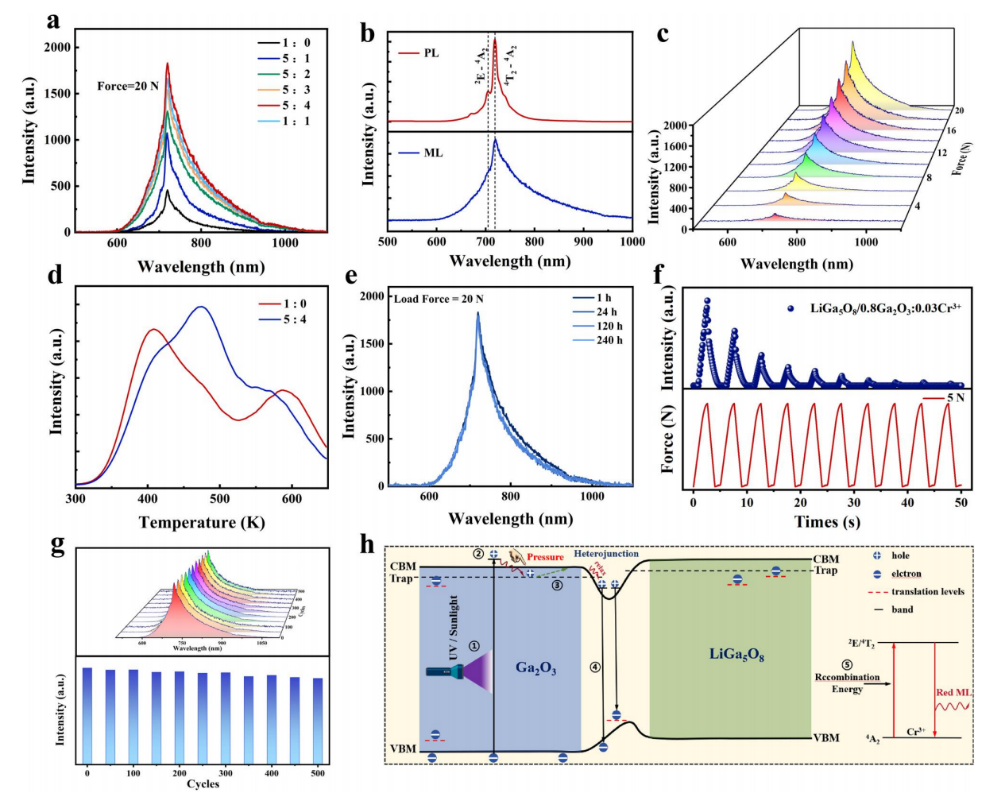
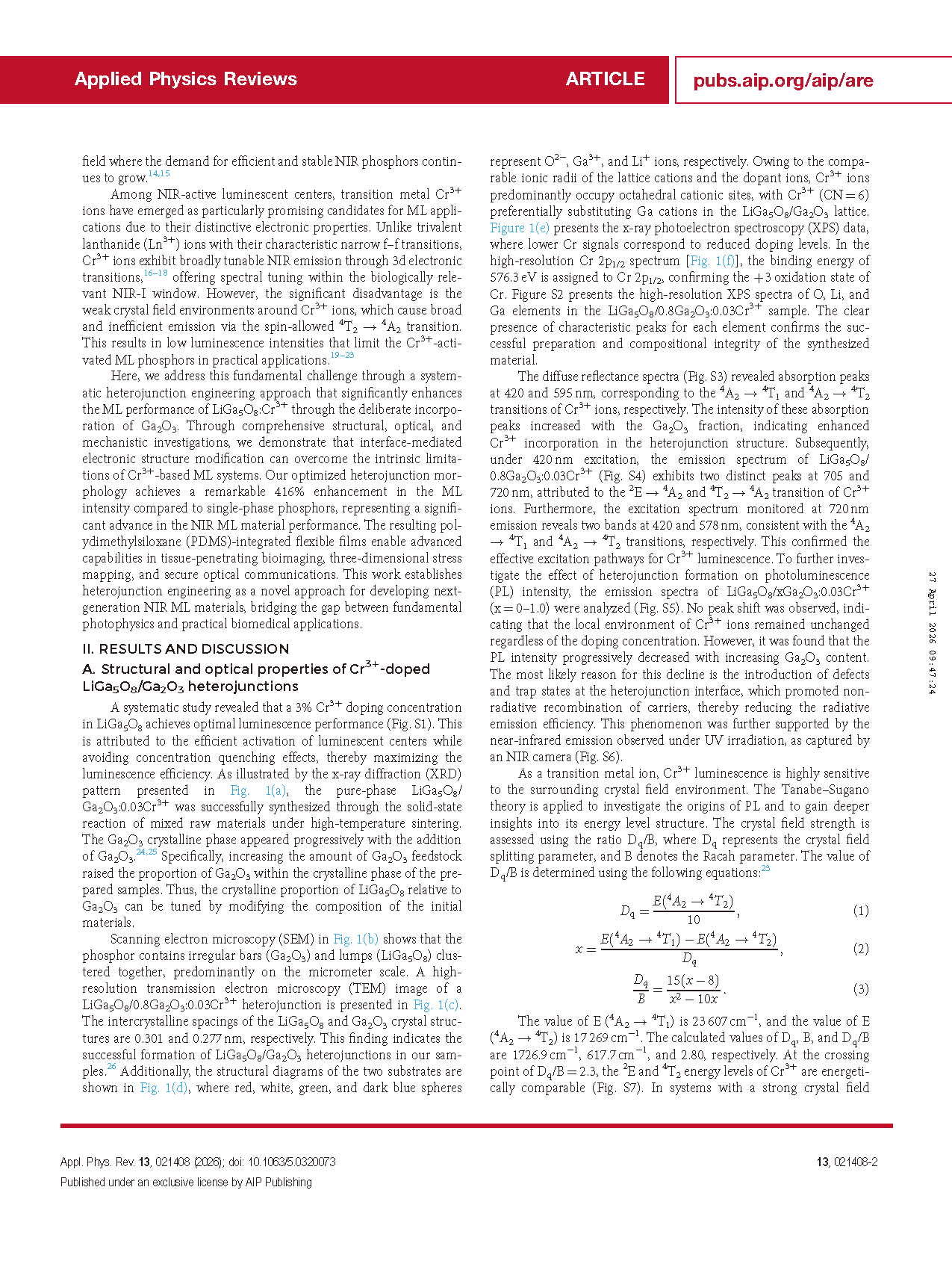
Fig. 1 (a) XRD patterns of samples with different LiGa₅O₈/xGa₂O₃:0.03Cr³⁺ (x=0-1.0) molar ratios. (b) The SEM image of LiGa₅O₈/0.8Ga₂O₃:0.03Cr³⁺ phosphor. (c) The high-resolution TEM image of LiGa₅O₈/Ga₂O₃:Cr³⁺. (d) The crystal structures of LiGa₅O₈ and Ga₂O₃ phosphor. (e) The XPS spectra of all elements in LiGa₅O₈/Ga₂O₃:Cr³⁺ phosphor. (f) The high-resolution Cr 2p XPS core energy level spectra of LiGa₅O₈/Ga₂O₃:Cr³⁺ phosphor.
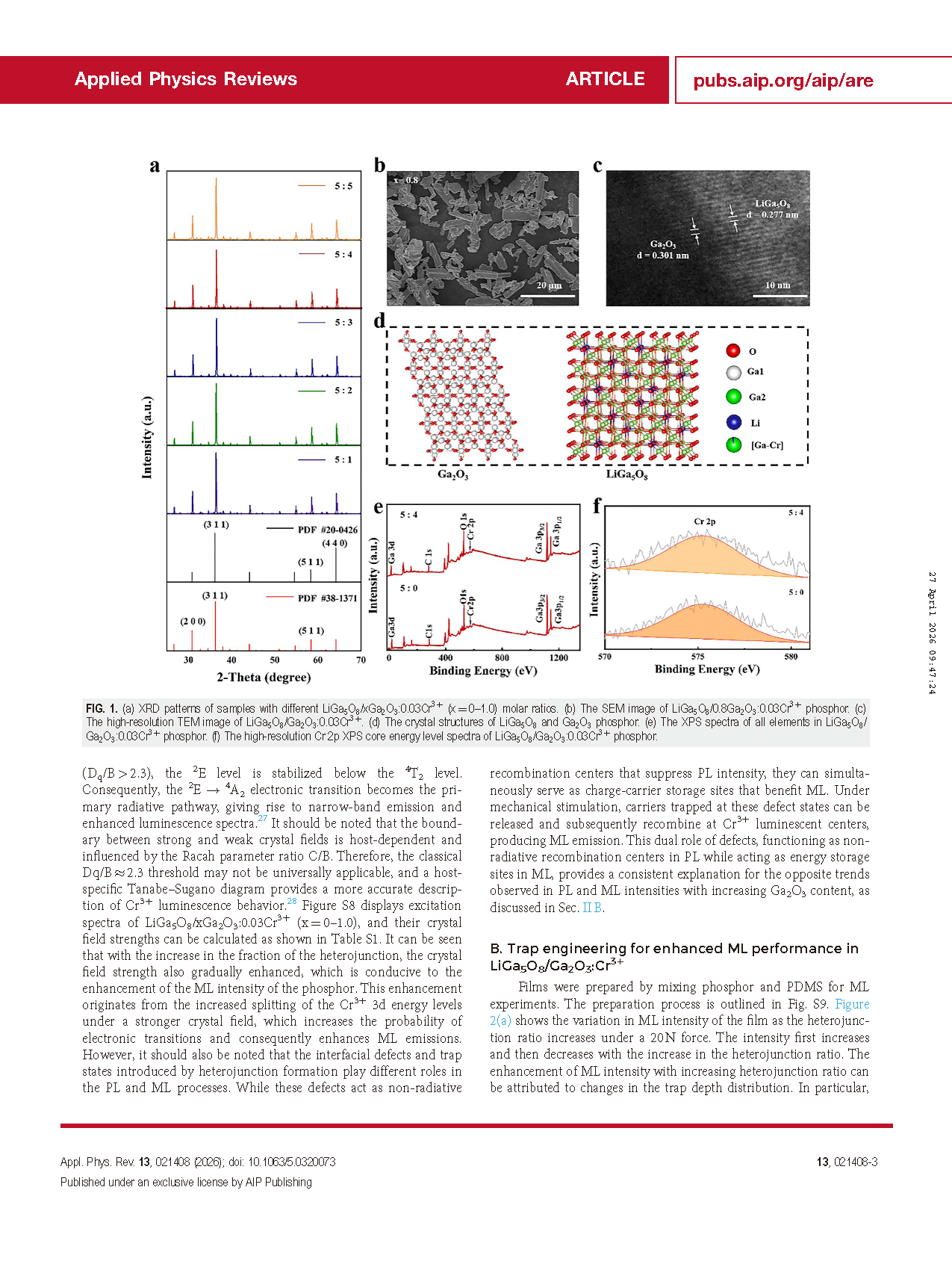
Fig. 2 (a) The ML spectra of LiGa₅O₈/xGa₂O₃:0.03Cr³⁺ (x=0-1.0) films under a force of 20N. (b) PL and ML spectrum of LiGa₅O₈/0.8Ga₂O₃:0.03Cr³⁺. (c) The ML spectra of LiGa₅O₈/0.8Ga₂O₃:0.03Cr³⁺ at 2–20N pressure. (d) TL curves of LiGa₅O₈/0.8Ga₂O₃:0.03Cr³⁺ and LiGa₅O₈:0.03Cr³⁺. (e) The ML spectra of LiGa₅O₈/0.8Ga₂O₃:0.03Cr³⁺ after 240h in air. (f) The ML decay behavior of LiGa₅O₈/0.8Ga₂O₃:0.03Cr³⁺ elastomer under the 5N consecutive stretching–releasing for ten cycles. (g) The ML spectra and intensities of the LiGa₅O₈/0.8Ga₂O₃:0.03Cr³⁺ elastomer for the cycle stability tests. (h) ML process driven by heterojunction formation between LiGa₅O₈ and Ga₂O₃.
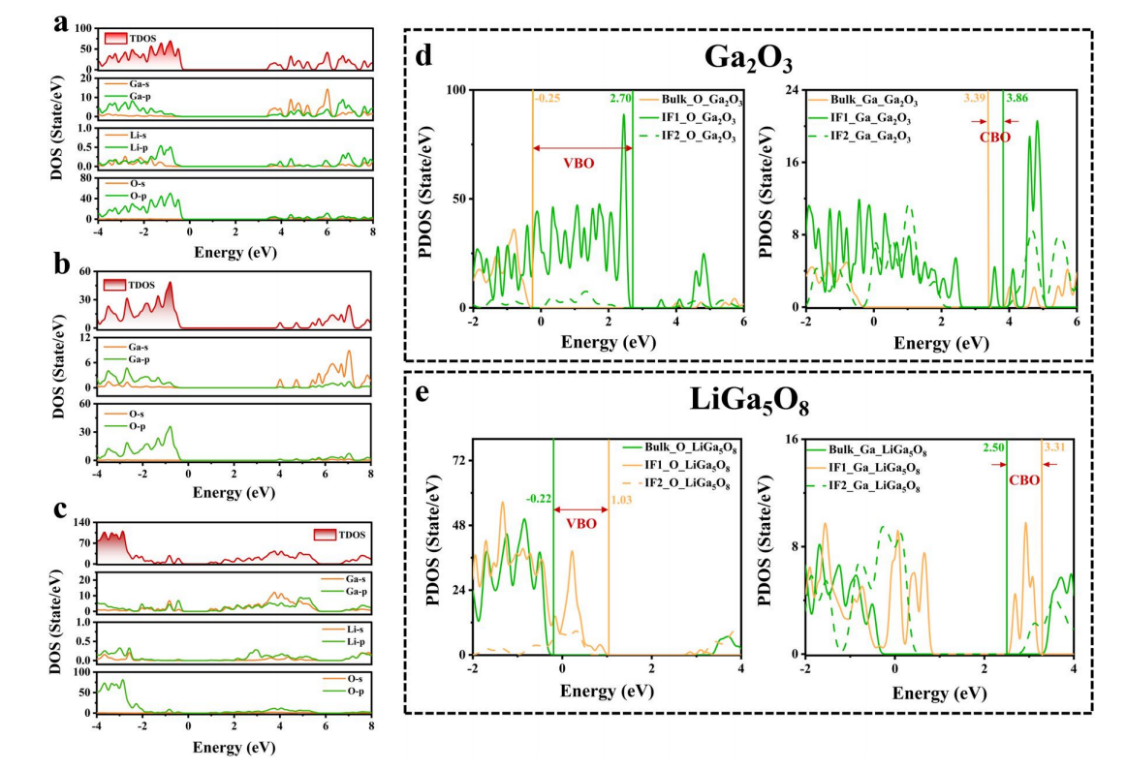
Fig. 3 (a) Density of states (DOS) of bulk LiGa₅O₈. (b) DOS of bulk Ga₂O₃. (c) DOS of the LiGa₅O₈/Ga₂O₃ heterojunction interface, illustrating the electronic structure modification at the interface. (d) Valence band offset (VBO) and conduction band offset (CBO) corresponding to O and Ga in the Ga₂O₃ layer, respectively. (e) VBO and CBO corresponding to O and Ga in the LiGa₅O₈ layer.
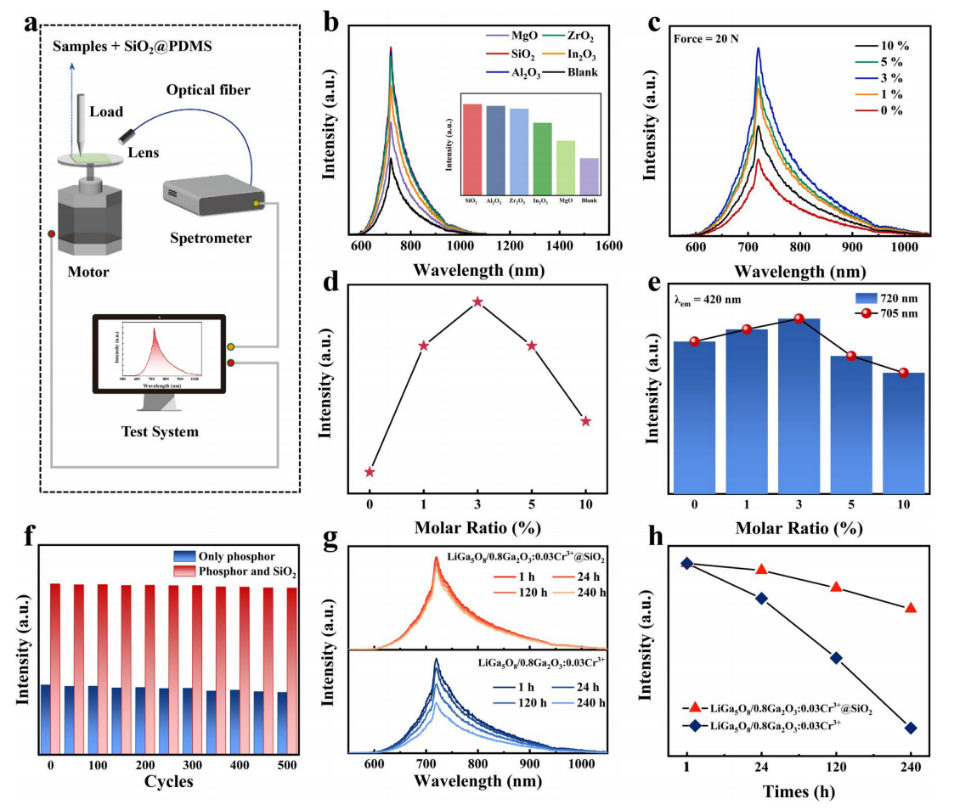
Fig. 4 (a) Schematic representation of the experimental setup designed to evaluate the mechanical-to-photonic conversion efficiency of ML films. (b) The ML spectra of membranes containing different kinds of oxide nanoparticles. The inset shows the ML intensity of membranes containing different kinds of oxide nanoparticles. (c) ML spectra of LiGa₅O₈/0.8Ga₂O₃:0.03Cr³⁺@SiO₂ composite films with different SiO₂ contents under an applied force of 20 N. (d) ML spectral intensity plot of LiGa₅O₈/0.8Ga₂O₃:0.03Cr³⁺ under different SiO₂ doping ratios. (e) Variation of the emission intensities at 705 and 720 nm under 420 nm excitation with different SiO₂ doping ratios. (f) Cyclic stability test of LiGa₅O₈/0.8Ga₂O₃:0.03Cr³⁺ and LiGa₅O₈/0.8Ga₂O₃:0.03Cr³⁺@SiO₂ composite films. (g) ML spectra of LiGa₅O₈/0.8Ga₂O₃:0.03Cr³⁺ and LiGa₅O₈/0.8Ga₂O₃:0.03Cr³⁺@SiO₂ composite films as a function of immersion time in de-ionized water. (h) ML intensity variation of LiGa₅O₈/0.8Ga₂O₃:0.03Cr³⁺ and LiGa₅O₈/0.8Ga₂O₃:0.03Cr³⁺@SiO₂ composite films after immersion in de-ionized water for different durations (1–240 h).
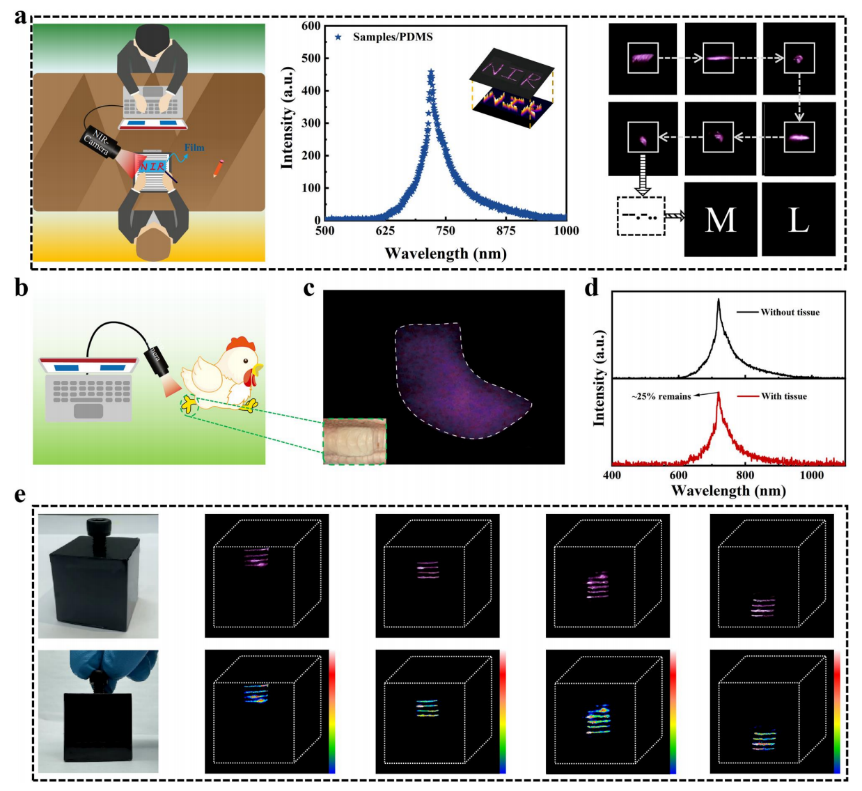
Fig. 5 (a) Application of LiGa₅O₈/0.8Ga₂O₃:0.03Cr³⁺@SiO₂ in electronic signatures, showing the spectral response during the signing process and a photograph of the information encryption. (b) Nondestructive imaging of the sample. (c) Photograph captured by an NIR camera after the film is bent on chicken feet. (d) ML spectra of the composite film before and after placement on bent chicken feet. (e) LiGa₅O₈/0.8Ga₂O₃:0.03Cr³⁺@SiO₂ phosphor arranged in a cube for 3D ML imaging.
DOI:
10.1063/5.0320073
Instruction
Official Account

Cooperation
Top