


Researchers from the Nanjing University of Posts and Telecommunications have published a dissertation titled "β-Ga2O3 Array with Extremely-Low 3 nW/cm2 Detection Threshold for Ultra-Weak UV-C Image Recognition and Instance Segmentation" in ACS Photonics.
Background
Ultraviolet (UV) radiation can be classified into three types based on wavelength: UV-A (315−400 nm), UV-B (280−315 nm), and UV-C (200−280 nm). UV-C radiation, as a component of extraterrestrial solar irradiance without any background signal from the sunlight, plays an indispensable role in various applications including flame detection, environmental science, high-voltage corona monitoring, and solar-blind communication. However, due to atmospheric absorption and scattering, the UV-C radiation to be detected in these scenarios is typically extremely weak, sometimes as low as nW/cm2. This necessitates improving the detection limit of UV-C photodetectors. β-Ga2O3, owing to its high stability and ultrawide bandgap (approximately 4.9 eV), demonstrates tremendous application potential in UV-C detection scenarios. However, current research on Ga2O3 optoelectronic devices rarely focuses on detection in weak ultraviolet light scenarios, overlooking the material’s significant advantages in this wavelength range. Currently, some studies focusing on weak UV-C light detection are based on photodetectors fabricated from narrow bandgap materials such as perovskites and organic materials. This leads to unnecessary absorption of visible and near-infrared light, resulting in increased image noise and degraded image quality. Moreover, the poor stability of these materials poses challenges for maintaining image quality and long-term operation. Other studies largely rely on complex heterojunctions, where sophisticated fabrication processes and high costs limit large-scale production and industrial advancement. More importantly, current research primarily focuses on improving single-device performance, while less attention has been paid to integrating high-performance devices into image preprocessing arrays.
Abstract
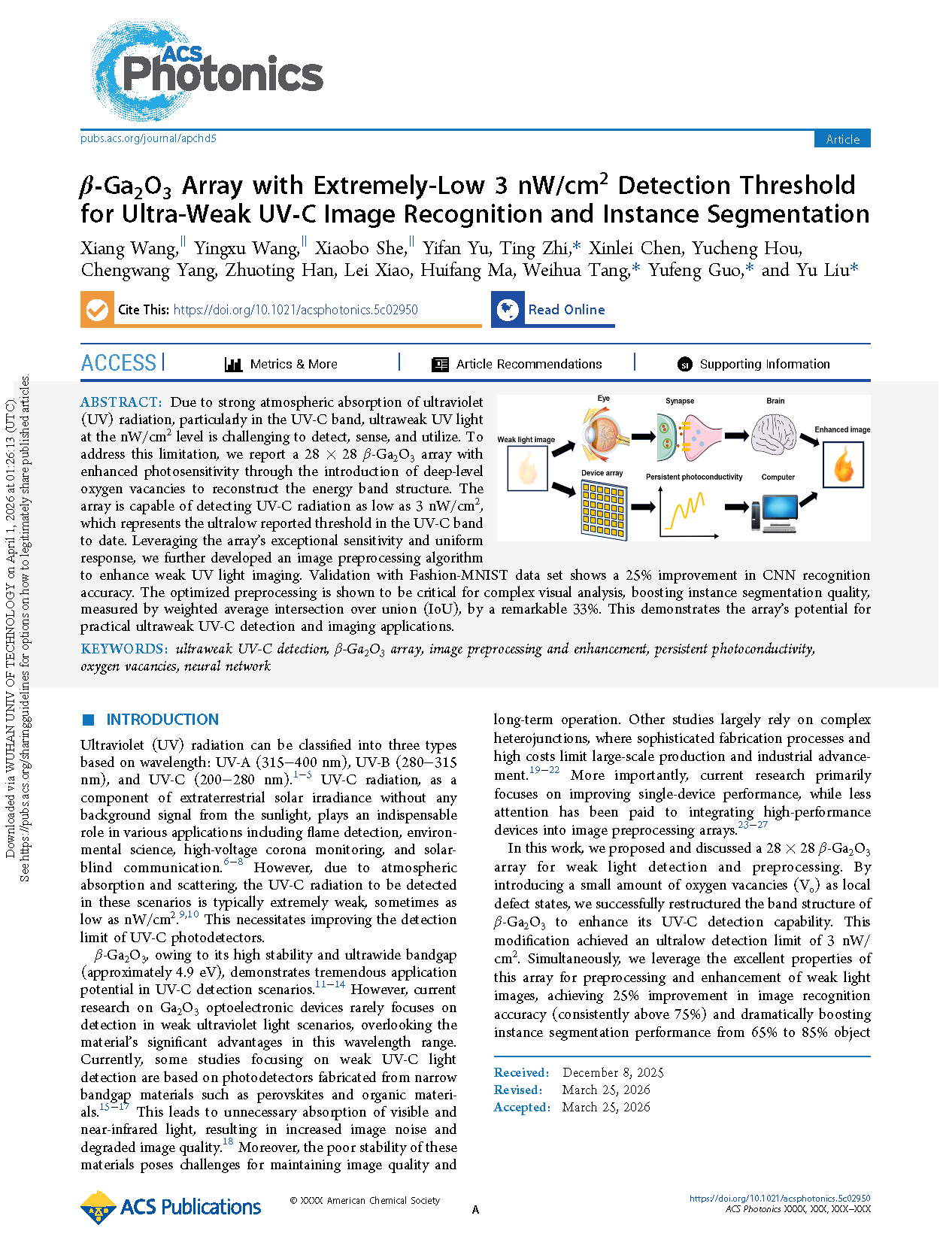
Due to strong atmospheric absorption of ultraviolet (UV) radiation, particularly in the UV-C band, ultraweak UV light at the nW/cm2 level is challenging to detect, sense, and utilize. To address this limitation, we report a 28 × 28 β-Ga2O3 array with enhanced photosensitivity through the introduction of deep-level oxygen vacancies to reconstruct the energy band structure. The array is capable of detecting UV-C radiation as low as 3 nW/cm2, which represents the ultralow reported threshold in the UV-C band to date. Leveraging the array’s exceptional sensitivity and uniform response, we further developed an image preprocessing algorithm to enhance weak UV light imaging. Validation with Fashion-MNIST data set shows a 25% improvement in CNN recognition accuracy. The optimized preprocessing is shown to be critical for complex visual analysis, boosting instance segmentation quality, measured by weighted average intersection over union (IoU), by a remarkable 33%. This demonstrates the array’s potential for practical ultraweak UV-C detection and imaging applications.
Conclusion
In this work, we have successfully demonstrated a highly sensitive 28 × 28 β-Ga2O3 array for ultraweak UV-C detection through oxygen vacancy-mediated band structure engineering. The device achieves an unprecedented detection limit of 3 nW/cm2 in the UV-C region, representing a significant breakthrough in ultraviolet sensing technology. Meanwhile, leveraging the excellent detection limit and the good uniformity of the device array, we perform weak-light image preprocessing, which effectively enhances the weak-light images. We first demonstrate this capability through Fashion-MNIST data set recognition using CNN, where the preprocessed images achieve ∼25% higher accuracy than weak-light images, consistently maintaining above 75%. For the advanced task of instance segmentation, this preprocessing led to a remarkable 33% relative improvement in the weighted average IoU compared to using the weak-light images. Furthermore, the segmentation accuracy was restored to a stable level of about 85%, dramatically enhancing image quality and enabling its use in complex analytical applications.
Project Support
This work was supported by the National Natural Science Foundation of China (Grant Nos. 62401276, 62334003, U23B2042), the Natural Science Research Start-up Foundation for Recruiting Talents of Nanjing University of Posts and Telecommunications (Grant No. NY223161), the Nanjing Science and Technology Plan Project (Grant No. 202309003), and the Suzhou Critical Core Technology Research Project (Grant No. SYG2024003).
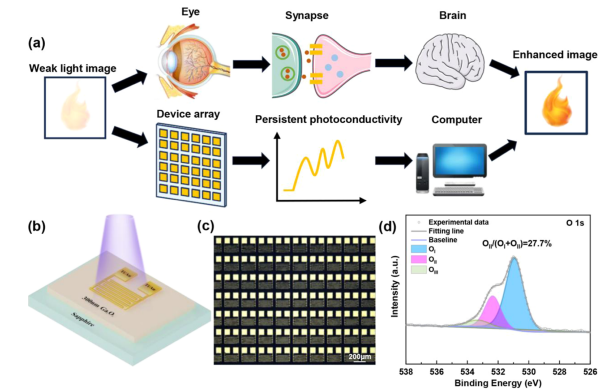
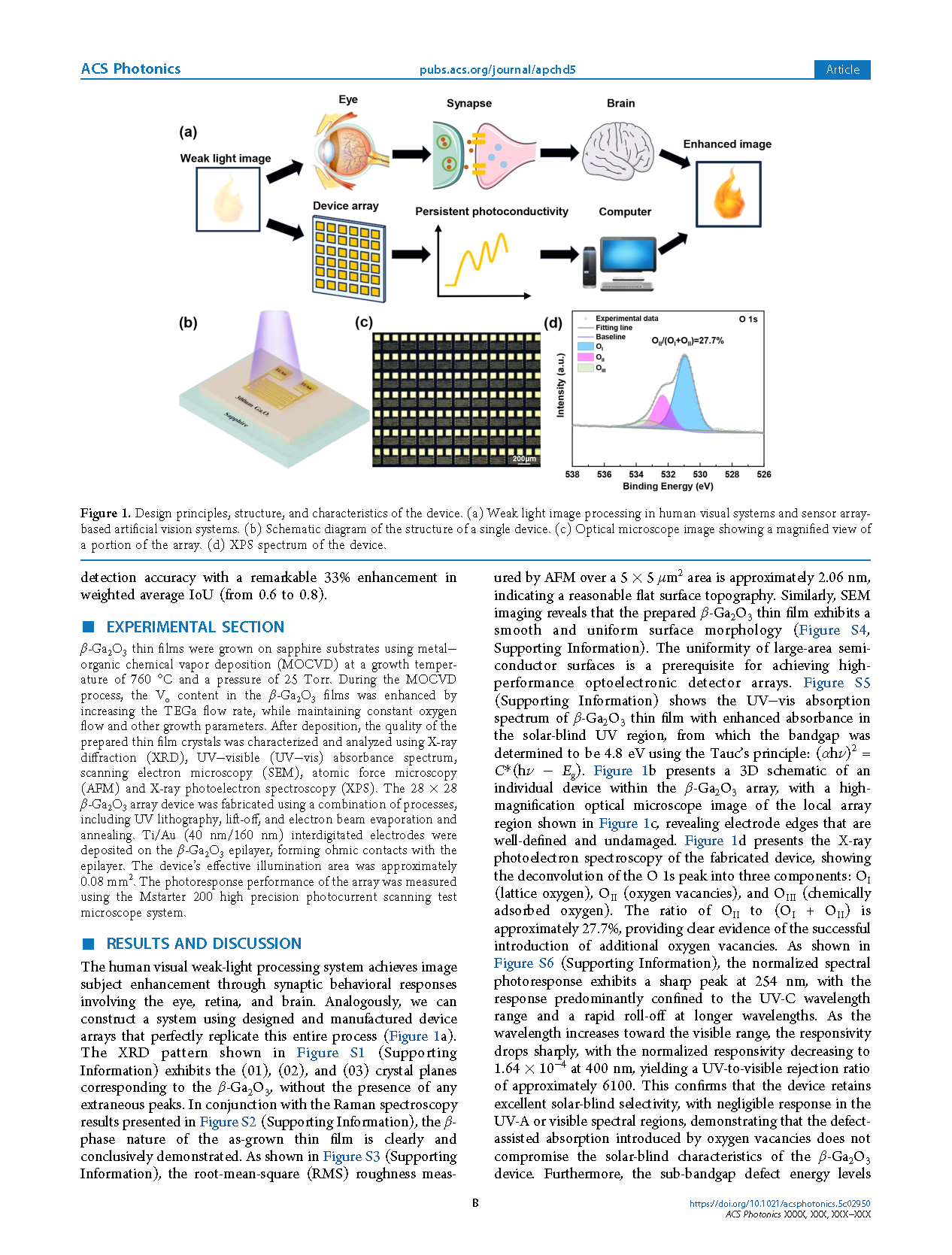
Figure 1. Design principles, structure, and characteristics of the device. (a) Weak light image processing in human visual systems and sensor array-based artificial vision systems. (b) Schematic diagram of the structure of a single device. (c) Optical microscope image showing a magnified view of a portion of the array. (d) XPS spectrum of the device.
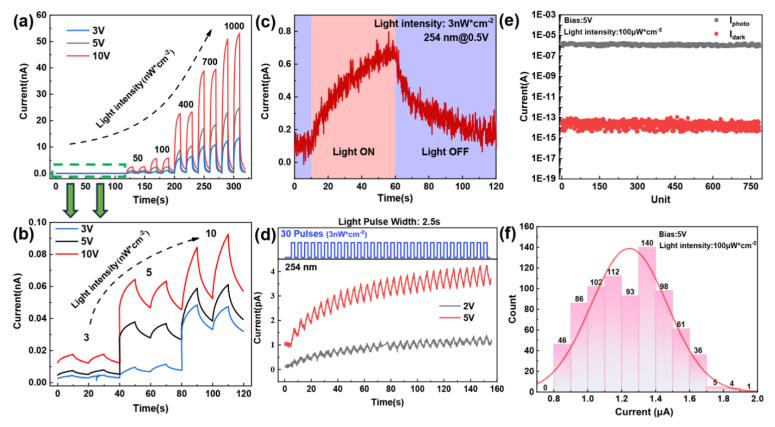
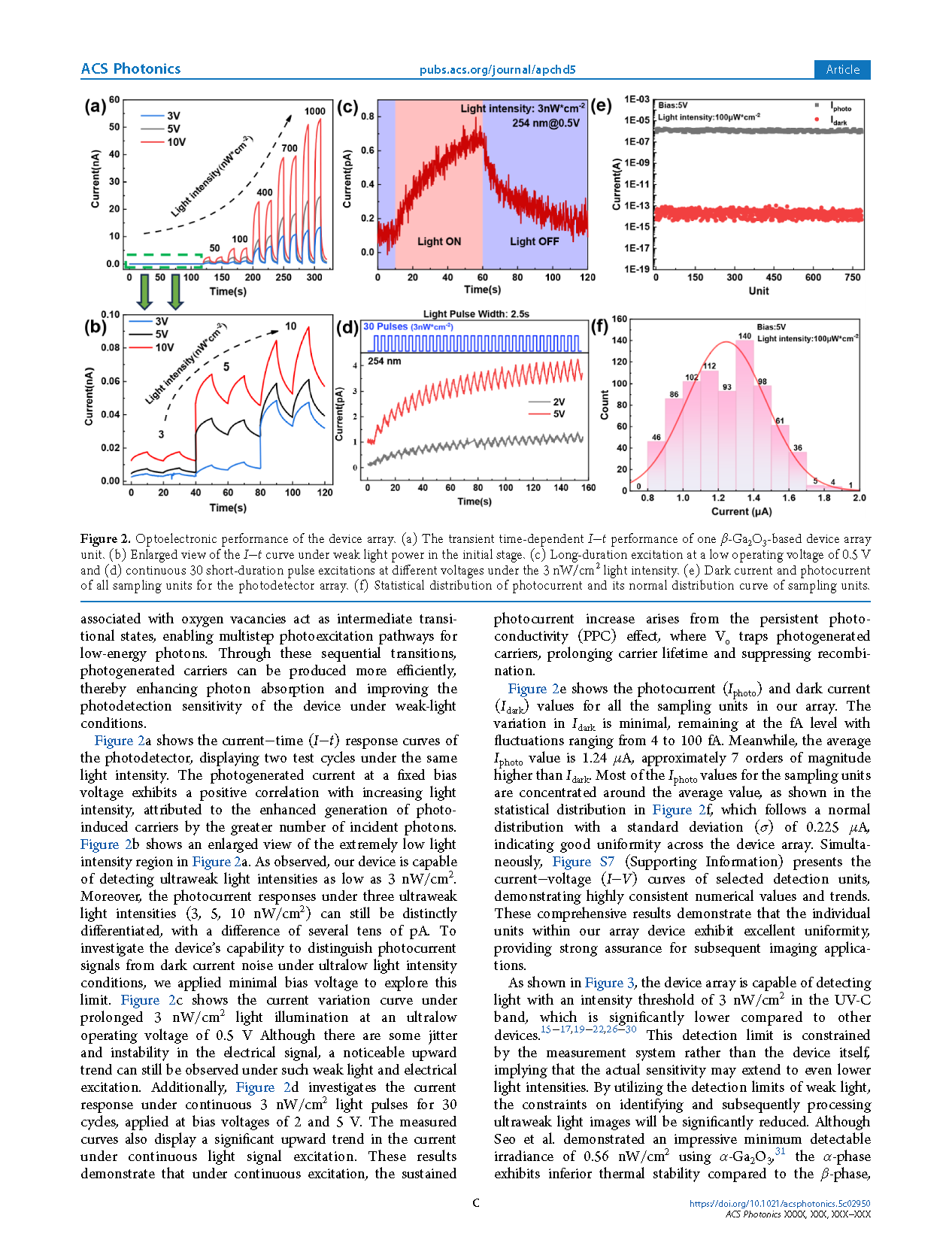
Figure 2. Optoelectronic performance of the device array. (a) The transient time-dependent I−t performance of one β-Ga2O3-based device array unit. (b) Enlarged view of the I−t curve under weak light power in the initial stage. (c) Long-duration excitation at a low operating voltage of 0.5 V and (d) continuous 30 short-duration pulse excitations at different voltages under the 3 nW/cm2 light intensity. (e) Dark current and photocurrent of all sampling units for the photodetector array. (f) Statistical distribution of photocurrent and its normal distribution curve of sampling units.
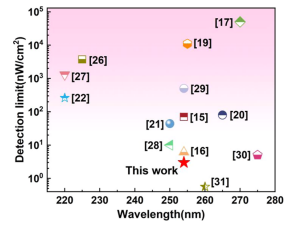
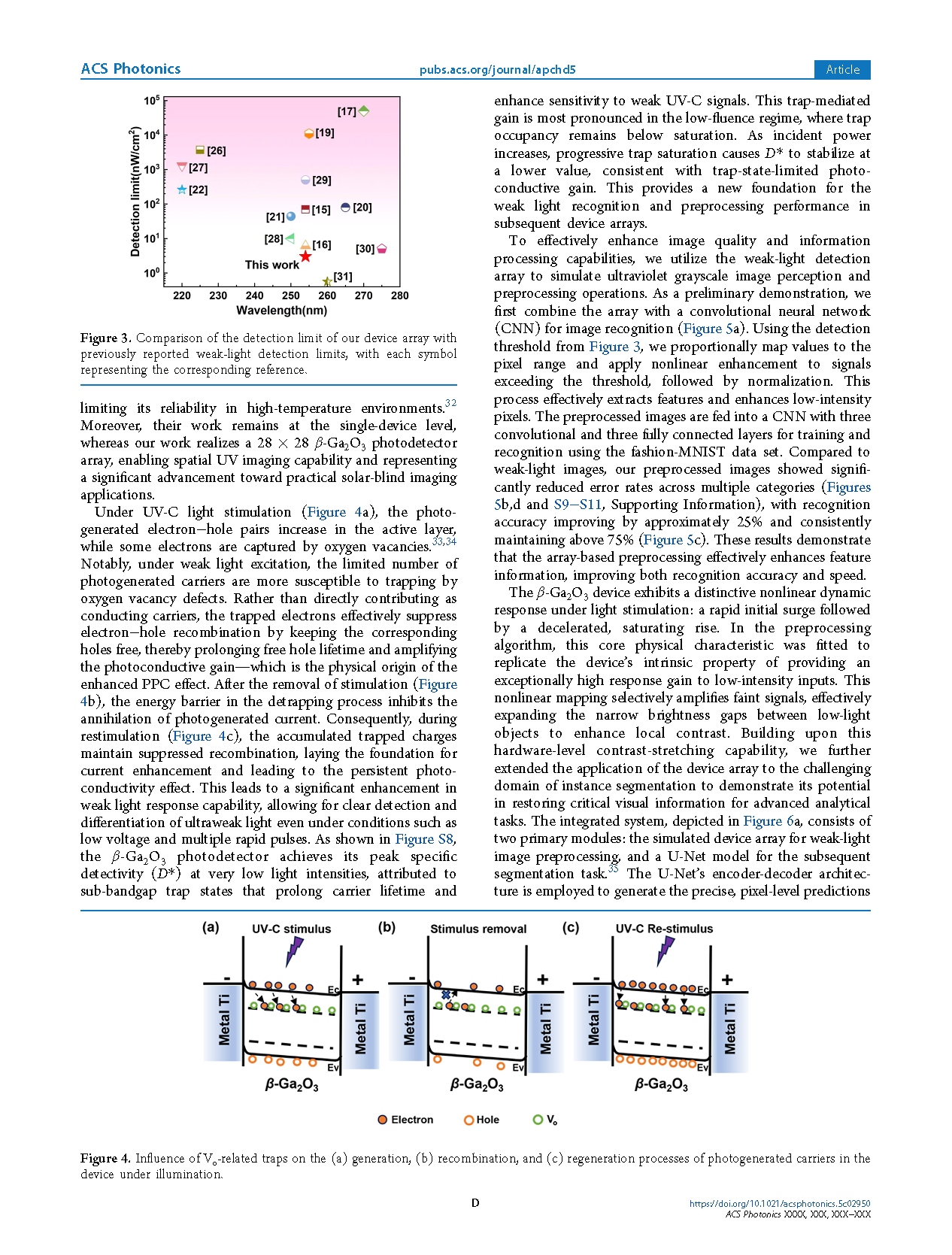
Figure 3. Comparison of the detection limit of our device array with previously reported weak-light detection limits, with each symbol representing the corresponding reference.
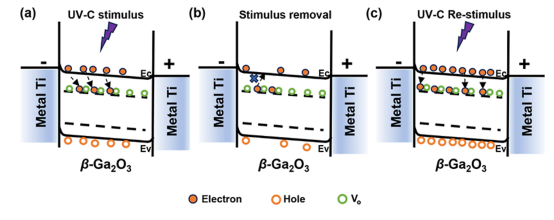
Figure 4. Influence of Vo-related traps on the (a) generation, (b) recombination, and (c) regeneration processes of photogenerated carriers in the device under illumination.
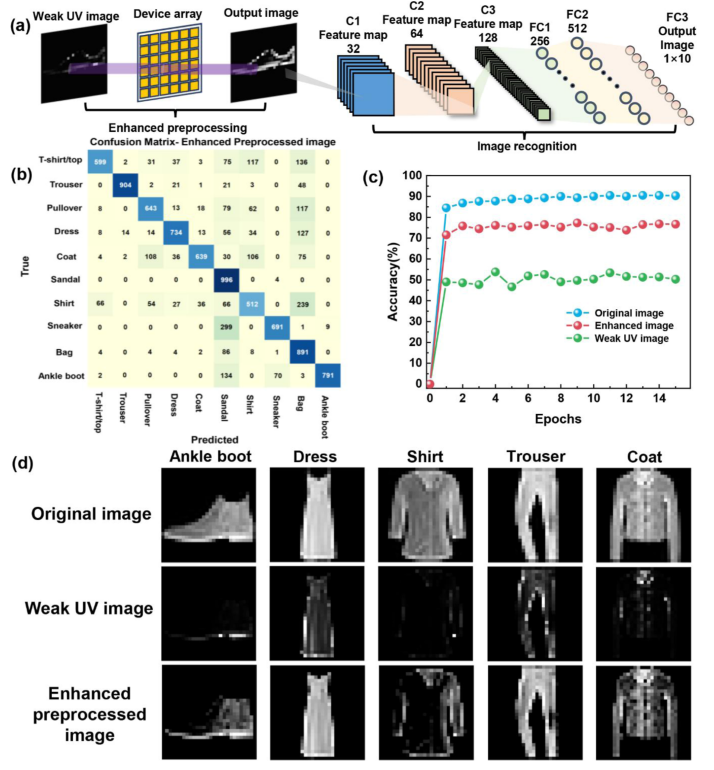
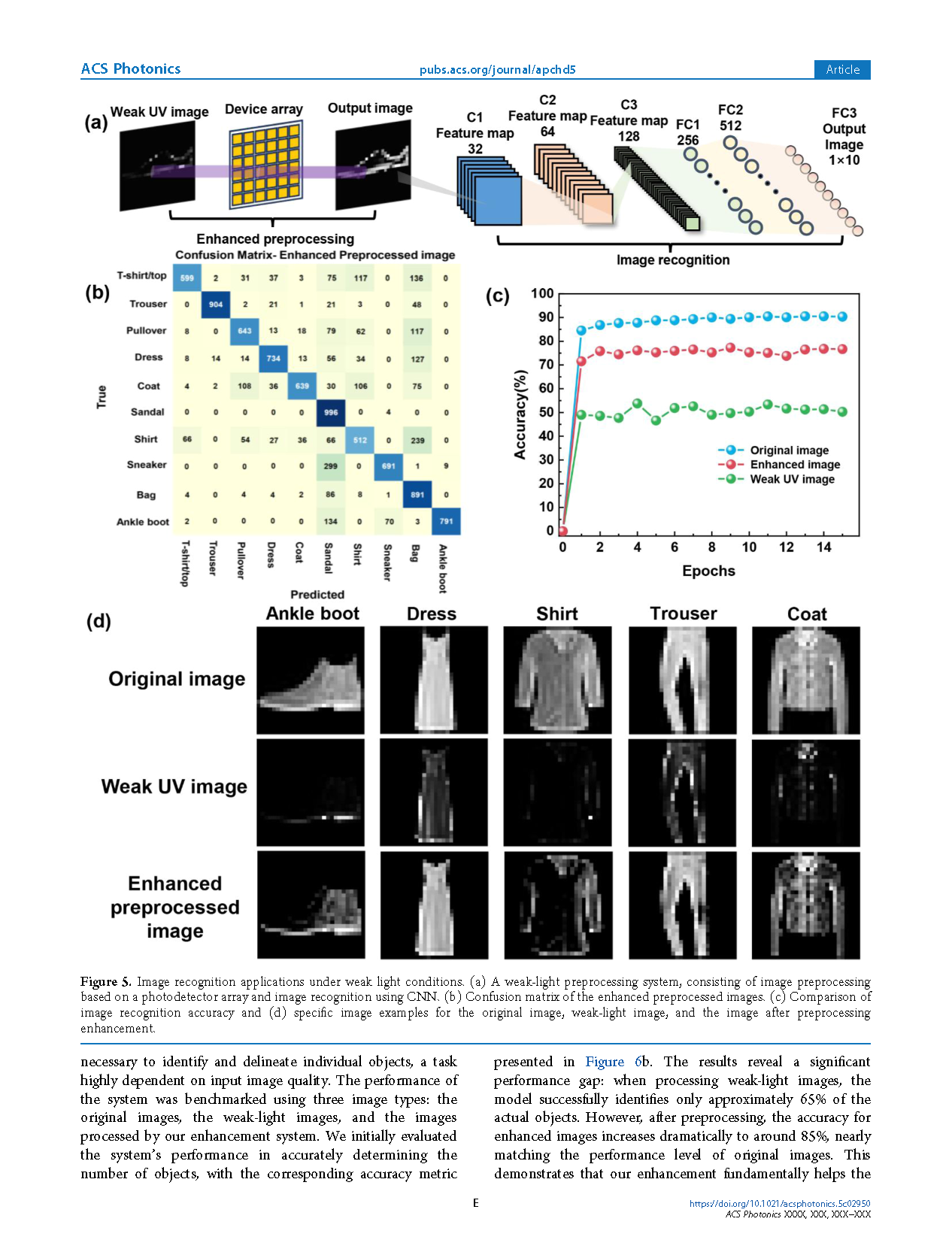
Figure 5. Image recognition applications under weak light conditions. (a) A weak-light preprocessing system, consisting of image preprocessing based on a photodetector array and image recognition using CNN. (b) Confusion matrix of the enhanced preprocessed images. (c) Comparison of image recognition accuracy and (d) specific image examples for the original image, weak-light image, and the image after preprocessing enhancement.
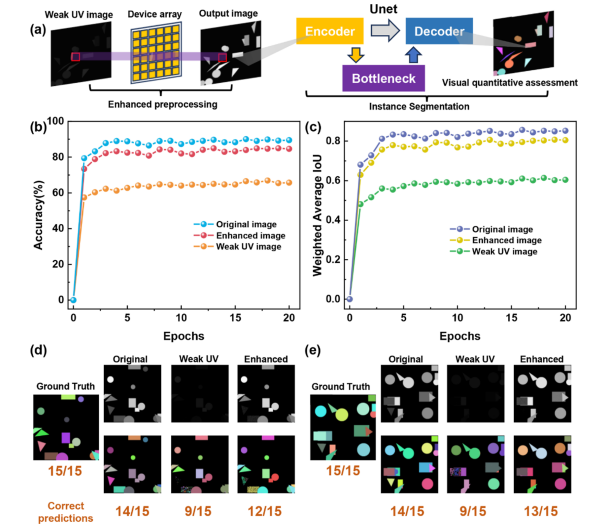
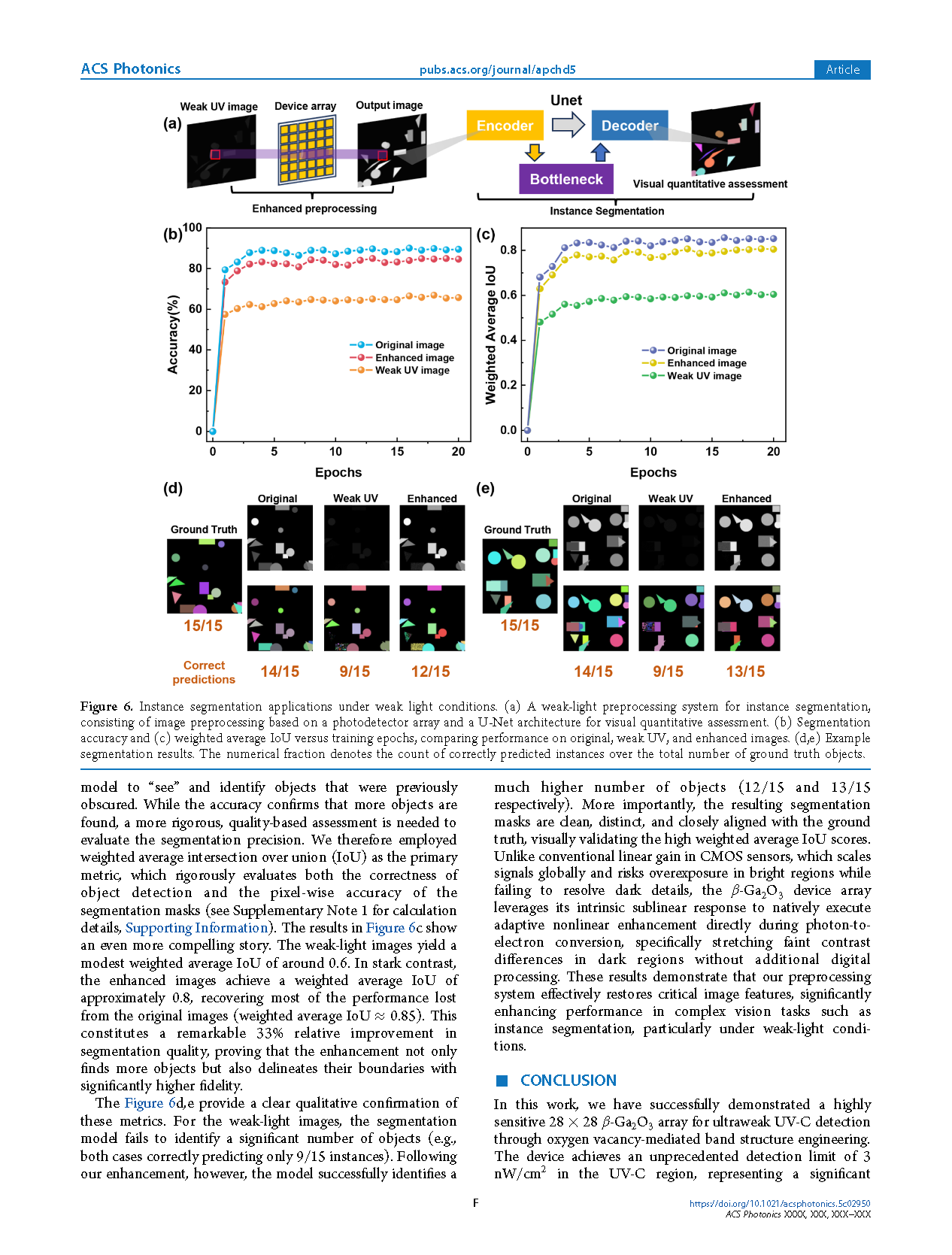
Figure 6. Instance segmentation applications under weak light conditions. (a) A weak-light preprocessing system for instance segmentation, consisting of image preprocessing based on a photodetector array and a U-Net architecture for visual quantitative assessment. (b) Segmentation accuracy and (c) weighted average IoU versus training epochs, comparing performance on original, weak UV, and enhanced images. (d,e) Example segmentation results. The numerical fraction denotes the count of correctly predicted instances over the total number of ground truth objects.
DOI:
doi.org/10.1021/acsphotonics.5c02950


Instruction
Official Account

Cooperation
Top