


Researchers from the Leibniz-Institut für Kristallzüchtung (IKZ) have published a dissertation titled " Metalorganic vapor phase epitaxy of β-(AlxGa1−x)2O3 (x = 0 – 0.55) and multilayer structure on (100) β-(Al0.24Ga0.76)2O3 substrates " in Journal of Vacuum Science & Technology A.
Background
Beta-gallium oxide (β-Ga2O3) is an emerging semiconductor that has drawn significant interest for next-generation power electronic devices, primarily because of its ultra-wide bandgap of ∼4.9 eV. and its high theoretical breakdown electric field of up to 8 MV/cm. In addition, the monoclinic β-phase of (AlxGa1−x)2O3 has attracted growing attention, as alloying with Al enables bandgap tuning to wider energies, making it particularly promising for applications in the ultraviolet spectral range. However, the synthesis of high-aluminum-composition β-(AlxGa1−x)2O3 films of sufficient quality poses significant challenges. These include a progressively increasing lattice mismatch with the underlying β-Ga2O3 substrate, which promotes strain and defect formation.
The epitaxial growth of β-(AlxGa1−x)2O3 on β-Ga2O3 substrates has been investigated using molecular beam epitaxy (MBE), metalorganic vapor phase epitaxy (MOVPE), and mist chemical vapor deposition. Epitaxial growth of β-(AlxGa1−x)2O3 on (010) β-Ga2O3 substrates is typically limited to aluminum compositions below 27%, as higher concentrations induce phase segregation. However, the use of alternative substrate orientations, including (100) and (-201), represents a promising pathway to achieve substantially higher Al incorporation (52%) in a phase-pure β-structure. However, the incorporation of a high aluminum concentration results in substantial lattice mismatch, which often leads to defect formation and cracking.
Abstract
We successfully achieved the growth of β-(AlxGa1−x)2O3 (x = 0–0.55) on a (100) β-Al0.24Ga0.76O3 substrate using metalorganic vapor phase epitaxy (MOVPE). A stacked layer composed of β-(Al0.47Ga0.53)2O3/β-Ga2O3 on a β-Al0.24Ga0.76O3 substrate was demonstrated. High-resolution x-ray diffraction and reciprocal space mapping analysis verified the coherent epitaxial growth of phase-pure β-(AlxGa1−x)2O3 thin films up to an Al composition of x = 0.55. Films with higher Al content exhibited partial plastic strain relaxation. The multilayer structure of the β-(Al0.47Ga0.53)2O3/β-Ga2O3 thin film exhibited good quality and coherent growth. Atomic force microscopy measurements proved a surface roughness well below 0.42 nm for the fully strained films and about 1 nm for the relaxed ones. These results indicate that the MOVPE technique has significant potential for the fabrication of β-Ga2O3-based heterojunctions suitable for device applications.
Conclusion
In summary, coherent epitaxial growth of β-(AlxGa1−x)2O3 (x = 0–0.55) thin films on (100) β-Al0.24Ga0.76O3 substrates was successfully achieved by metalorganic vapor phase epitaxy. Structural characterization confirmed that fully strained epitaxial layers were maintained up to x = 0.55, while higher Al compositions led to partial strain relaxation. The β-(Al0.47Ga0.53)2O3/β-Ga2O3 multilayer structure exhibited high crystalline quality and a coherent epitaxial relationship with the substrate. Atomic force microscopy revealed atomically smooth surfaces, with root-mean-square roughness values of 0.33–0.42 nm for strained films and approximately 1 nm for relaxed layers. These results demonstrate that MOVPE provides a controllable and reliable route for the synthesis of high-quality β-(AlxGa1–x)2O3 heterostructures. The demonstrated growth control and interface quality establish a foundation for further optimization of Al incorporation and strain management. Future work may explore higher Al compositions, intentional doping, and device-oriented heterostructures, advancing the development of (AlxGa1−x)2O3/β-Ga2O3-based electronic and optoelectronic devices.
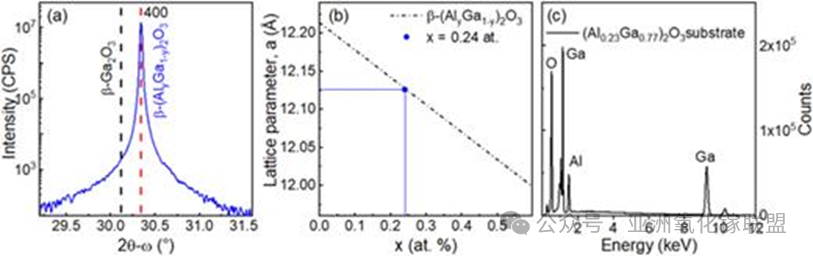
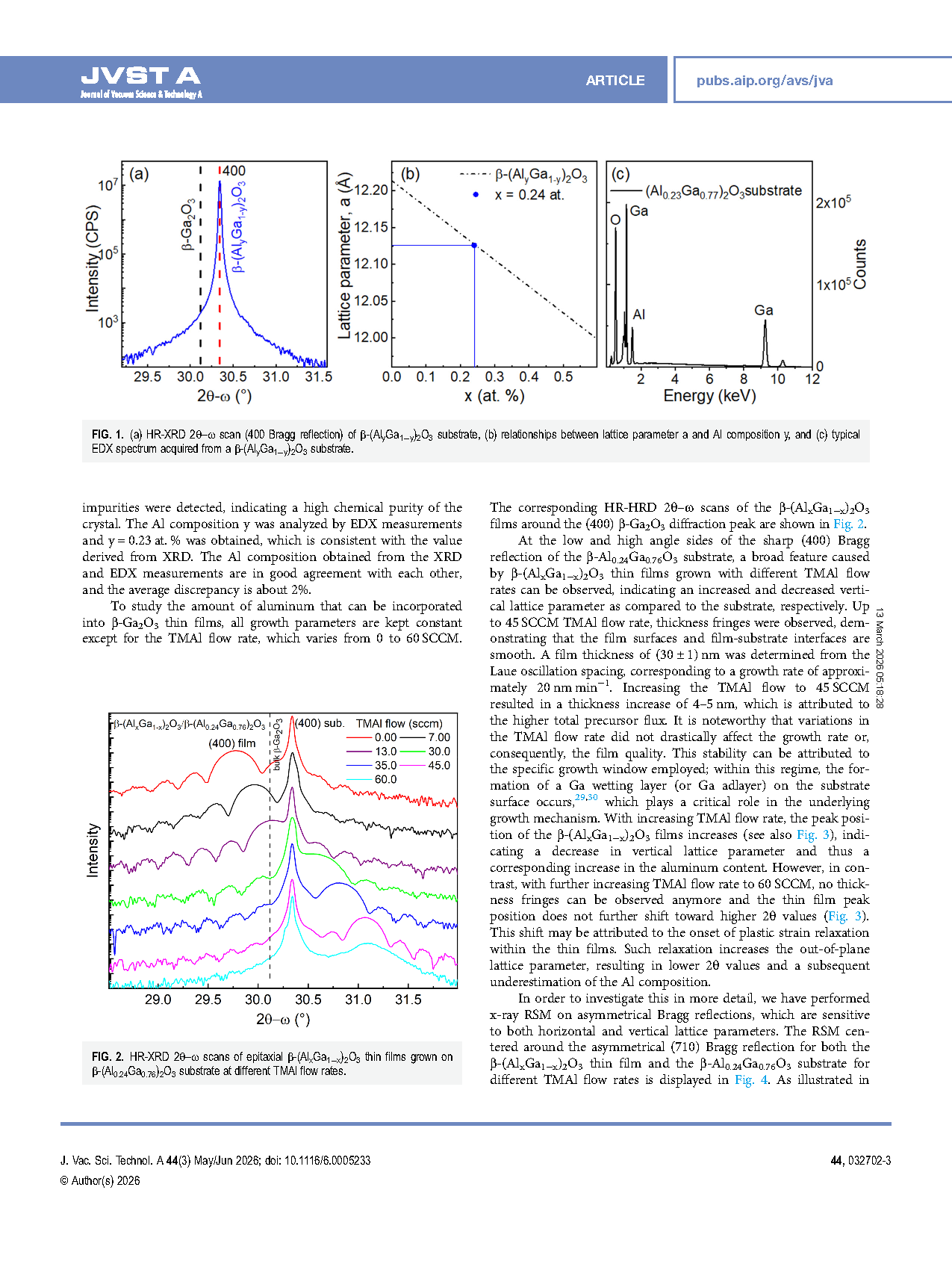
FIG 1.(a) HR-XRD 2θ–ω scan (400 Bragg reflection) of β-(AlyGa1−y)2O3 substrate, (b) relationships between lattice parameter a and Al composition y, and (c) typical EDX spectrum acquired from a β-(AlyGa1−y)2O3 substrate.
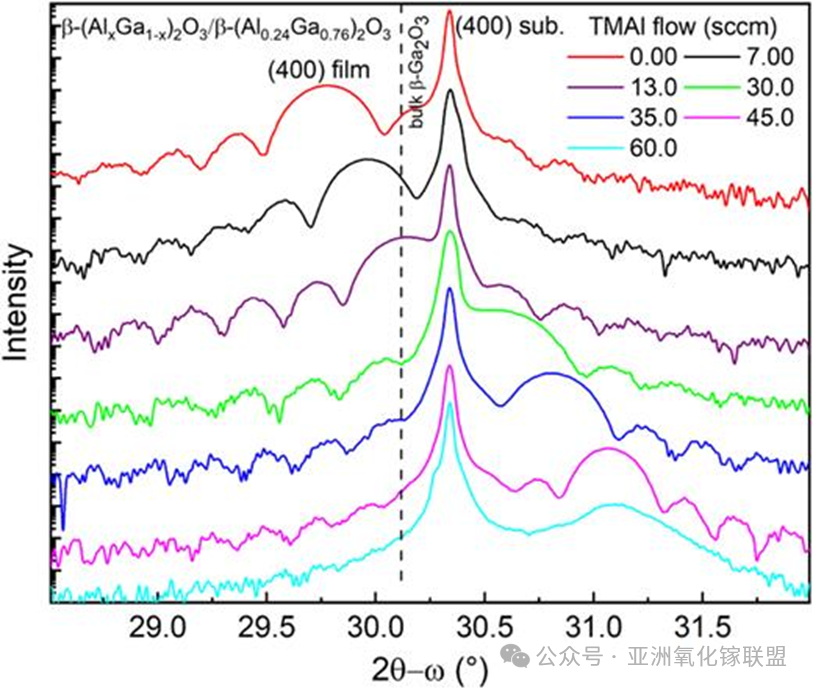
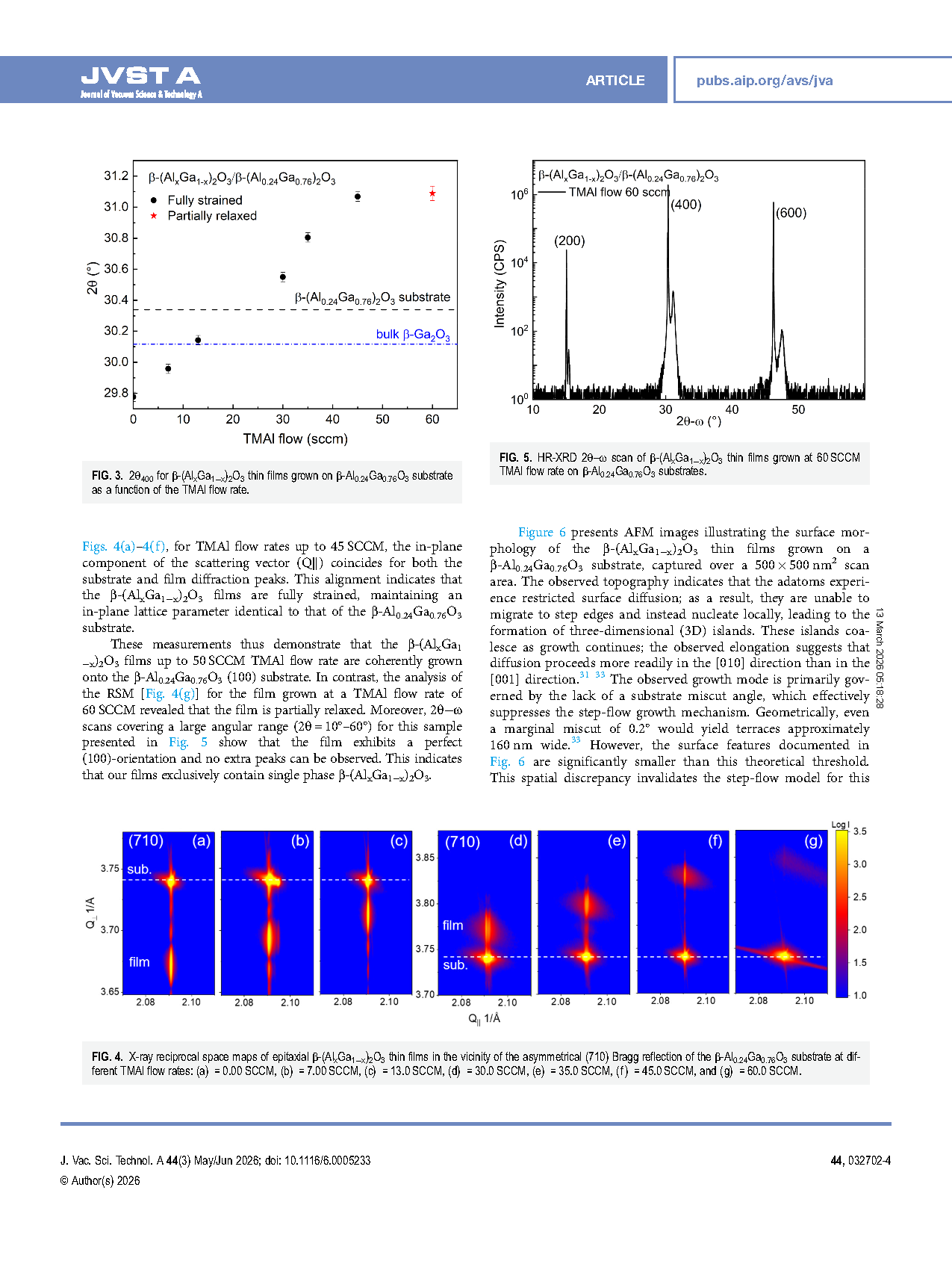
FIG 2.HR-XRD 2θ–ω scans of epitaxial β-(AlxGa1−x)2O3 thin films grown on β-(Al0.24Ga0.76)2O3 substrate at different TMAl flow rates.
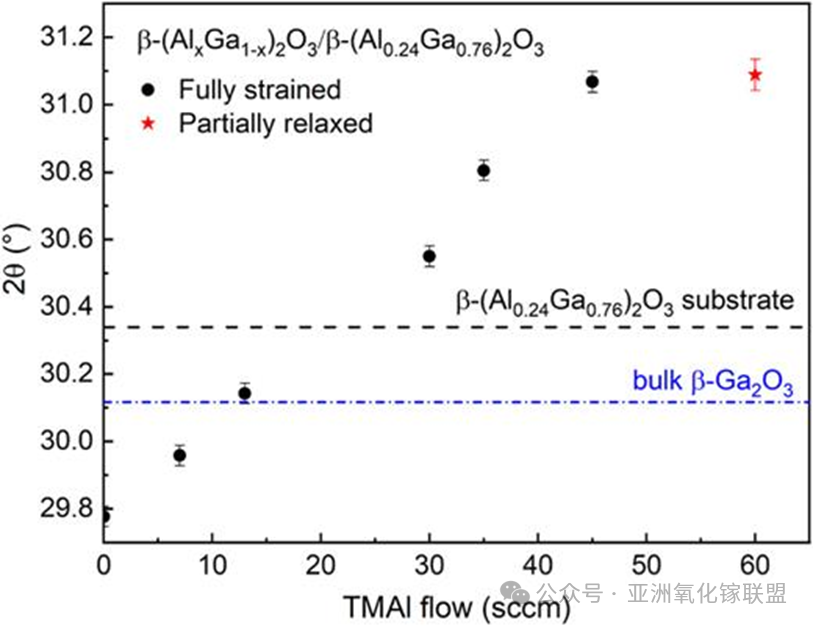
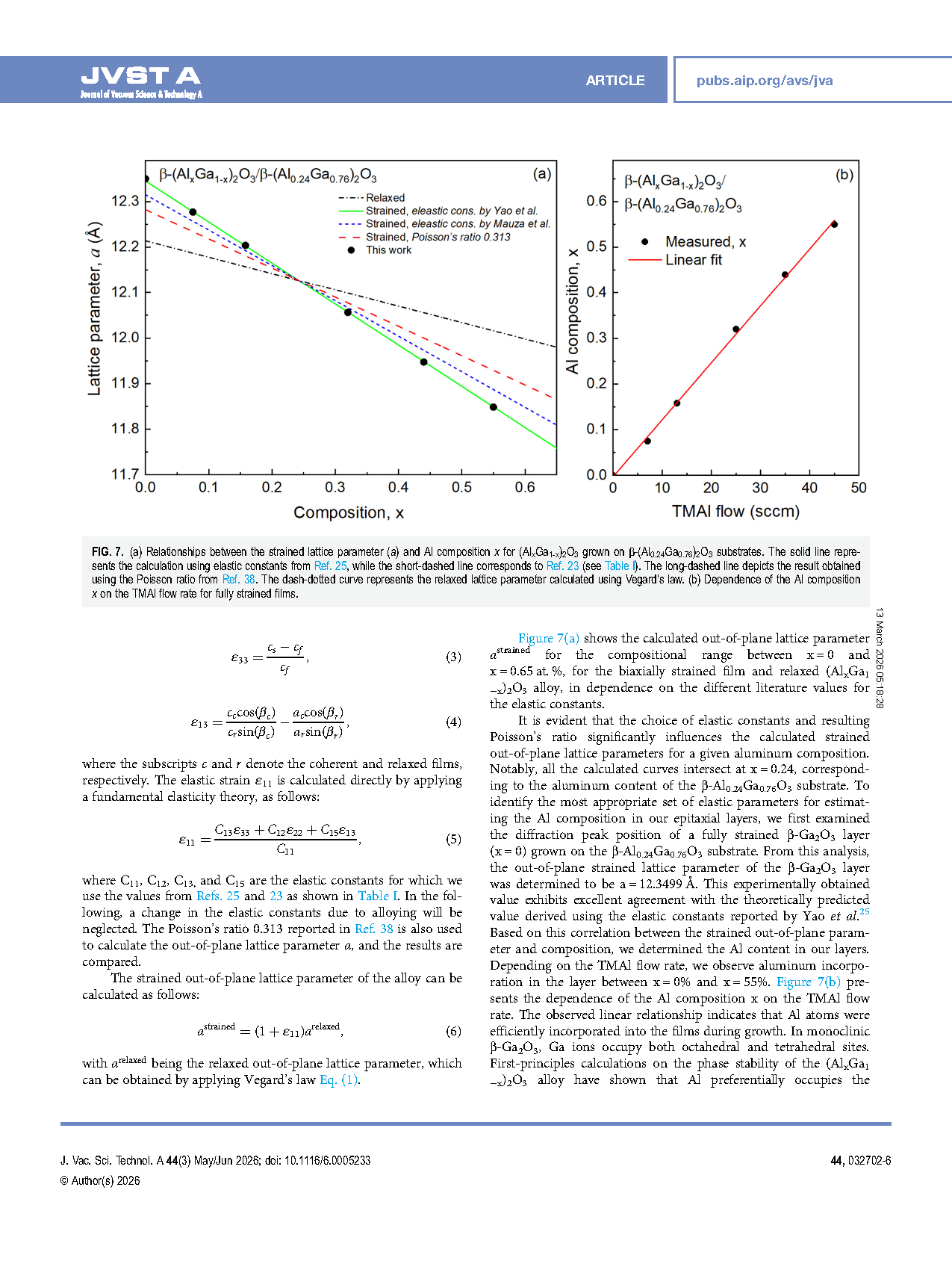
FIG 3.2θ400 for β-(AlxGa1−x)2O3 thin films grown on β-Al0.24Ga0.76O3 substrate as a function of the TMAl flow rate.
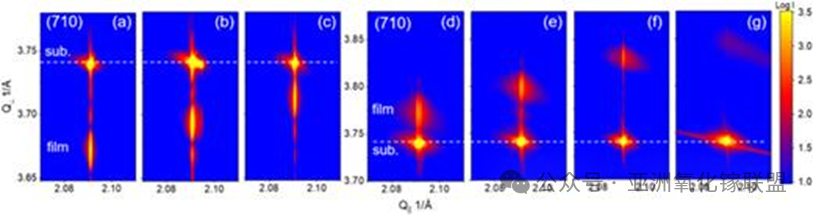
FIG 4.X-ray reciprocal space maps of epitaxial β-(AlxGa1−x)2O3 thin films in the vicinity of the asymmetrical (710) Bragg reflection of the β-Al0.24Ga0.76O3 substrate at different TMAl flow rates: (a) = 0.00 SCCM, (b) = 7.00 SCCM, (c) = 13.0 SCCM, (d) = 30.0 SCCM, (e) = 35.0 SCCM, (f) = 45.0 SCCM, and (g) = 60.0 SCCM.
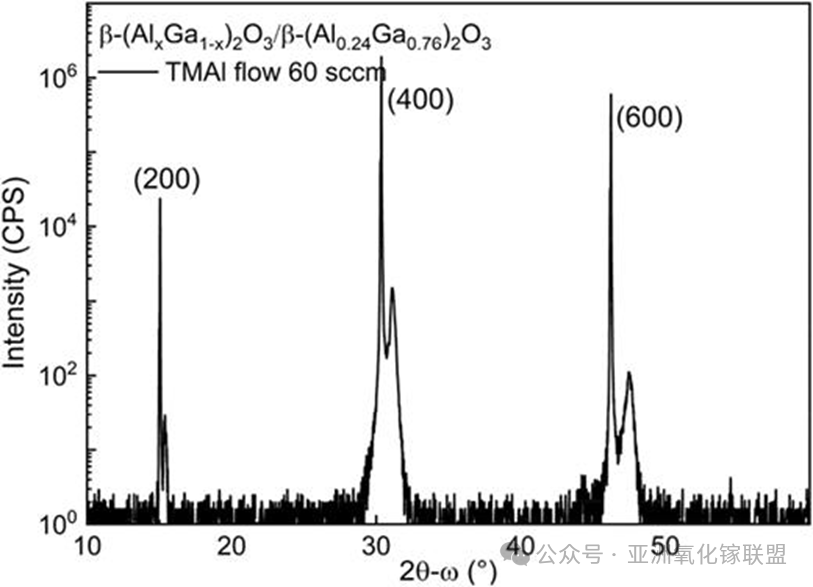
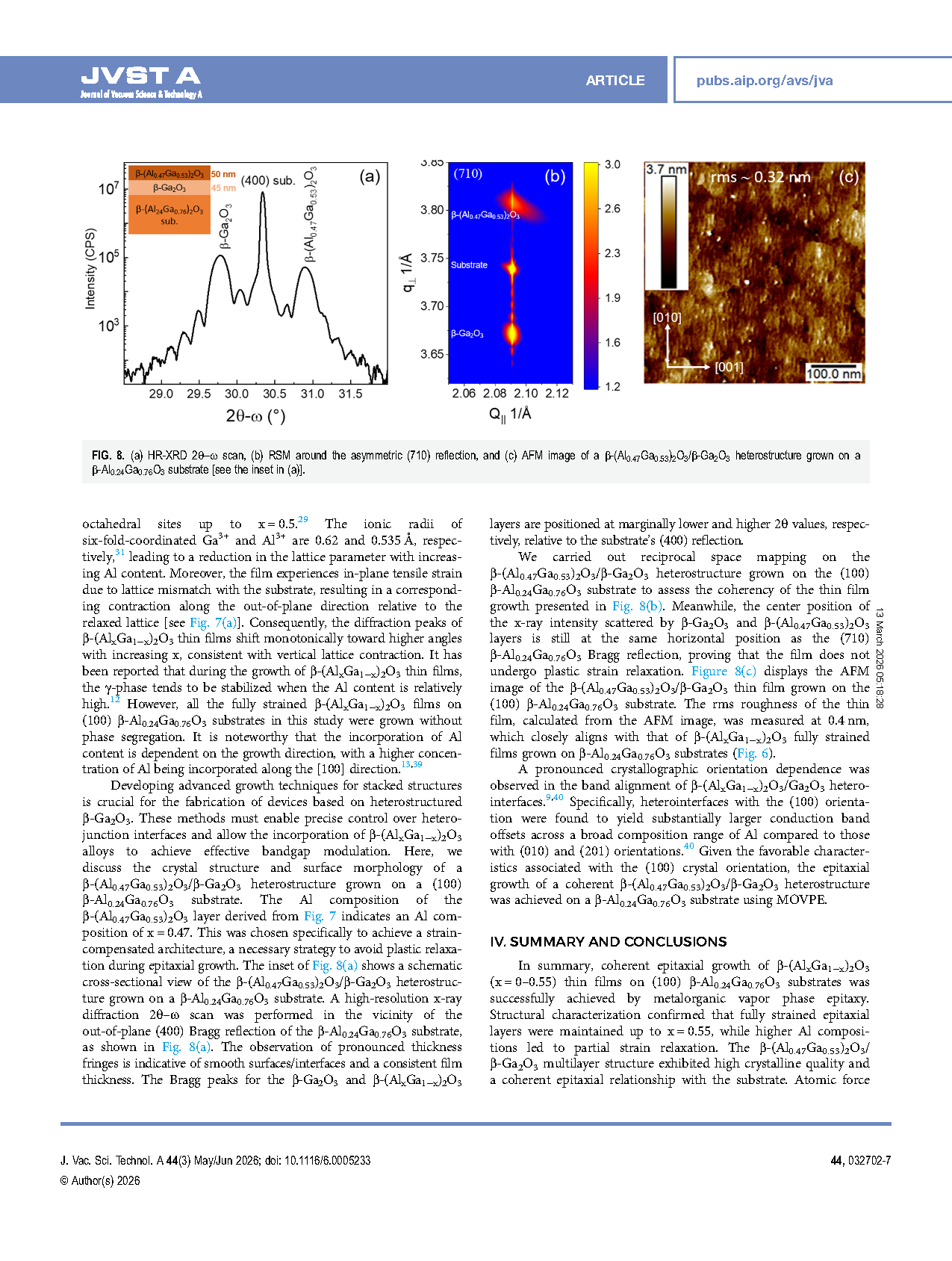
FIG 5.HR-XRD 2θ–ω scan of β-(AlxGa1−x)2O3 thin films grown at 60 SCCM TMAl flow rate on β-Al0.24Ga0.76O3 substrates.
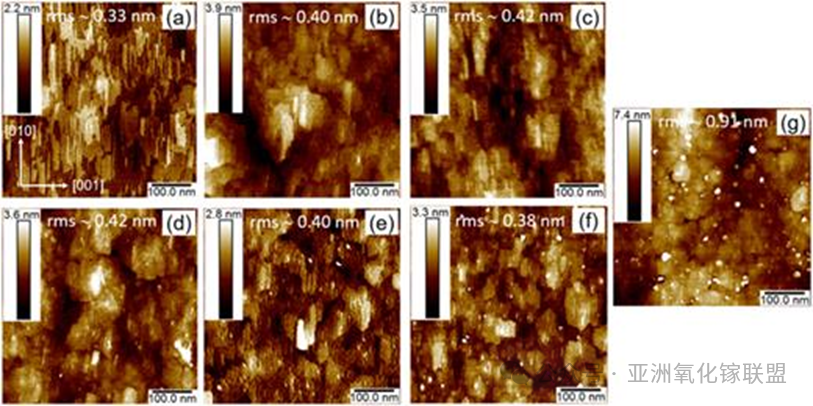
FIG 6.AFM images of β-(AlxGa1−x)2O3 thin films grown at different TMAl flow rates: (a) = 0.00 SCCM, (b) = 7.00 SCCM, (c) = 13.0 SCCM, (d) = 30.0 SCCM, (e) = 35.0 SCCM, (f) = 45.0 SCCM, and (g) = 60.0 SCCM.
DOI:
doi.org/10.1116/6.0005233

Instruction
Official Account

Cooperation
Top