


Researchers from the School of Electronic Science and Engineering, Nanjing University and School of Integrated Circuits, Jiangnan University have published a dissertation titled "Quantitative insight into illumination-induced barrier lowering mediated by self-trapped-holes in Ga₂O₃ Schottky photodiodes" in Applied Physics Letters.
Background
β-Ga₂O₃ as an ultrawide-bandgap semiconductor with a bandgap of 4.6–4.9 eV and excellent thermal stability, is a core candidate for solar-blind photodetectors. Such devices are mainly divided into photoconductive and photovoltaic types, and the photovoltaic type includes Schottky barrier photodiodes (SBPD) and heterojunction photodiodes (HJPD). Previous studies have found that Ga₂O₃-based SBPDs often exhibit anomalously high photoresponsivity far exceeding the theoretical photovoltaic limit, while this phenomenon is rarely observed in HJPDs. The performance difference between the two cannot be explained only by differences in optical absorption and electric field distribution, and the avalanche multiplication effect can be excluded. Two hypotheses have been proposed in the academic community to explain the Schottky barrier lowering (SBL) effect: minority carrier trapping by interface traps and accumulation of photogenerated self-trapped holes (STH) on the surface, but neither has been quantitatively verified. β-Ga₂O₃ has the highest hole self-trapping energy and the lowest self-trapping formation barrier, and holes can stably form STH within sub-picoseconds. This intrinsic characteristic significantly affects its optoelectronic behavior. To solve the problem of responsivity difference between the two types of photovoltaic devices, the team fabricated SBPD and NiO/β-Ga₂O₃ HJPD on the same epitaxial substrate, and quantitatively analyzed the STH-mediated photoresponse mechanism by combining bias-dependent photoresponse spectra, photocurrent transient spectra, Franz-Keldysh (F-K) effect modeling and Technology Computer Aided Design (TCAD) simulation, providing physical support for the device design of ultrawide-bandgap photodetectors.
Abstract
Anomalously high photoresponsivity exceeding the theoretical photovoltaic limit has been widely reported in Ga₂O₃ Schottky barrier photodiodes (SBPDs) but seldom observed in heterojunction photodiodes (HJPDs). Here, we quantitatively identify the illumination-induced Schottky barrier lowering (SBL) effect mediated by self-trapped holes (STHs) as the physical origin of this discrepancy. Bias-dependent photoresponse spectra, photocurrent transients, and Franz–Keldysh effect-based rigorous modeling reveal that an apparent photoresponsivity of 19.8 A/W and a corresponding external quantum efficiency (EQE) of 95.8 in β-Ga₂O₃ SBPD are results of a 0.22 eV reduction of the Schottky barrier under solar-blind illumination. The STH-mediated SBL facilitates electron injection under reverse bias, yielding EQE values far beyond the unity photovoltaic limit. In comparison, NiO/β-Ga₂O₃ HJPDs with type-II band alignment enable efficient extraction of photogenerated carriers and exhibit intrinsic photoresponse behavior. The model quantitatively elucidates the mechanism of STH-mediated photoresponse gain, offering physical insights for engineering ultrawide-bandgap photodetectors.
Highlights
● Mechanism Quantitative Confirmation
First quantitatively confirm that the illumination-induced Schottky barrier lowering effect mediated by self-trapped holes is the physical origin of the ultra-high responsivity of Ga₂O₃-based Schottky photodiodes.
● Key Performance Parameters
Under solar-blind illumination, the Schottky barrier of β-Ga₂O₃ SBPD is reduced by 0.22 eV, the photoresponsivity reaches 19.8 A/W, and the external quantum efficiency is as high as 95.8%.
● Device Performance Difference
NiO/β-Ga₂O₃ heterojunction photodiodes can efficiently extract holes due to type-II band alignment, without self-trapped hole induced barrier lowering, showing intrinsic photoresponse.
● Modeling and Simulation Verification
Combined with Franz-Keldysh effect modeling and TCAD simulation, the regulation effect of self-trapped holes on Schottky barrier is accurately quantified.
● Application Guidance Value
Clarify the self-trapped hole mediated photoresponse gain mechanism, providing core physical guidance for the optimal design of ultrawide-bandgap solar-blind photodetectors.
Conclusion
In summary, illumination-induced Schottky barrier lowering mediated by self-trapped holes is quantitatively identified as the physical origin of the anomalously high photoresponsivity observed in β-Ga₂O₃ Schottky barrier photodetectors. The accumulated self-trapped holes locally reduce the interfacial potential and enhance electron injection across the Schottky junction, producing excess leakage current that yields an apparent responsivity beyond the unity photovoltaic limit. In contrast, NiO/β-Ga₂O₃ heterojunction photodiode with type-II band alignment enables efficient hole extraction and exhibits intrinsic photocurrent behavior. This work quantitatively elucidates the STH-mediated photoresponse gain mechanism, providing insights for optimizing ultrawide-bandgap photodetectors.
Project Support
This research was supported by the National Key R&D Program of China, Jiangsu Provincial Science and Technology Major Project and the National Natural Science Foundation of China.
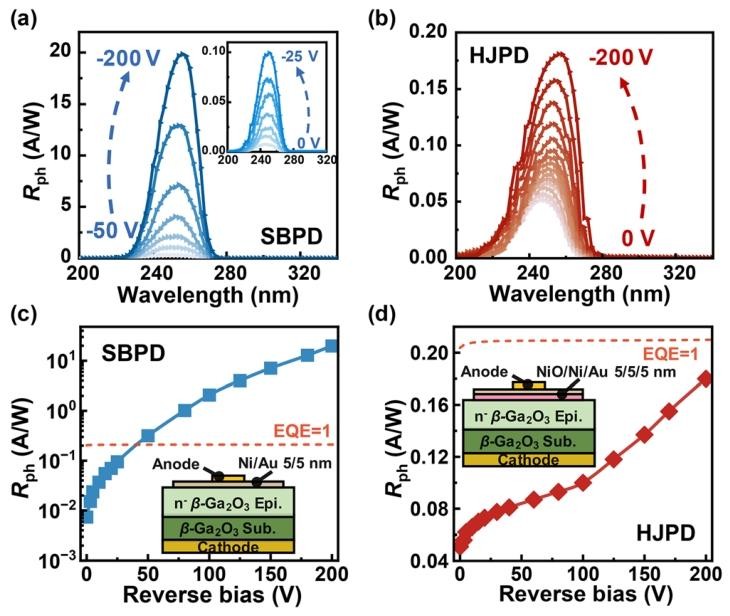
FIG. 1. Bias-dependent photoresponse spectra of (a) SBPDs and (b) HJPDs. Peak photoresponsivity (Rph) as a function of reverse biases for (c) SBPDs and (d) HJPDs (EQE = 1). Insets show schematics of the SBPD and HJPD device structures.
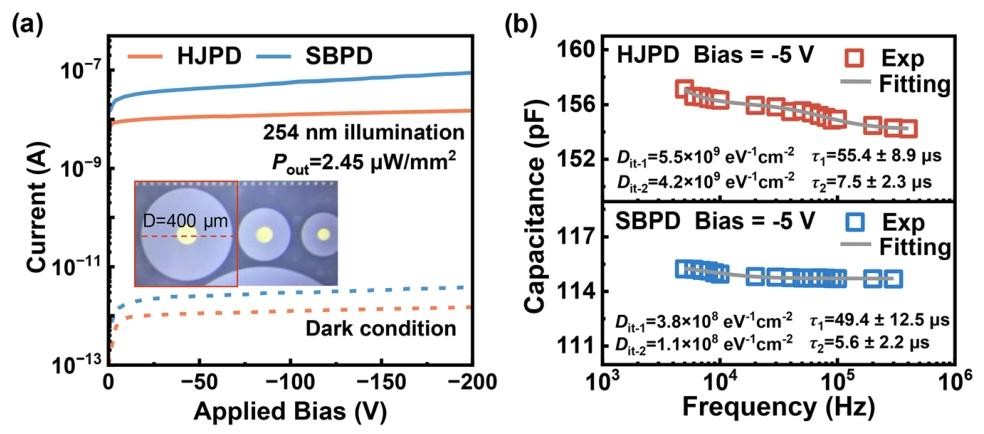
FIG. 2. (a) Reverse I–V characteristics of SBPDs and HJPDs under the 254 nm light and dark conditions, and the inset is optical image of HJPDs. (b) Capacitance–frequency (C–f) spectra measured at -5 V with fitting results overlaid.
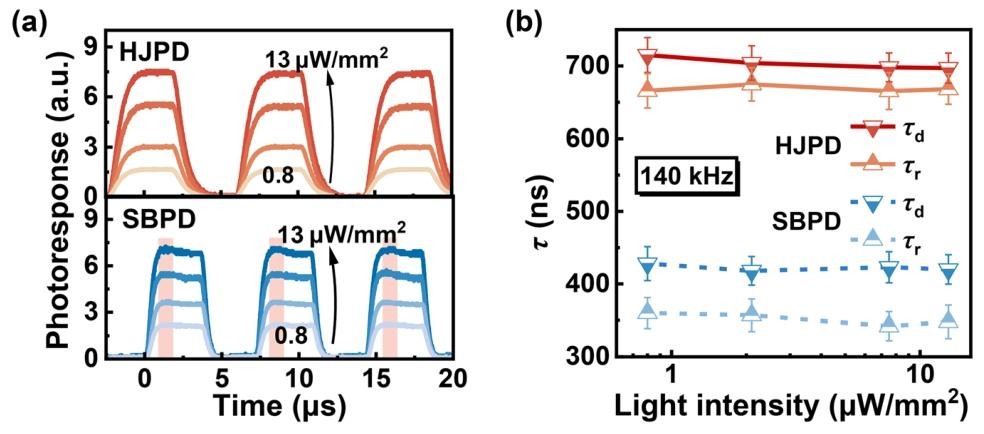
FIG. 3. (a) Transient photoresponse of SBPDs and HJPDs measured at 140 kHz under different incident optical power densities. (b) Extracted rising (τr) and decay (τd) time constants under illumination with various optical power densities.
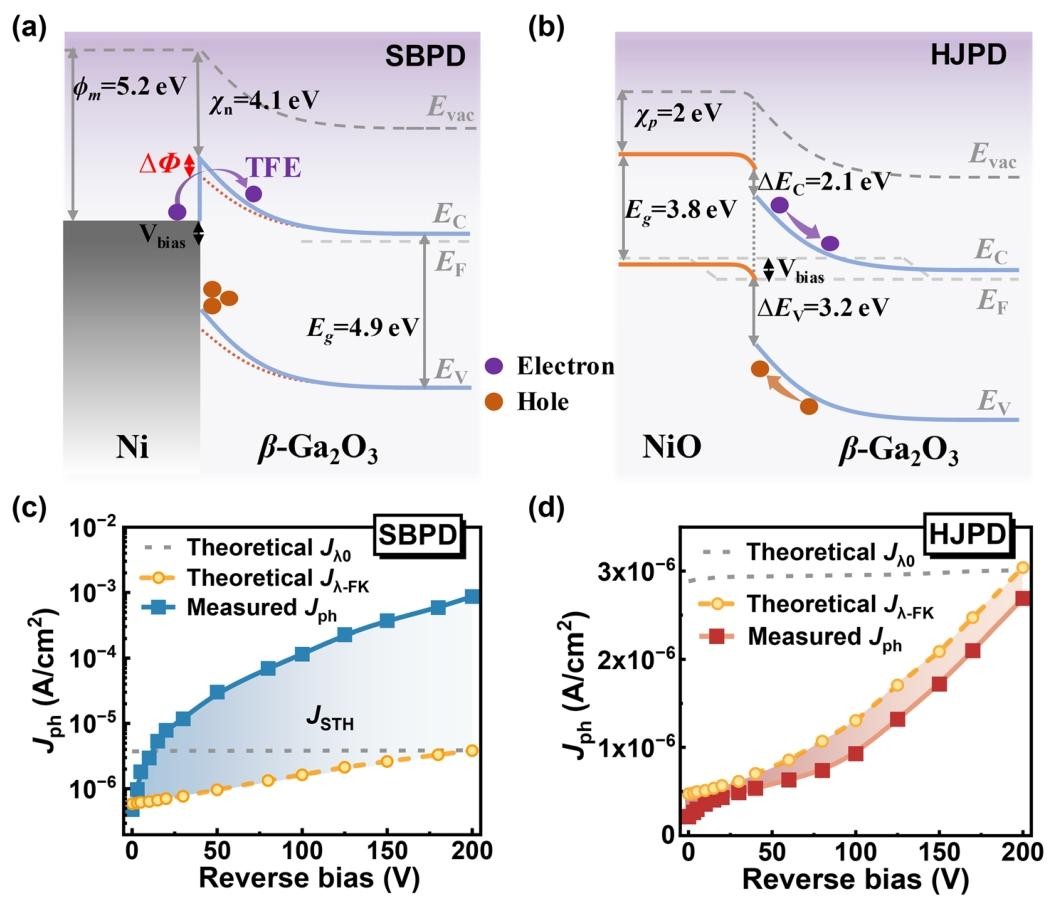
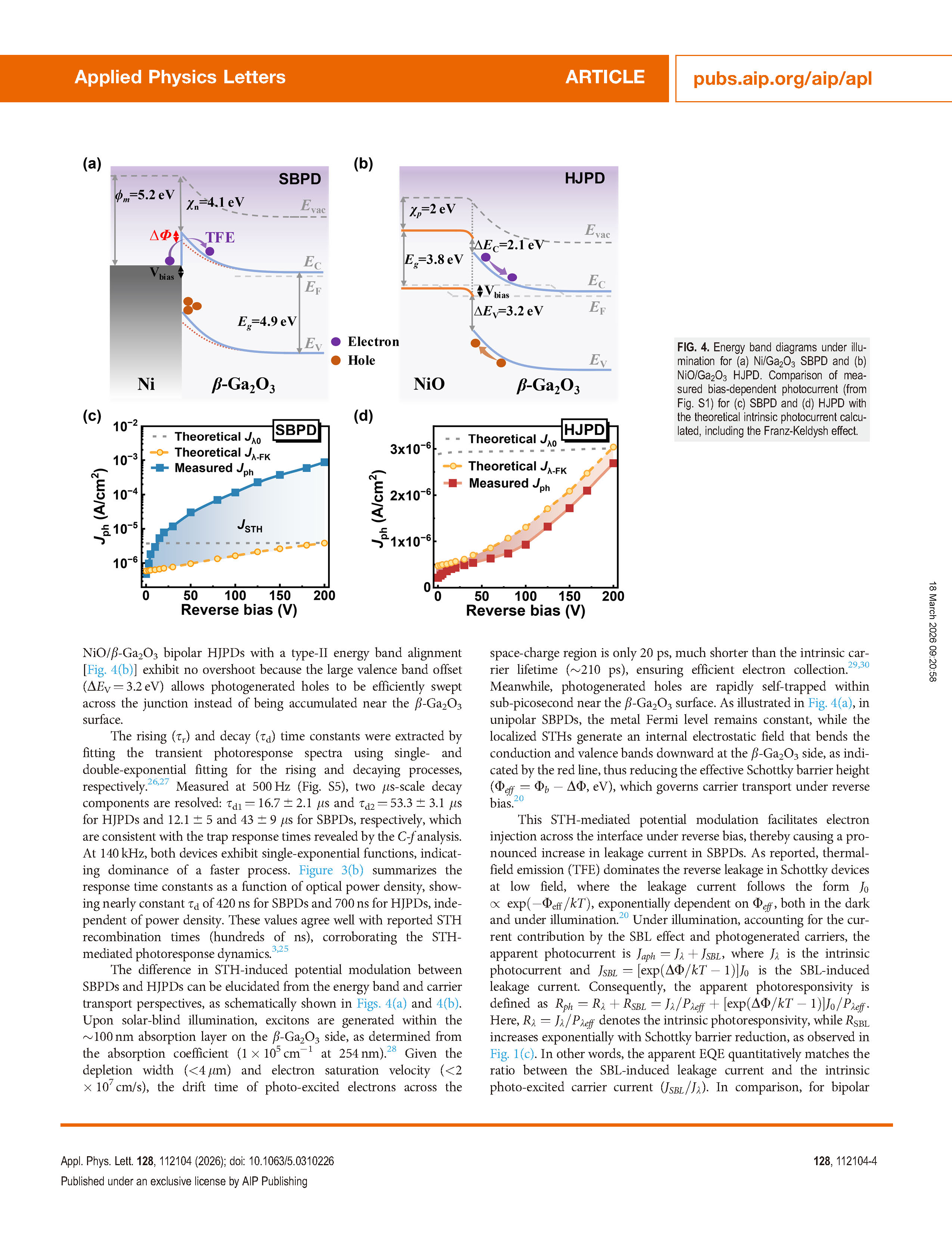
FIG. 4. Energy band diagrams under illumination for (a) Ni/Ga₂O₃ SBPD and (b) NiO/Ga₂O₃ HJPD. Comparison of measured bias-dependent photocurrent (from Fig. S1) for (c) SBPD and (d) HJPD with the theoretical intrinsic photocurrent calculated, including the Franz-Keldysh effect.
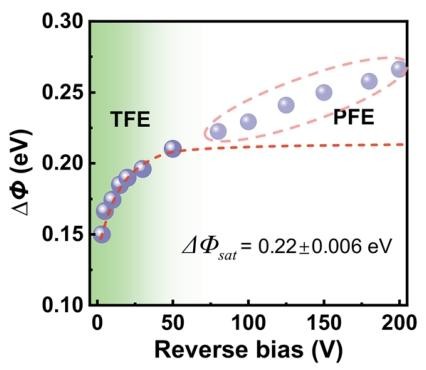
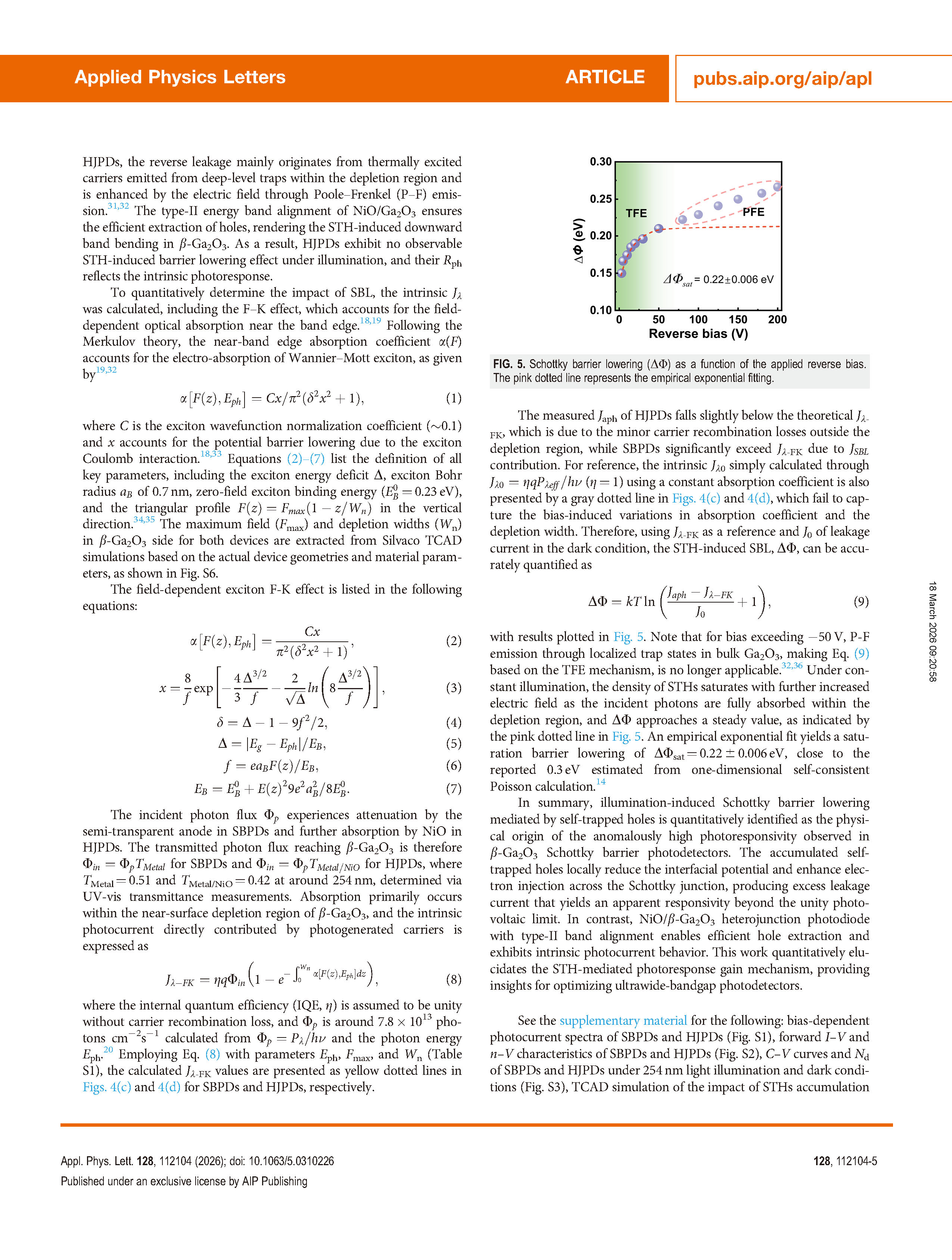
FIG. 5. Schottky barrier lowering (ΔΦ) as a function of the applied reverse bias. The pink dotted line represents the empirical exponential fitting.
DOI:
10.1063/5.0310226
Instruction
Official Account

Cooperation
Top