


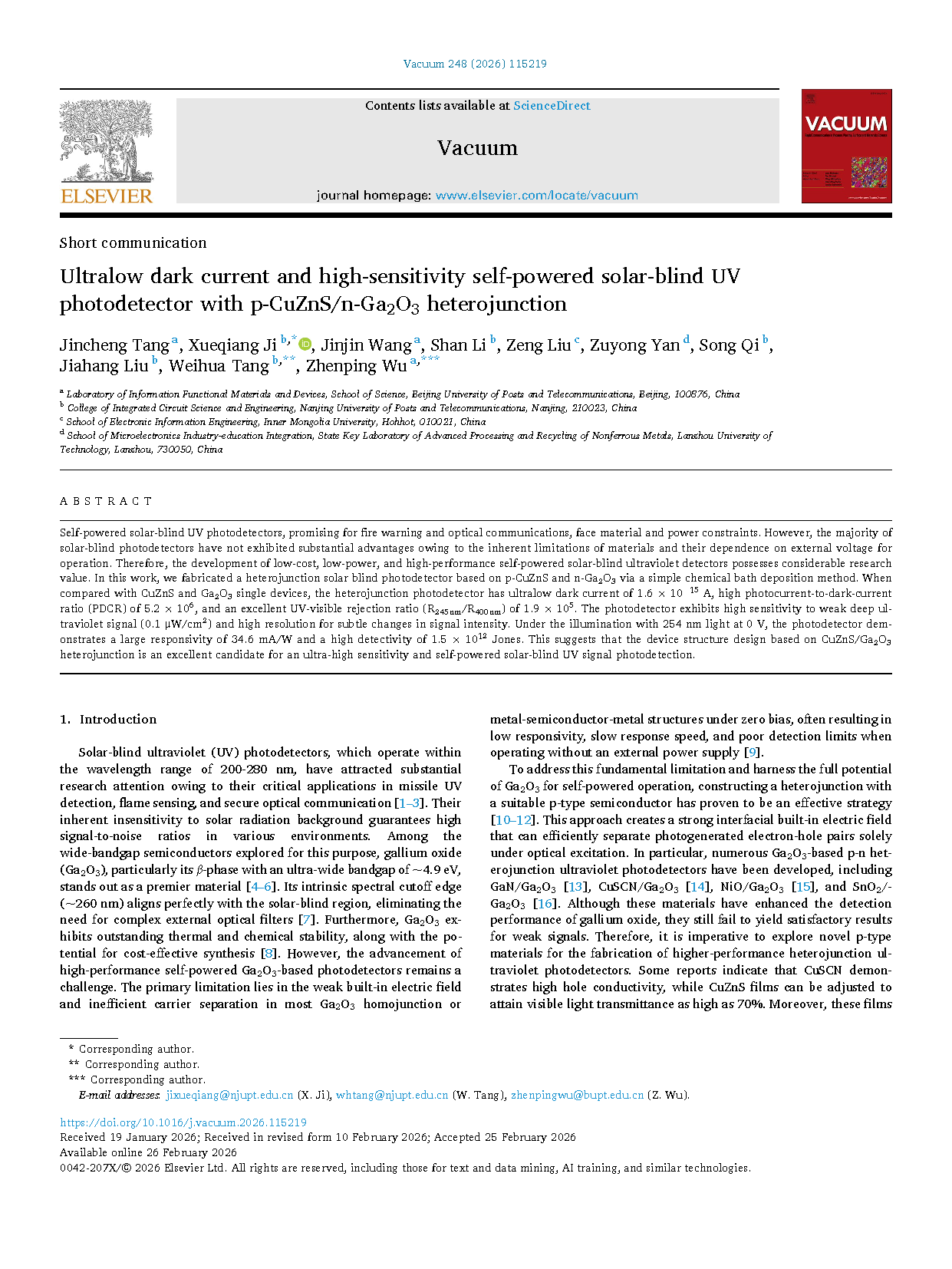
Researchers from the Beijing University of Posts and Telecommunications have published a dissertation titled " Ultralow dark current and high-sensitivity self-powered solar-blind UV photodetector with p-CuZnS/n-Ga2O3 heterojunction " in Vacuum.
Background
Solar-blind ultraviolet (UV) photodetectors, which operate within the wavelength range of 200-280 nm, have attracted substantial research attention owing to their critical applications in missile UV detection, flame sensing, and secure optical communication. Their inherent insensitivity to solar radiation background guarantees high signal-to-noise ratios in various environments. Among the wide-bandgap semiconductors explored for this purpose, gallium oxide (Ga2O3), particularly its β-phase with an ultra-wide bandgap of ∼4.9 eV, stands out as a premier material. Its intrinsic spectral cutoff edge (∼260 nm) aligns perfectly with the solar-blind region, eliminating the need for complex external optical filters . Furthermore, Ga2O3 exhibits outstanding thermal and chemical stability, along with the potential for cost-effective synthesis. However, the advancement of high-performance self-powered Ga2O3-based photodetectors remains a challenge. The primary limitation lies in the weak built-in electric field and inefficient carrier separation in most Ga2O3 homojunction or metal-semiconductor-metal structures under zero bias, often resulting in low responsivity, slow response speed, and poor detection limits when operating without an external power supply .
Abstract
Self-powered solar-blind UV photodetectors, promising for fire warning and optical communications, face material and power constraints. However, the majority of solar-blind photodetectors have not exhibited substantial advantages owing to the inherent limitations of materials and their dependence on external voltage for operation. Therefore, the development of low-cost, low-power, and high-performance self-powered solar-blind ultraviolet detectors possesses considerable research value. In this work, we fabricated a heterojunction solar blind photodetector based on p-CuZnS and n-Ga2O3 via a simple chemical bath deposition method. When compared with CuZnS and Ga2O3 single devices, the heterojunction photodetector has ultralow dark current of 1.6 ×10¹⁵ A, high photocurrent-to-dark-current ratio (PDCR) of 5.2 ×10⁶, and an excellent UV-visible rejection ratio (R245nm/R400nm) of 1.9 ×10⁵. The photodetector exhibits high sensitivity to weak deep ultraviolet signal (0.1 μW/cm2) and high resolution for subtle changes in signal intensity. Under the illumination with 254 nm light at 0 V, the photodetector demonstrates a large responsivity of 34.6 mA/W and a high detectivity of 1.5 ×10¹² Jones. This suggests that the device structure design based on CuZnS/Ga2O3 heterojunction is an excellent candidate for an ultra-high sensitivity and self-powered solar-blind UV signal photodetection.
Conclusion
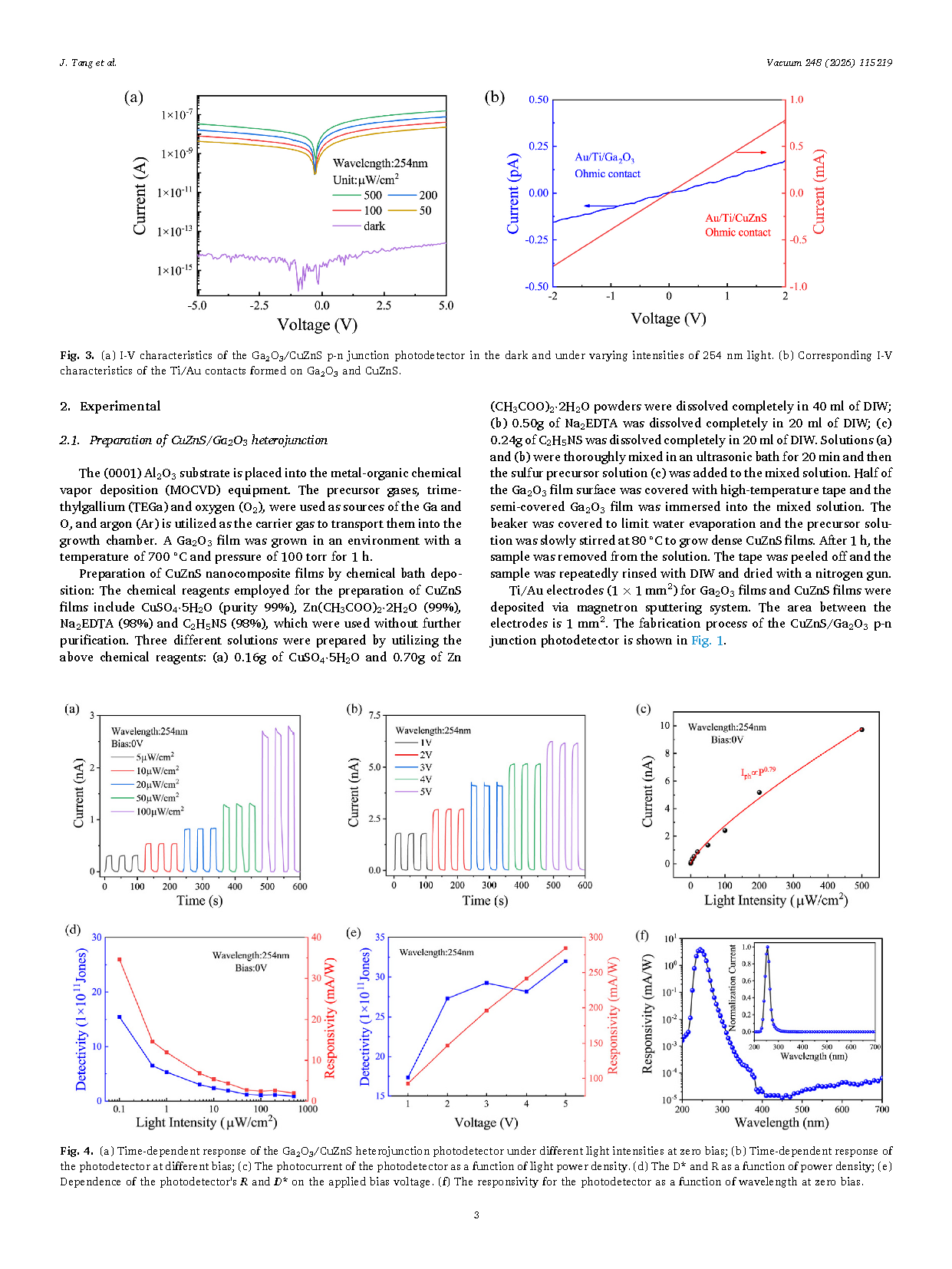
In conclusion, we have fabricated a self-powered solar-blind UV photodetector based on the Ga2O3/CuZnS heterojunction, which feature a highly responsive and an ultrahigh UV-visible rejection ratio, The device exhibits excellent photoelectric performance with a low dark current of 1.6 ×10¹⁵ A, a high PDCR (Ilight/Idark) of 5.2×10⁶,an excellent UV-visible rejection ratio (R245nm/R400nm) of 1.9 ×10⁵, a large responsivity of 34.6 mA/W and a high detectivity of 1.5 ×10¹² Jones. These results demonstrate the significant potential of Ga2O3/CuZnS film devices for practical application as high-performance, self-powered deep-UV photodetectors.
Project Support
This work was supported in part by the Natural Science Research Start-up Foundation of Recruiting Talents of Nanjing University of Posts and Telecommunications under Grant NY224052, and the Natural Sci ence Foundation of Gansu province of China (Grant No. 25JRRA087), and the Hongliu Outstanding Young Talents Funding Scheme of Lanzhou University of Technology.
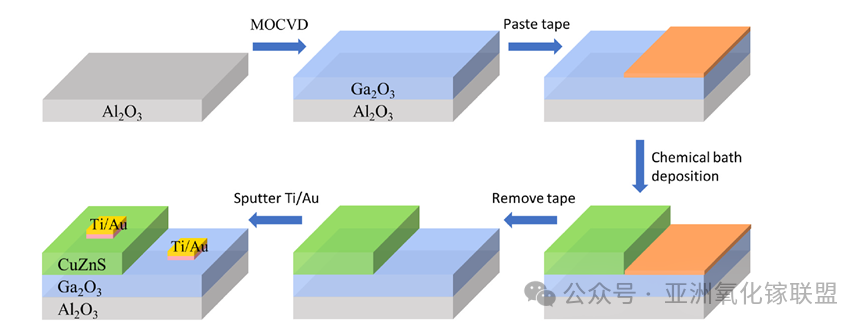
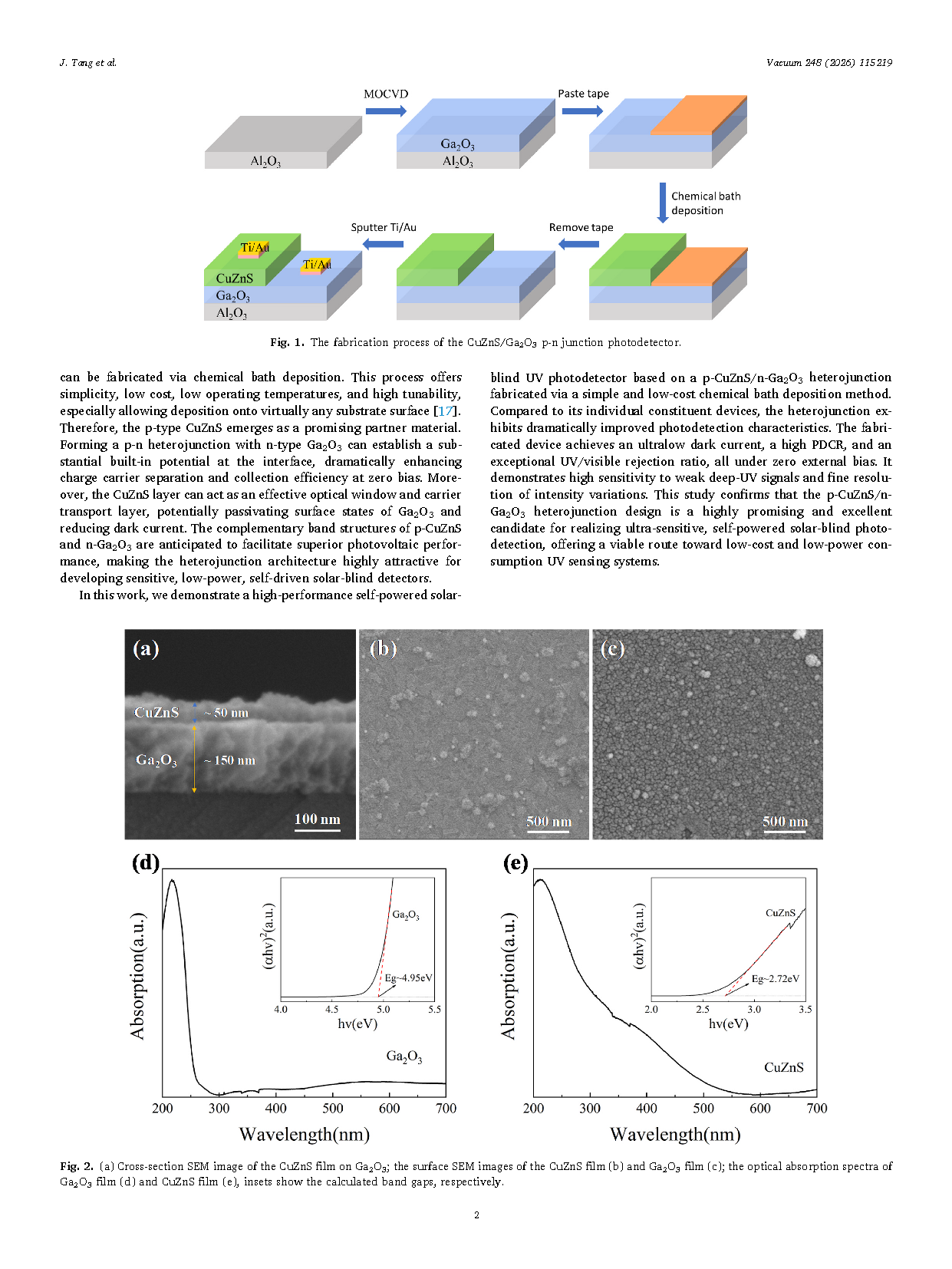
Fig. 1. The fabrication process of the CuZnS/Ga2O3 p-n junction photodetector.
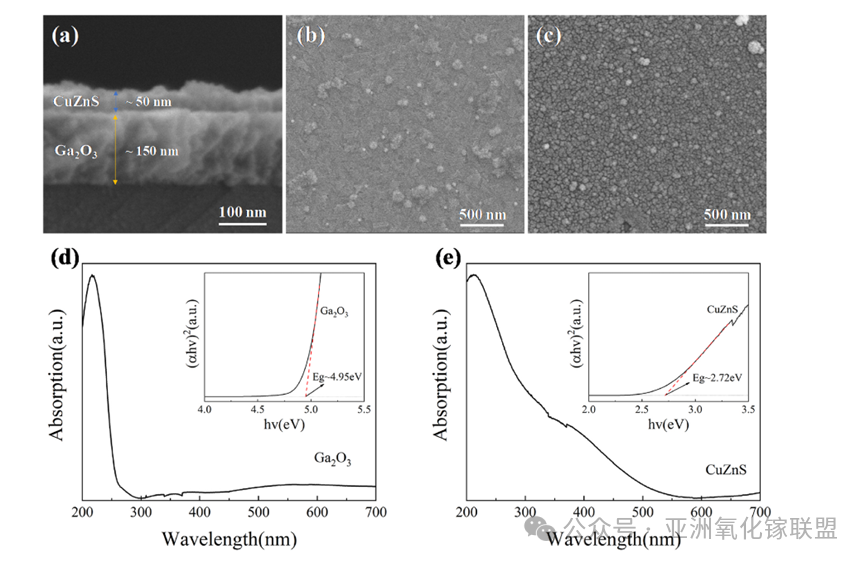
Fig. 2. (a) Cross-section SEM image of the CuZnS film on Ga2O3; the surface SEM images of the CuZnS film (b) and Ga2O3 film (c) the optical absorption spectra of Ga2O3 film (d) and CuZnS film (e), insets show the calculated band gaps, respectively.
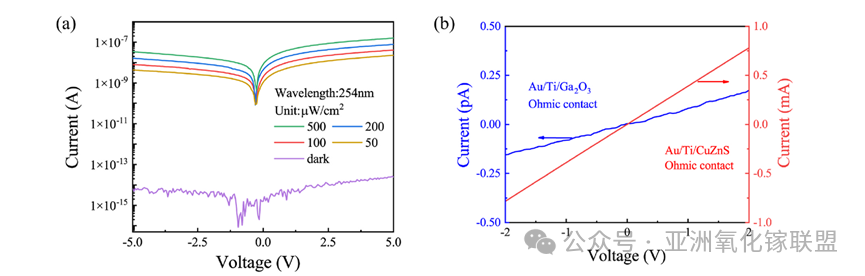
Fig. 3. (a) I-V characteristics of the Ga2O3/CuZnS p-n junction photodetector in the dark and under varying intensities of 254 nm light. (b) Corresponding I-V characteristics of the Ti/Au contacts formed on Ga2O3 and CuZnS.
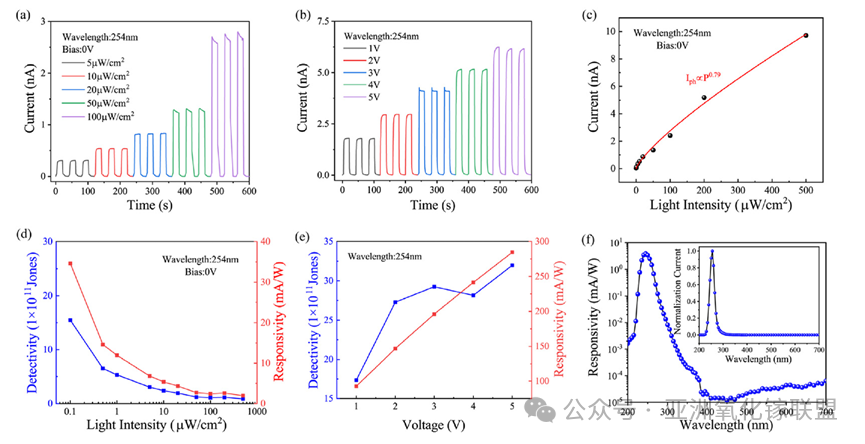
Fig. 4. (a) Time-dependent response of the Ga2O3/CuZnS heterojunction photodetector under different light intensities at zero bias; (b) Time-dependent response of the photodetector at different bias; (c) The photocurrent of the photodetector as a function of light power density. (d) The D* and R as a function of power density; (e) Dependence of the photodetector's R and D* on the applied bias voltage. (f) The responsivity for the photodetector as a function of wavelength at zero bias.
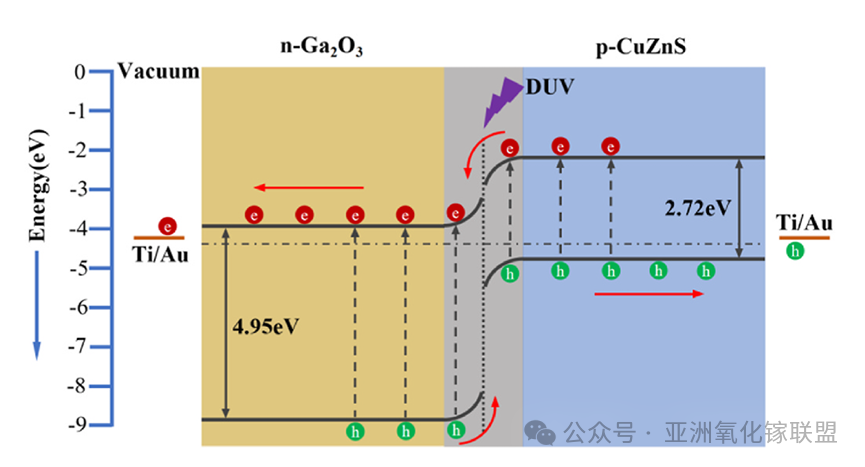
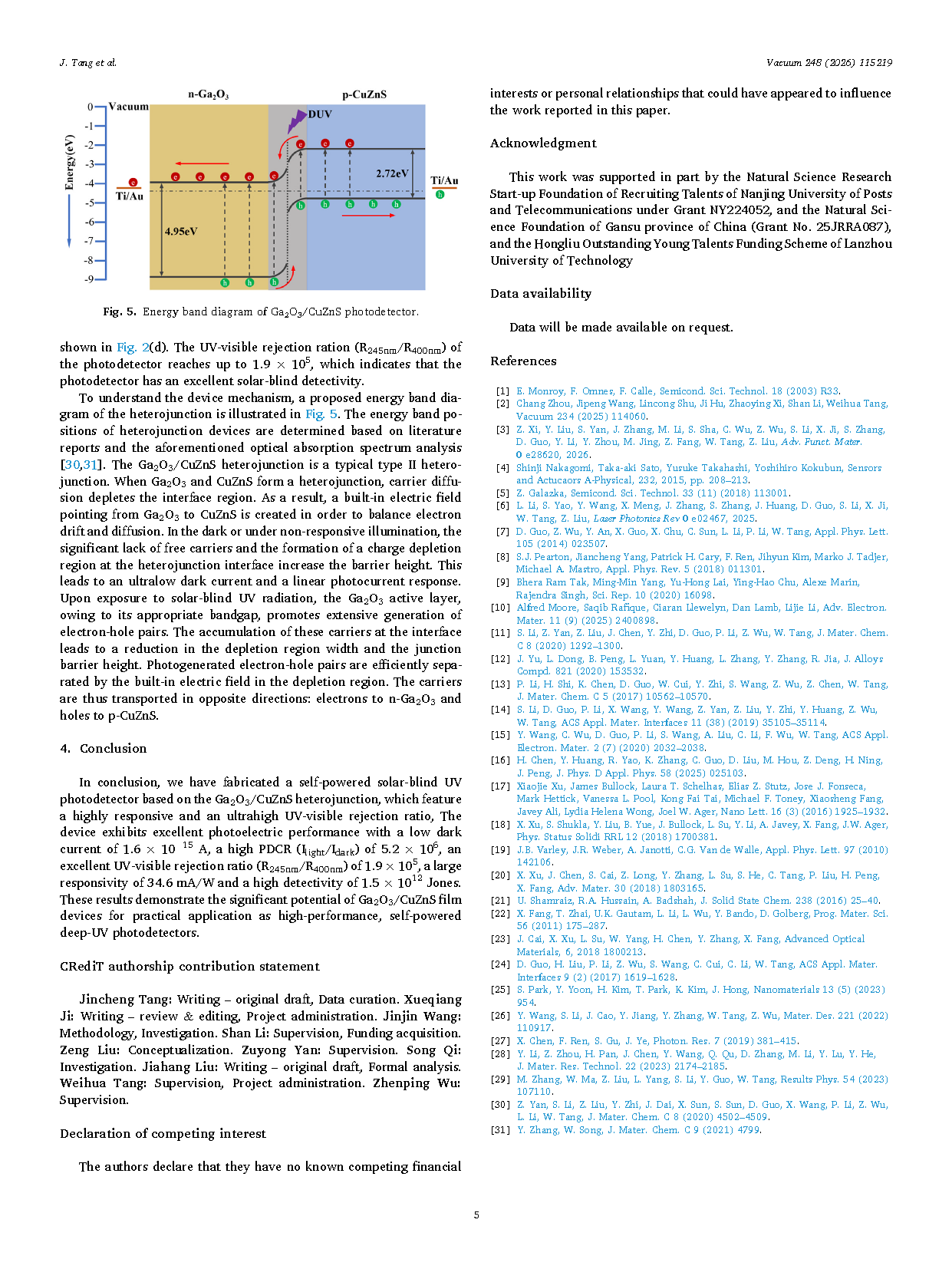
Fig. 5. Energy band diagram of Ga2O3/CuZnS photodetector.
DOI:
doi.org/10.1016/j.vacuum.2026.115219
Instruction
Official Account

Cooperation
Top