


Researchers from the Wuhan University have published a dissertation titled "Wide-bandgap Ga2O3 single crystal-based heterojunctions with organic interlayers for high-performance x-ray detection" in Applied Physics Letters.
Background
X-ray detection plays a pivotal role in diverse and multiple fields, including medical imaging, industrial nondestructive testing, space exploration, scientific research, and national security. The device performance in these applications is fundamentally governed by the properties of the semiconductor materials serving as the active sensing layers. Ideal materials require high sensitivity to ionizing radiation, efficient charge collection efficiency (CCE), excellent energy resolution, and thermal stability. Conventional semiconductors like silicon (Si) and germanium (Ge) possess relatively narrow bandgaps (1.12 and 0.67 eV, respectively). This inherent property leads to significant limitations: high intrinsic carrier concentrations at room temperature, resulting in substantial leakage currents and noise that degrade the signal-to-noise ratio and energy resolution, particularly for low-dose or low-energy x-ray detection. Furthermore, their lower critical breakdown electric field strength limits the maximum applicable bias voltage, constraining achievable sensitivity and charge collection efficiency. Wide bandgap semiconductors (WBGSs), such as silicon carbide (SiC) and gallium nitride (GaN), offer significant improvements regarding these issues, enabling room-temperature operation with lower leakage currents and enhanced radiation tolerance. For more advanced applications, it is the quest for materials exhibiting even greater robustness and performance for next-generation, high-flux, or high-energy x-ray detection.
Abstract
Gallium oxide (Ga2O3) exhibits significant potential for next-generation x-ray detection due to its excellent optoelectronic properties. However, x-ray detectors based on β-Ga2O3 single crystals scarcely reported, mainly because fabricating p-type Ga2O3 remains challenging. In this work, unintentionally doped and Fe-doped β-Ga2O3 single crystal wafers have been systematically investigated for x-ray detection using a heterojunction strategy with organic interlayers. The device performance has been carefully evaluated, achieving high response speed (<0.1 s), low dark current (0.42 nA at −40 V), excellent device stability (stable photoresponse over 6 days of continuous operation), and relatively high x-ray sensitivity (20.7 μC Gy−1 cm−2 for the Fe-doped device). Furthermore, the reduced oxygen vacancy concentration can improve the photocurrent/dark current ratio of the detector. This study proposes an innovative approach for high-performance x-ray detectors based on β-Ga2O3 single crystals.
Conclusion
To sum up, two types of β-Ga2O3 single crystal wafers were introduced for fabricating x-ray detectors. The fundamental properties and device performance were systematically compared. It was found that Fe can effectively compensate free electrons, significantly enhance the resistivity of the single crystals, and enable the fabrication of high-performance x-ray detectors. The Fe-doped β-Ga2O3-based detectors demonstrate superior x-ray performance in ambient air at room temperature, including a high photo-to-dark current ratio, low noise density, and excellent operational stability. These results indicate the significant potential of Fe-doped β-Ga2O3 single crystals for x-ray detection applications.
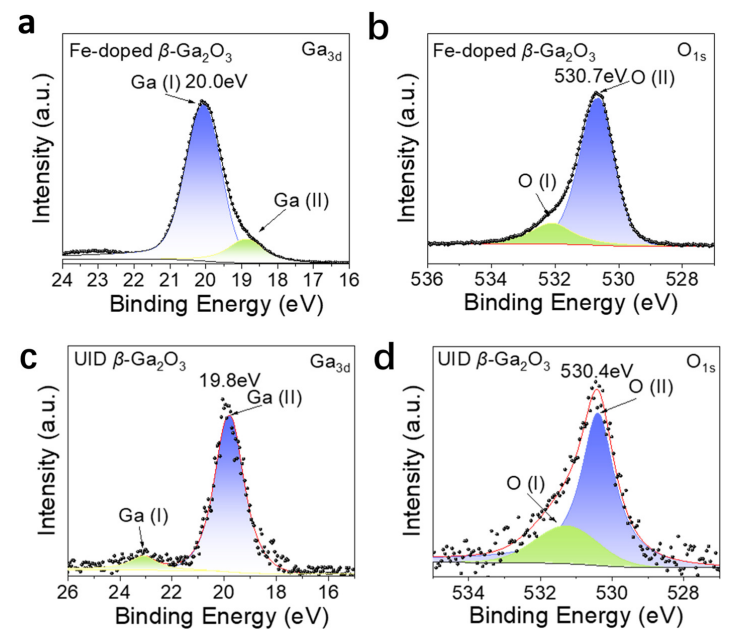
FIG. 1. XPS spectra of Fe-doped β-Ga2O3: (a) Ga3d region, and (b) O1s region. XPS spectra of UID β-Ga2O3: (c) Ga3d region, and (d) O1s region.
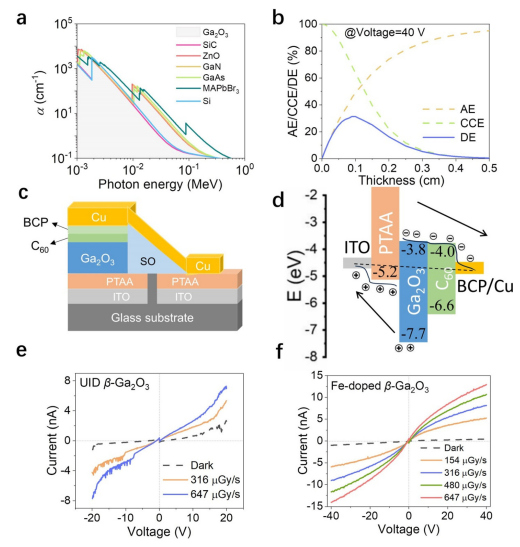
FIG. 2. (a) Comparison of the attenuation coefficients of various semiconductors, and (b) the calculated AE, CCE, and DE of β-Ga2O3, (c) cross-sectional and (d) schematic energy diagram of the β-Ga2O3-based x-ray detectors under equilibrium conditions, and the obtained I– V curves of (e) UID and (f) Fe-doped β-Ga2O3 detectors.
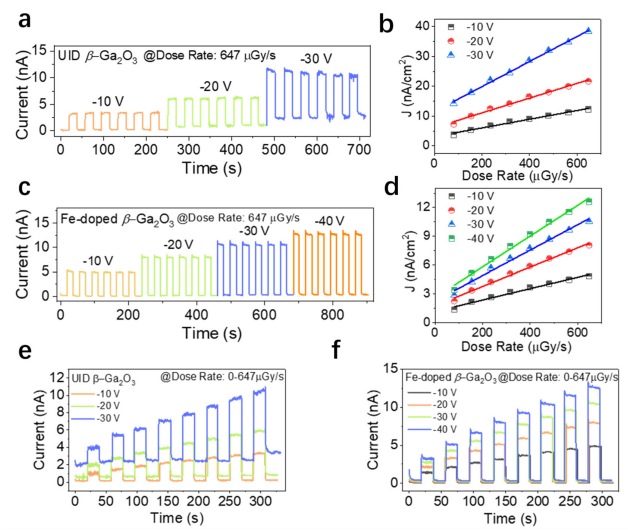
FIG. 3. (a) Temporal response of the UID β-Ga2O3 detector under x-ray irradiation at different bias voltages (dose rate, 647 μGy/s) and (b) the relationship between x-ray dose rate and current of UID β-Ga2O3 device. (c) Temporal response of the Fe-doped β-Ga2O3 detector under x-ray irradiation at different bias voltages (dose rate, 647 μGy/s). (d) The relationship between x-ray dose rate and current of Fe-doped β-Ga2O3 device. Temporal response of the detectors of (e) UID β-Ga2O3 and (f) Fe-doped β-Ga2O3 under x-ray irradiation with linearly increasing dose rates.
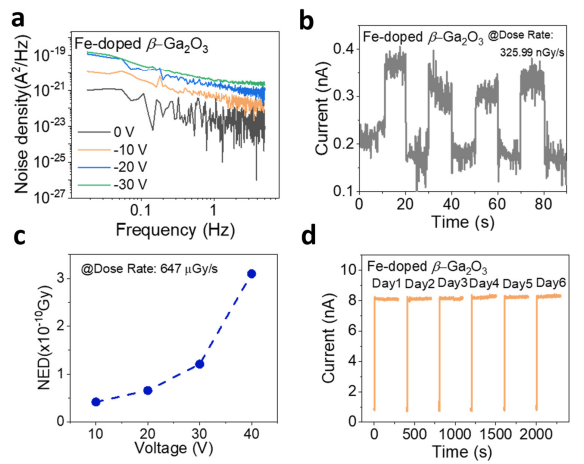
FIG. 4. (a) The noise spectra and (b) detection limit, (c) NED and (d) device stability of the Fe-doped β-Ga2O3 detectors.
DOI:
doi.org/10.1063/5.0289681
Instruction
Official Account

Cooperation
Top