


Researchers from the Wuhan Textile University have published a dissertation titled "Remarkably improved performance in ferroelectric BaTiO3/Ga2O3 heterojunction based self-driven ultraviolet photodetector" in Journal of Alloys and Compounds.
Project Support
This work was supported by the National Natural Science Foundation of China (Grant Nos. 62274057, 11975093, and 52202132), the Program for Science and Technology Innovation Team in Colleges of Hubei Province (Grant No. T201901), and Hubei International Science and Technology Cooperation Project (Grant No. 2022EHB023).
Background
This study focuses on solar-blind ultraviolet (SBUV) photodetectors operating in the 200–280 nm spectral range, which have broad applications in both military and civilian fields, including missile warning systems, forest fire monitoring, wireless communication, and neuromorphic visual sensors. Traditional silicon-based photodetectors are limited by their narrow bandgap (1.12 eV) and high sensitivity to visible light, requiring expensive optical filters, and their relatively low responsivity constrains practical applications.
In recent years, wide-bandgap semiconductors such as AlGaN, MgZnO, diamond, and β-Ga₂O₃ have emerged as promising candidates for SBUV detection. Among them, β-Ga₂O₃, with its suitable bandgap (4.9 eV) and excellent chemical and thermal stability, stands out as a highly promising material. However, existing photovoltaic-type β-Ga₂O₃ photodetectors suffer from limited responsivity and detectivity, which hinders their practical deployment.
Various device configurations, including ZnO/Ga₂O₃ heterojunctions and Au/Ga₂O₃ Schottky devices, have been explored, but performance improvements remain limited. Recently, ferroelectric/β-Ga₂O₃ heterojunctions have shown potential because ferroelectric polarization fields can enhance carrier separation, though the selection of suitable ferroelectric materials remains a challenge.
In this context, this work designs and fabricates a BaTiO₃/Ga₂O₃ heterojunction photodetector. By leveraging the ferroelectric polarization of BaTiO₃, the device demonstrates significantly enhanced photodetection performance at zero bias, providing a new approach toward high-performance, self-driven SBUV photodetectors.
Abstract
High-performance self-driven ultraviolet photodetectors (UVPDs) have broad applications in both military and civilian fields. However, self-driven UVPDs often deliver unsatisfactory performance due to limited separation and transport of photo-generated carriers in the devices. Herein, we designed and fabricated BaTiO3/Ga2O3 heterojunction-based photodetectors with a type-II energy band configuration using MgO (100) single crystal as the substrate and (Sn, F) co-doped Ga2O3 as the bottom electrodes. The BaTiO3/Ga2O3 heterojunction-based device with a 100 nm-thick BaTiO3 layer demonstrated the best performance (Responsivity, R = 41.55 mA/W; Detectivity, D* = 5.74 × 10¹¹ Jones; rise/decay time, τr/τd = 94/165 ms) under zero bias. The performances (R, D*, and τr/τd) of the device are significantly superior to those of single-layer Ga2O3- (R = 1.17 mA/W, D* = 5.15 × 10¹⁰ Jones, τr/τd=129/327 ms) and BaTiO3-based (R = 0.21 mA/W, D* = 2.09 × 10¹⁰ Jones, τr/τd =111/287 ms) devices fabricated under the same conditions. Furthermore, the BaTiO3/Ga2O3 device’s photocurrent responses can be modulated by its ferroelectric depolarization electric field. It exhibits superior responsivity in the upward poling state (R = 43.68 mA/W) compared to those in unpoled and downward poling states. The device even demonstrates a higher performance under weak light (light intensity: 1.32 μW/cm2) illumination, with a responsivity of 88.92 mA/W and a detectivity of 1.23 × 10¹² Jones. These performance parameters surpass those of most Ga2O3-based self-driven photodetectors reported in the literature. Our results suggest that the BaTiO3/Ga2O3 heterojunction is a potential candidate for achieving highly sensitive, deep ultraviolet photodetection.
Highlights
• High-performance BaTiO3/Ga2O3 heterojunction-based UV-PD was achieved.
• The optimized device shows ultrahigh zero-bias responsivity (88.92 mA/W) and detectivity (1.23 ×10¹² Jones).
• The performance of BaTiO3/Ga2O3 PD is superior to those of the single- Ga2O3- and BaTiO3- based PDs.
• The excellent performance of BaTiO3/Ga2O3 PD is attributed to the coupling effect of Edp and EBaTiO3/Ga2O3 .
Conclusion
In summary, we designed and prepared BaTiO3/Ga2O3 heterojunction-based self-driven photodetectors with a type-II band alignment. The BaTiO3/Ga2O3 device with an optimized BaTiO3 layer thickness of 100nm demonstrates an excellent performance (R = 41.55mA/W, D* =5.74×10¹¹ Jones, τr/τd =94/165 ms). The R and D* of the BaTiO3/Ga2O3 heterojunction-based device are significantly su perior to those of the single Ga2O3- (R =1.17mA/W, D* =5.15×10¹⁰) and single BaTiO3- based (R =0.21mA/W, D* =2.09×10¹⁰) devices. The Au/BaTiO3/Ga2O3 device exhibits an ultrahigh R of 88.92mA/W and a D* of 1.23×10¹² Jones under weak light illumination (P255nm = 1.32 μW/cm2). Furthermore, the photodetection performance of the Au/ BaTiO3/Ga2O3 device can be effectively modulated by the ferroelectric polarization across BaTiO3. The responsivity of the device in the upward poling state (R =43.68mA/W) is significantly superior to that of the device in the unpoled (R =41.55mA/W) and downward poling states (R =33.56mA/W). Our work demonstrates that separating the photo generated carriers by coupling the Edp in ferroelectric BaTiO3 with the built-in electric field at the BaTiO3/Ga2O3 heterojunction is a feasible strategy for the development of high-performance self-driven photodetectors.
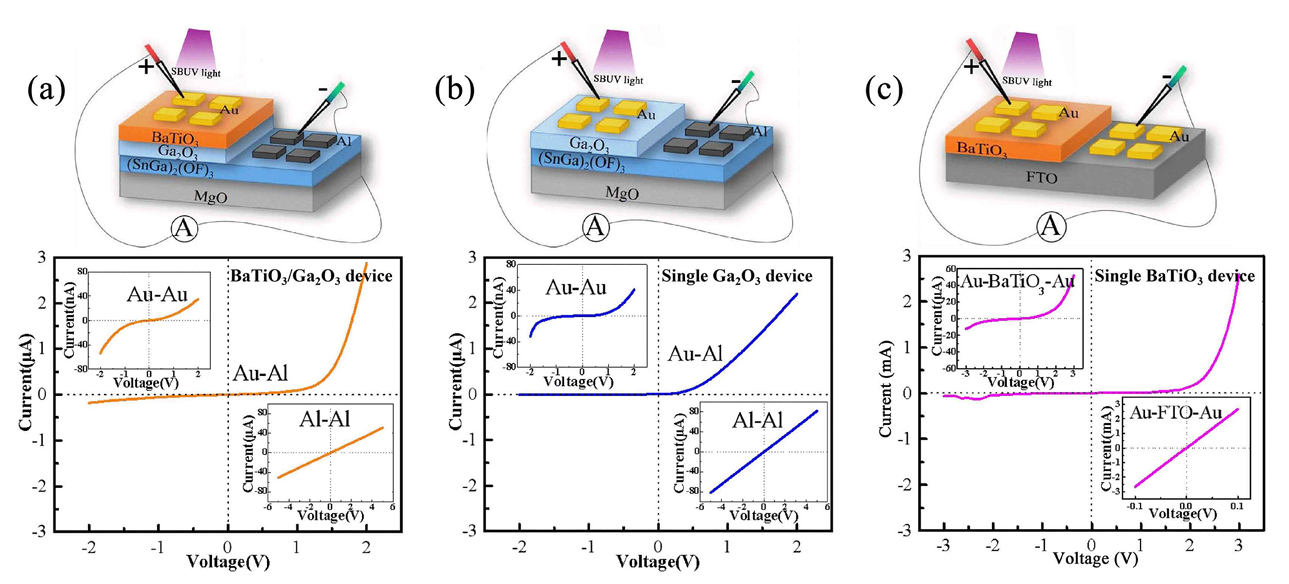
Fig. 1. (a) XRD patterns of the BaTiO₃, Ga₂O₃, and BaTiO₃/Ga₂O₃/(SnGa)₂(OF)₃ films grown on the MgO (100) substrate; (b) Optical transmittance spectra; and (c) plots of (αhν)² vs hν of the BaTiO₃, Ga₂O₃, and (SnGa)₂(OF)₃ films. (d) Cross-sectional FE-SEM image and corresponding EDS elemental mappings of the BaTiO₃/Ga₂O₃/(SnGa)₂(OF)₃/MgO multilayer film.

Fig. 2. Cross-sectional TEM image of the (a) BaTiO₃/Ga₂O₃/(SnGa)₂(OF)₃/MgO multilayer film. HRTEM images at the (b) BaTiO₃/Ga₂O₃ and (c) (SnGa)₂(OF)₃/MgO interfaces. The insets are magnified views of the dashed-box marked regions and corresponding fast Fourier transform (FFT) patterns.
Fig. 3. Device structure diagrams (upper panels) and I–V curves measured under dark conditions (lower panels) of the (a) BaTiO₃/Ga₂O₃, (b) single Ga₂O₃, and (c) single BaTiO₃ devices. The insets reveal the corresponding top Schottky contacts and bottom ohmic contacts in these devices.
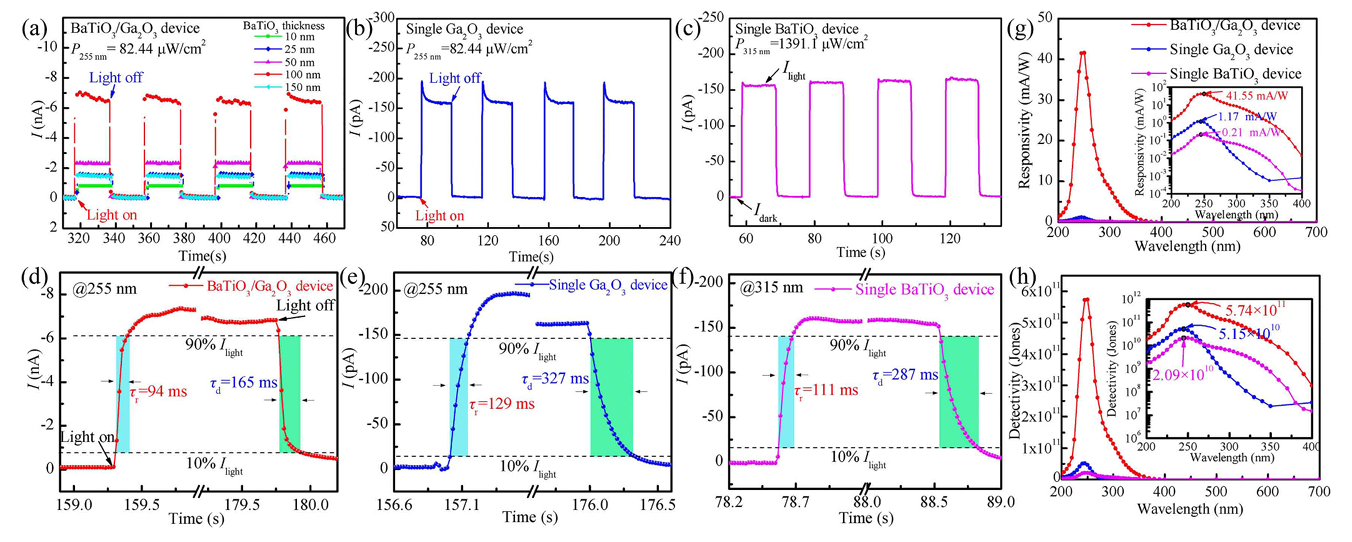
Fig. 4. (a–c) The multicycle I–t curves and (d–f) response times of (a) BaTiO₃/Ga₂O₃, (b) single Ga₂O₃, and (c) single BaTiO₃ devices measured under zero bias. (g) Spectral responsivity and (h) spectral detectivity of the three devices; insets show responsivity and detectivity in logarithmic scale for light in the wavelength range of 200–400 nm.
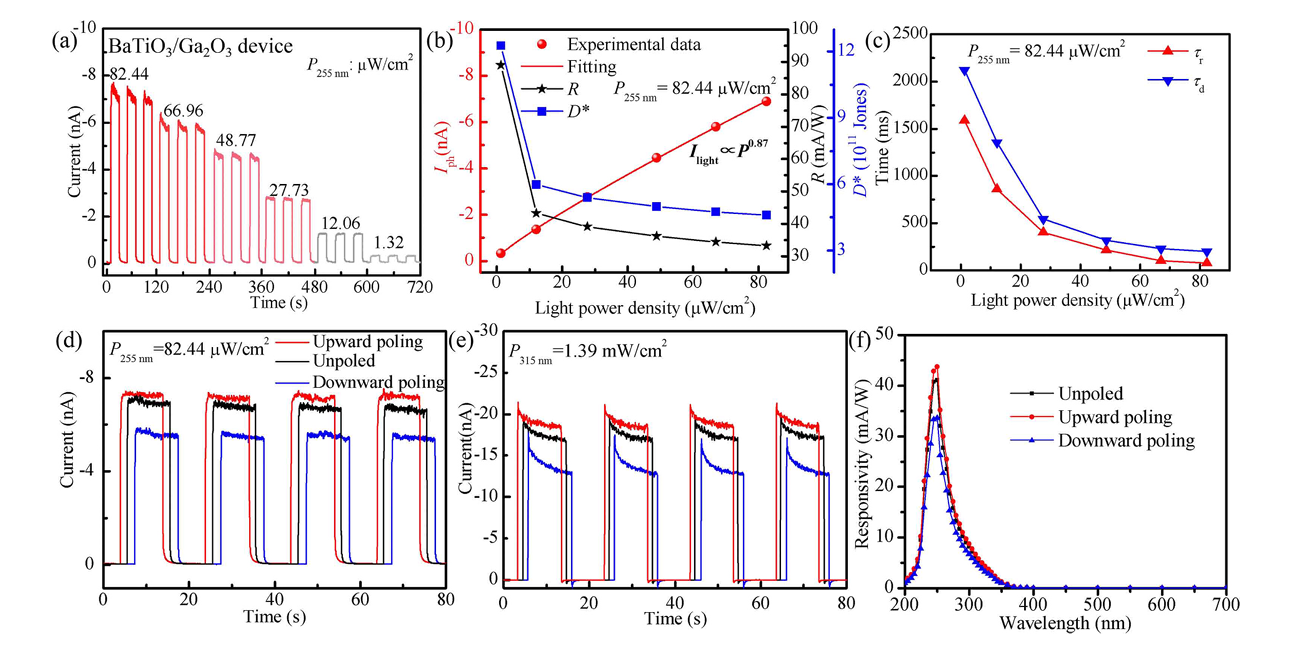
Fig. 5. (a) The light intensity-dependent photocurrent response of the BaTiO₃/Ga₂O₃ device, measured under 255 nm incident light. (b) Light intensity-dependent Iₚₕₒₜₒ, R, and D*, and (c) τᵣ/τd of the BaTiO₃/Ga₂O₃ device. The photocurrent responses of the BaTiO₃/Ga₂O₃ device in various poling states under illumination with (d) 255 nm and (e) 315 nm incident light. (f) Spectral responsivities of the BaTiO₃/Ga₂O₃ device in various poling states.
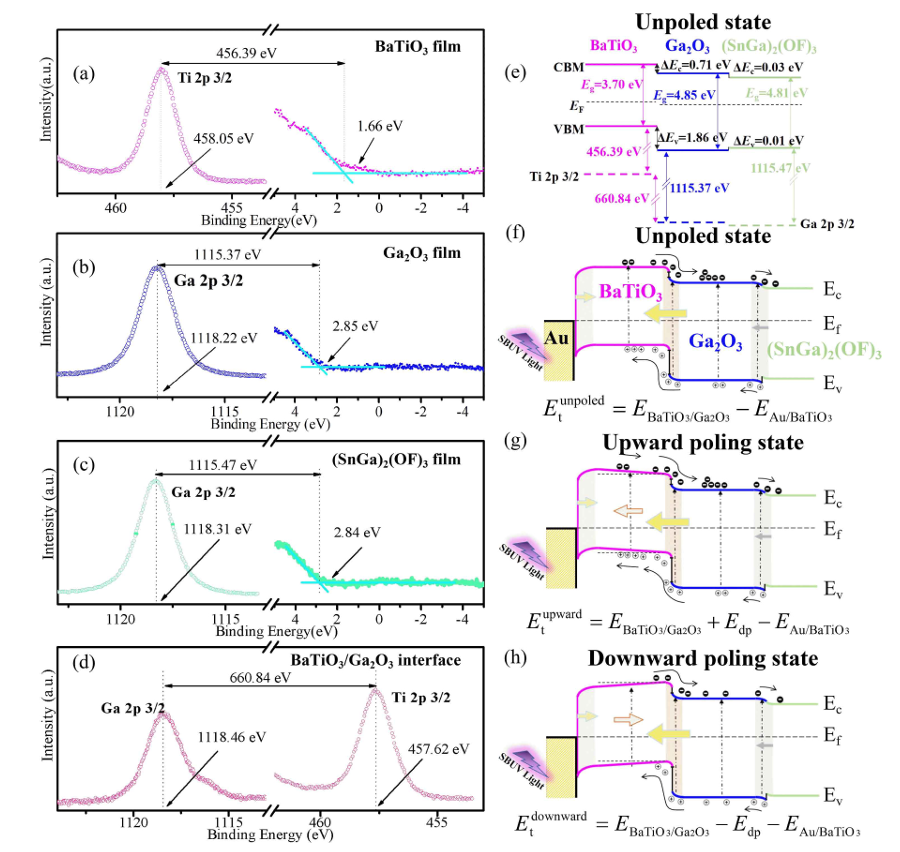
Fig. 6. (a) Ti 2p, (b) Ga 2p, and (c) Ga 2p core levels and valence band spectra of the BaTiO₃, Ga₂O₃, and (SnGa)₂(OF)₃ films. (d) Ga 2p and Ti 2p core levels at the BaTiO₃/Ga₂O₃ heterojunction interfaces. (e) Band alignment diagram of the BaTiO₃/Ga₂O₃/(SnGa)₂(OF)₃ multilayer film with the BaTiO₃ layer in the unpoled state. Schematic energy band diagrams of the BaTiO₃/Ga₂O₃ heterojunction device in (f) unpoled state, (g) upward poling state, and (h) downward poling state.
DOI:
doi.org/10.1016/j.jallcom.2025.184731



Instruction
Official Account

Cooperation
Top