


Researchers from the University of Texas at Austin have published a dissertation titled "High-Temperature Photoluminescence Study of MOCVD-Grown β-Ga2O3: Effects of Doping and Crystallinity" in ACS Applied Electronic Materials..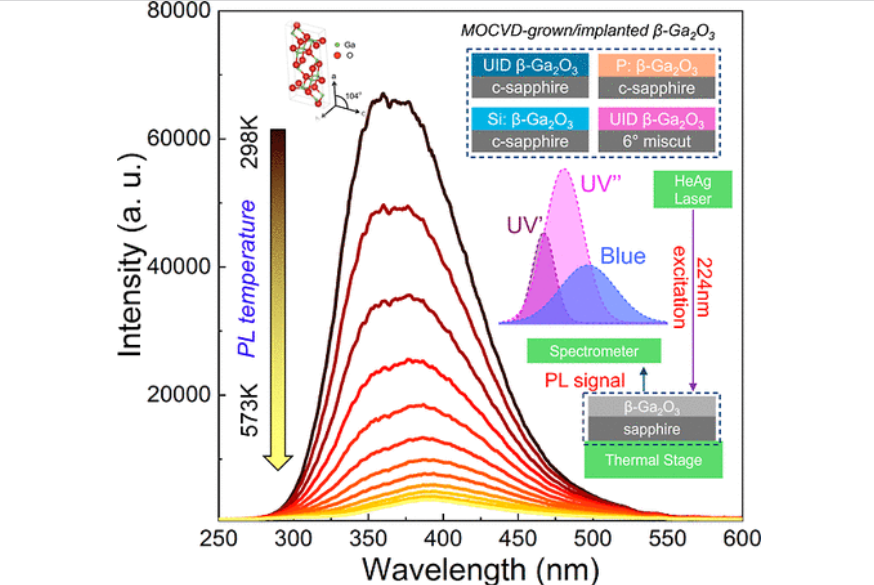
Abstract
β-Ga2O3 is a promising ultrawide-bandgap semiconductor for high-power electronics due to its large bandgap (∼4.9 eV), high breakdown field, and substrate availability. However, performance degradation at elevated temperatures remains a major hurdle. In this work, we present a comprehensive study of temperature-dependent photoluminescence (PL) of β-Ga2O3 grown by metalorganic chemical vapor deposition (MOCVD), focusing on the roles of silicon (Si) doping, postgrowth phosphorus (P) implantation, and crystallinity. Under 224 nm above-bandgap excitation from 298 to 573 K, we observe three dominant emission bands, UV′ (∼345 nm), UV″ (∼378 nm), and blue (∼435 nm), whose intensities and positions evolve distinctly depending on defect and impurity conditions. Si doping suppresses shallow defect emissions and induces a blueshift in the blue band at high temperature, suggesting defect reconfiguration. P-implantation further suppresses radiative recombination from shallow traps and alters the thermal stability of midgap defect states. Crystallinity, enhanced via high-temperature growth and substrate offcut, significantly improves the PL intensity and thermal robustness. These findings, representing the first quantitative correlation of doping, implantation, and crystallinity with PL thermal stability, offer key insights into defect evolution and provide guidelines for optimizing growth and doping strategies to improve the performance and reliability of β-Ga2O3 in high-temperature, high-power electronics.
DOI:
https://doi.org/10.1021/acsaelm.5c01835
Instruction
Official Account

Cooperation
Top