


Researchers from the Suzhou University of Science and Technology have published a dissertation titled " Fe-related defect-induced strong broadband two-photon absorption and nonlinear refraction transients in β-Ga2O3 for ultrafast all-optical switching" in Applied Physics Letters.
Project Support
This work was supported by the National Natural Science Foundation of China (Nos. 11704273 and 12374300), the Natural Science Foundation of Jiangsu Province (No. BK20221384), the Jiangsu Key Disciplines of the 14th Five-Year Plan (No. 2021135), the Natural Science Foundation of Guizhou Province Science and Technology Agency (Nos. ZK[2023]049 and ZK[2025]098), and the Qing-Lan Project of Jiangsu Province (No. SZ2022002).
Background
The ultrawide-bandgap semiconductor β-Ga₂O₃ has attracted increasing attention in power electronics and photodetectors owing to its wide bandgap (~4.9 eV), high breakdown field (8 MV/cm), and broad optical transparency from the UV to visible region. Its large Kerr nonlinear refractive index makes it a promising material for all-optical switching. In the UV–visible range, nonlinear processes such as two-photon absorption (TPA) and Kerr refraction govern optical behavior, yet carrier-related nonlinearities remain insufficiently understood. The anisotropic crystal structure of β-Ga₂O₃ leads to polarization-dependent nonlinear responses, and carrier relaxation times extending to hundreds of picoseconds suggest complex carrier dynamics. However, its intrinsic nonlinear coefficient is relatively low, motivating doping strategies to enhance nonlinear responses. Fe doping, in particular, can introduce defect states that modulate both bound-electron and free-carrier effects, thereby extending nonlinear absorption into the visible region. Understanding these defect-state–assisted mechanisms is essential for optimizing β-Ga₂O₃-based all-optical devices.
Abstract
Investigating the broadband nonlinear optical response and related dynamic mechanisms in the wide-bandgap semiconductor gallium oxide is crucial for ultrafast photonic applications. In this study, transient absorption spectroscopy was used to probe the metal-doping effect on the bound-electron nonlinear optical response. Fe doping was found to significantly enhance the nondegenerate two-photon absorption, a remarkably large imaginary component of the figure of merit, indicating potential applications for nonlinear absorption-based all-optical switching. Analysis of the optical polarization dependence of carrier absorption, combined with carrier-induced nonlinear refractive effect, demonstrated that Fe doping modulates the carrier lifetime and enables the transformation of phase symbols, establishing mechanisms for the implementation of dual-channel optical switching. An energy-level model based on photoluminescence elucidates the nonlinear optical modulation mechanism of Fe-related defect states on bound electrons and carriers. This study serves as a valuable reference for the design of gallium-oxide-based waveguides and all-optical switching materials.
Conclusion
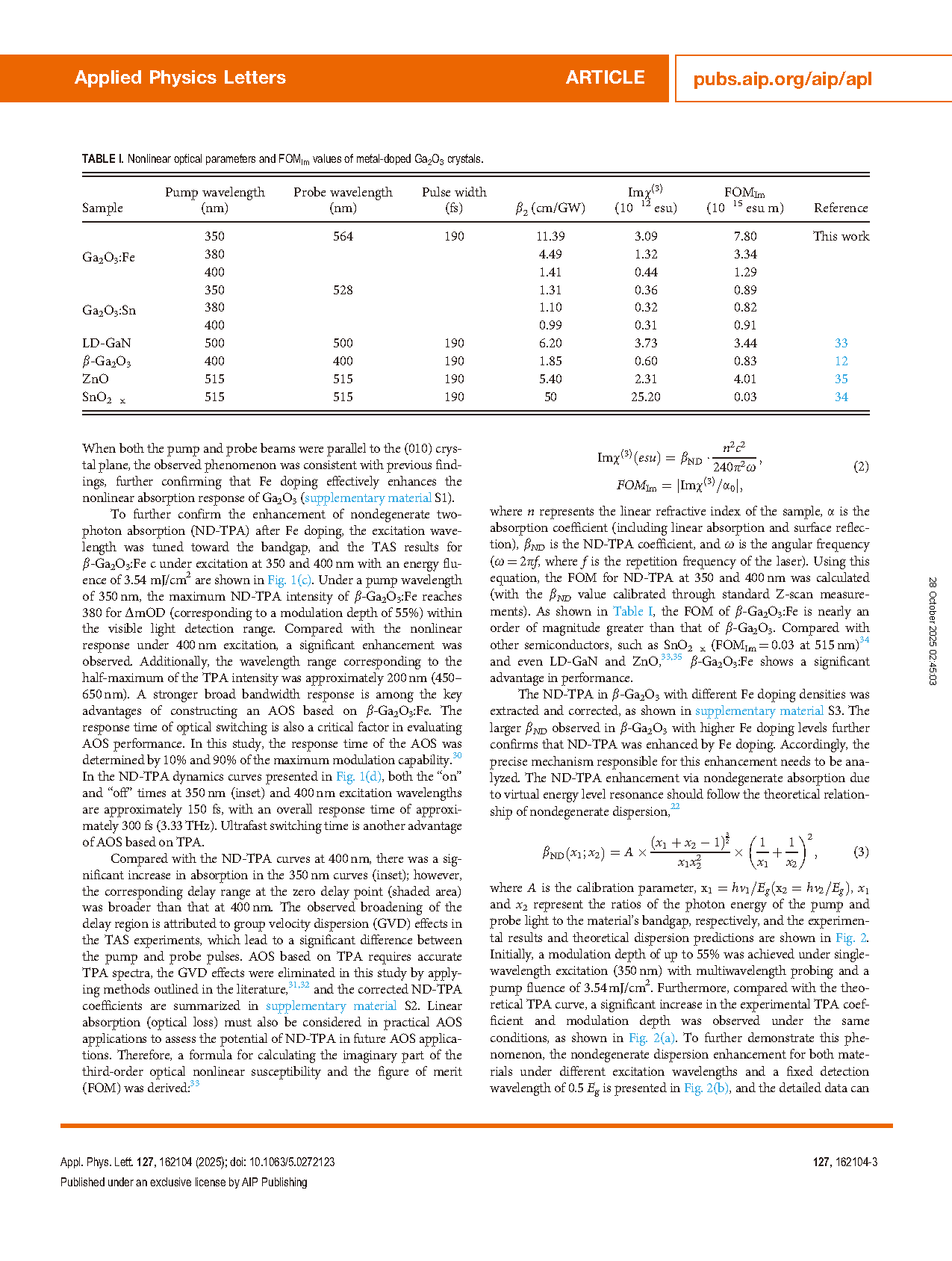
In summary, we employed transient absorption spectroscopy (TAS) to demonstrate that under different polarization conditions and excitation wavelengths, Fe doping can increase the nondegenerate two-photon absorption (ND-TPA) by up to an order of magnitude in β-Ga₂O₃ crystals. Under an excitation wavelength of 350 nm and a pump fluence of 3.54 mJ/cm², a modulation depth of approximately 55% and a response time of 300 fs were achieved within the visible broadband detection range. The imaginary part of the figure of merit (FOM) based on ND-TPA was calculated to be as high as 7.8 × 10⁻¹⁵ esu·m. Notably, polarization-resolved (PO) pump–probe experiments further confirmed that Fe-related defects effectively regulate carrier refraction, and phase sign reversal was observed, laying the groundwork for dual-channel optical switching applications. The established Fe-related energy-level model reveals that the resonant enhancement of ND-TPA is facilitated by the FeGa(-/0) energy levels, while the red emissions are attributed to Cr³⁺ transitions (2E→4A2). This study elucidates the mechanisms by which Fe defects modulate both bound-electron dynamics and carrier processes, providing valuable insights for the development of advanced all-optical switching (AOS) devices.

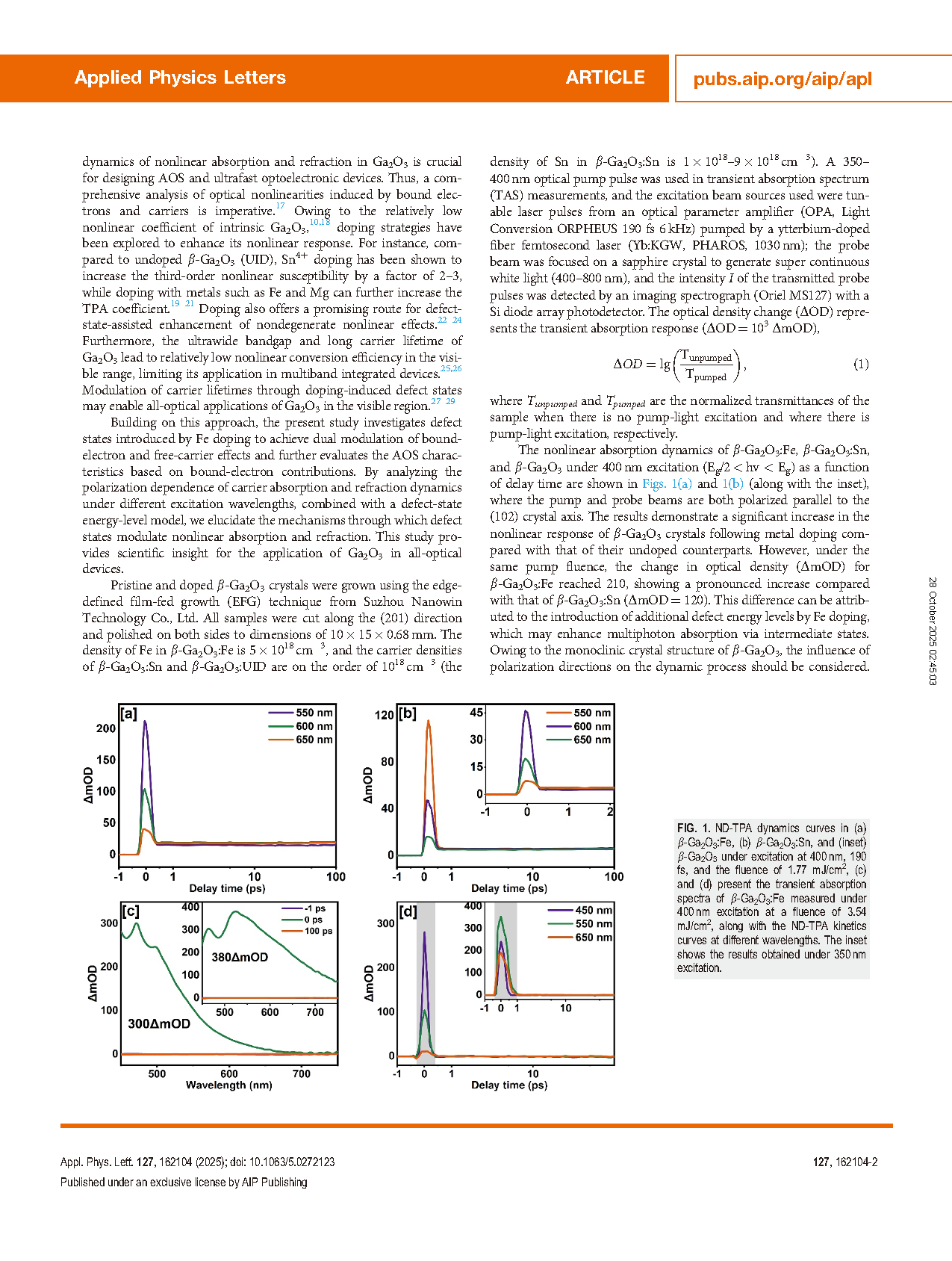
FIG. 1. ND-TPA dynamics curves in (a) β-Ga2O3:Fe, (b) β-Ga2O3:Sn, and (inset) β-Ga2O3 under excitation at 400 nm, 190 fs, and the fluence of 1.77 mJ/cm2 , (c) and (d) present the transient absorption spectra of β-Ga2O3:Fe measured under 400 nm excitation at a fluence of 3.54 mJ/cm2, along with the ND-TPA kinetics curves at different wavelengths. The inset shows the results obtained under 350 nm excitation.
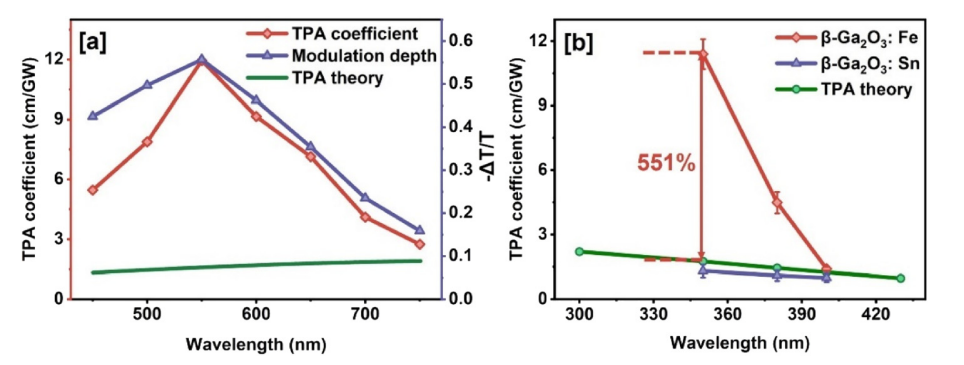
FIG. 2. (a) The corrected TPA coefficient and modulation depth of β-Ga2O3:Fe exhibit an increasing trend as the detection wavelength shifts under 350 nm excitation, (b) the experimental ND-TPA dispersion relations for β-Ga2O3:Fe and β-Ga2O3:Sn, and the TPA theory line represents the nondegenerate dispersion theoretical curve.
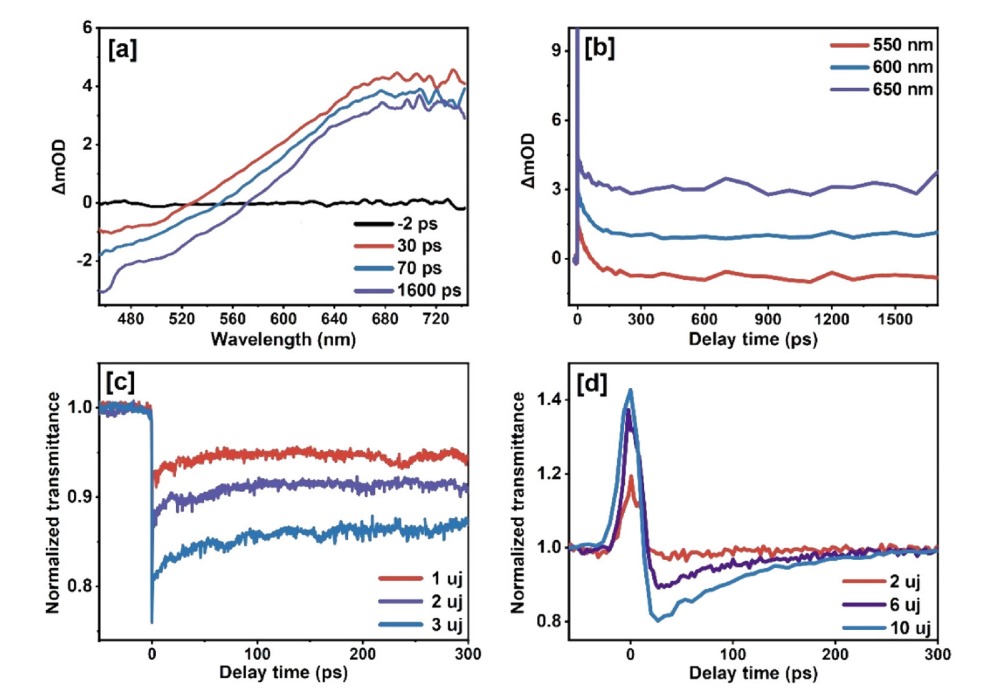
FIG. 3. Under 400 nm excitation, (a) and (b) display the dependence of charge carrier absorption on the delay time and the charge carrier dynamics of the β-Ga2O3:Fe crystal, and (c) and (d) show the nonlinear refraction dynamics curves of the β-Ga2O3:Fe crystal, measured at a probe wavelength of 515 nm under pump excitation at 380 and 532 nm, respectively.

FIG. 4. Energy-level model for Fe-related defect states in β-Ga2O3:Fe, TE:energy transfer.
DOI:
doi.org/10.1063/5.0272123


Instruction
Official Account

Cooperation
Top