


Researchers from the Xiamen University and Shanghai Institute of Optics and Fine Mechanics have published a dissertation titled "Impact of Deep Levels in Iron-Doped Gallium Oxides on Electron Transport" in Journal of Physical Chemistry C.
Project Support
The authors acknowledge funding support from the National Natural Science Foundation of China (grant nos. 22473093, 22403078, and 22175154), the Fundamental Research Funds for the Central Universities (grant no. 20720240150), the China Postdoctoral Science Foundation (grant no. 2024M751767), and the Shenzhen Science and Technology Program (grant no. JCYJ20220530143016036).
Background
The monoclinic gallium oxide (β-Ga2O3) is garnering intense research interest due to its promising application in power electronics, solar-blind ultraviolet photodetection, and deep ultraviolet optoelectronics. Owing to the ultrawide bandgap (Eg∼ 4.8 eV) and high theoretical breakdown field, the Baliga figure of merit of β-Ga2O3 surpasses those of its rival materials (such as Si, SiC, and GaN) rendering it ideal for high-voltage power electronics. Like other semiconductors, the electronic properties of β-Ga2O3 can be tailored for device fabrication by controlled doping. Iron (Fe) doping in β-Ga2O3 is particularly notable. As a transition metal with multiple oxidation states (Fe2+/Fe3+), Fe introduces deep acceptor levels that compensate intrinsic n-type conductivity and thus Fe-doped Ga2O3 typically serves as a semi-insulating substrate for epitaxial thin film growth and device fabrication (i.e., lateral MOSFETs and solar-blind ultraviolet photodetectors)
Abstract
Iron-doped gallium oxide (Ga2O3) is extensively exploited as semi-insulating substrates for epitaxial thin film growth to fabricate next-generation high-power electronics and ultraviolet optoelectronics. However, the influence of iron (Fe) dopants on electron transport dynamics remains poorly understood, particularly in the context of defect-mediated scattering and trapping mechanisms. Here, we employ time-resolved terahertz (THz) spectroscopy to investigate the temperature-dependent photoconductivity and free electron dynamics in Fe-doped Ga2O3 crystals. The frequency-dependent THz conductivities demonstrate dispersive charge transport dominated by heterogeneous scattering, modeled effectively by the Drude–Smith formulizm. The temperature dependence of both electron mobility and electron scattering time indicates a transition from phonon-dominated scattering to a defect-mediated scattering mechanism. Moreover, the kinetics of transient photoconductivity further uncover that the free electrons collapse into a highly localized state fostered by Fe3+ dopants on a sub-100 ps timescale. Nevertheless, this trapping process is suppressed at low temperature because the itinerant electrons are trapped at the shallow defects before encountering deep centers associated with the Fe3+ dopant. Our results offer a fundamental understanding of the microscopic electron transport mechanism in Fe-doped Ga2O3 crystals.
Conclusion
In summary, the influences of intrinsic shallow defects and extrinsic dopant on the electron transport are both assessed by measuring the temperature-dependent photoconductivity using time-resolved THz spectroscopy. The shallow defects can greatly suppress the electron mobility, whereas the deep levels fostered by the Fe3+ dopant lead to severe electron localization. The free electron lifetime in the Fe-doped Ga2O3 crystals depends on the probability that electrons encounter the Fe3+ dopants. In other words, a high Fe doping level could lead to a short electron diffusion length because of its short lifetime. Our results provide quantitative information about the interplay between Fe3+ dopants and free electron dynamics, which is of importance particularly for the development of the Ga2O3 optoelectronic devices.
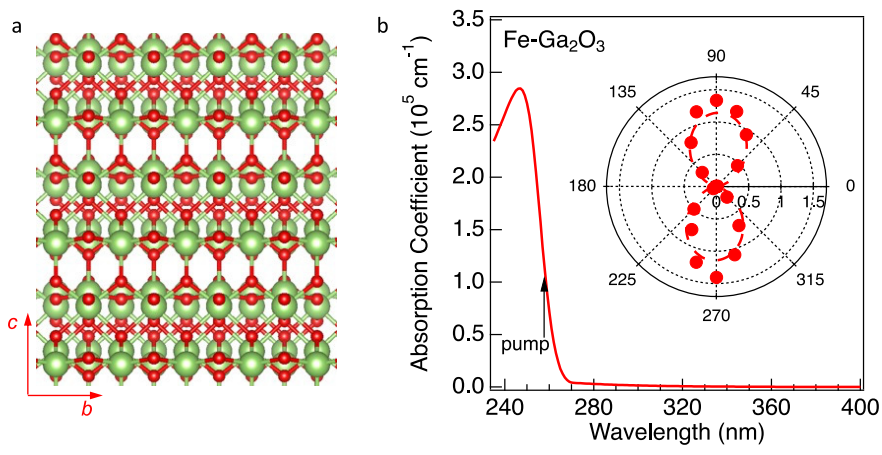
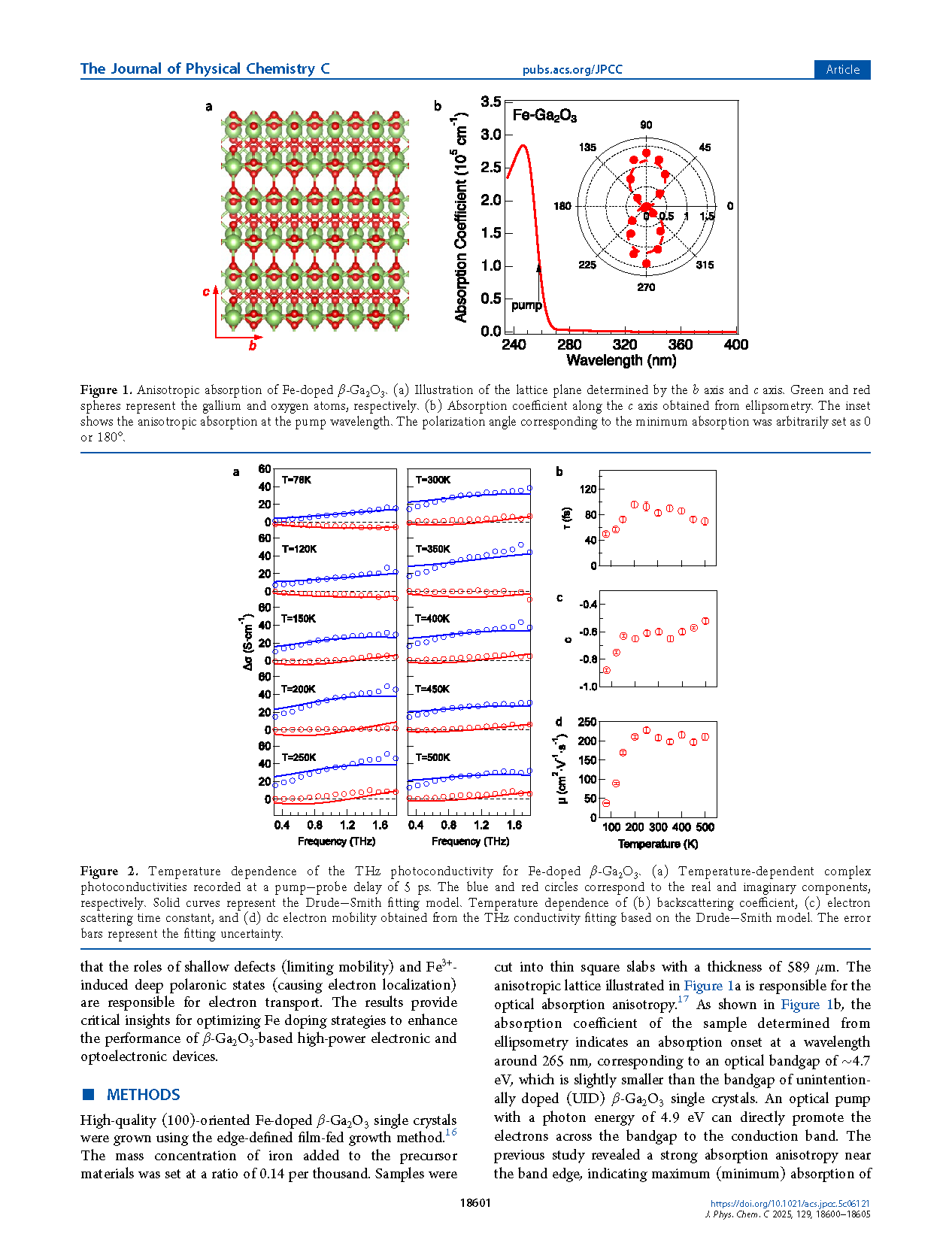
Figure 1. Anisotropic absorption of Fe-doped β-Ga2O3. (a) Illustration of the lattice plane determined by the b axis and c axis. Green and red spheres represent the gallium and oxygen atoms, respectively. (b) Absorption coefficient along the c axis obtained from ellipsometry. The inset shows the anisotropic absorption at the pump wavelength. The polarization angle corresponding to the minimum absorption was arbitrarily set as 0 or 180°.
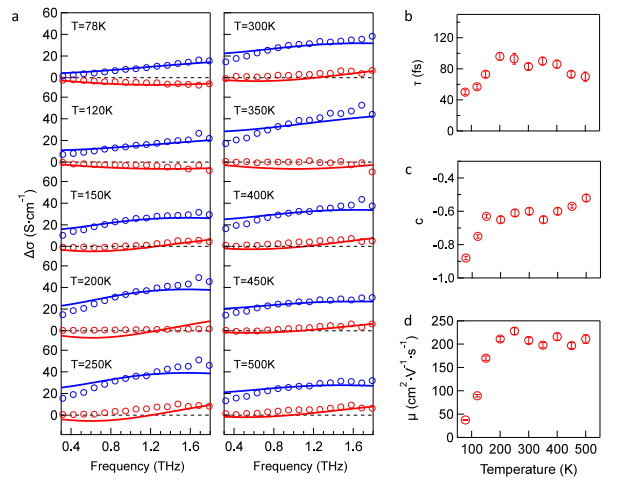
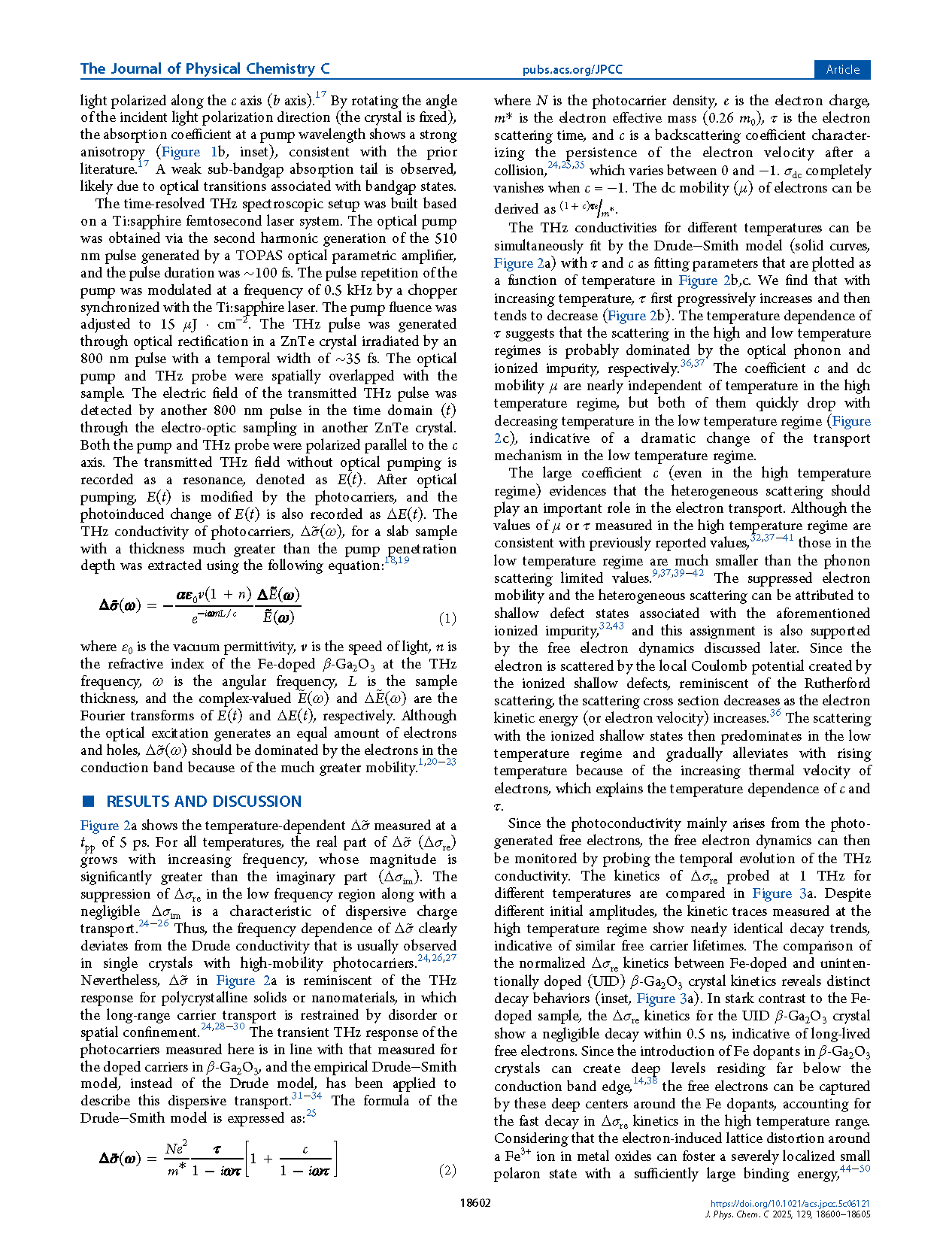
Figure 2. Temperature dependence of the THz photoconductivity for Fe-doped β-Ga2O3. (a) Temperature-dependent complex photoconductivities recorded at a pump−probe delay of 5 ps. The blue and red circles correspond to the real and imaginary components, respectively. Solid curves represent the Drude−Smith fitting model. Temperature dependence of (b) backscattering coefficient, (c) electron scattering time constant, and (d) dc electron mobility obtained from the THz conductivity fitting based on the Drude−Smith model. The error bars represent the fitting uncertainty.
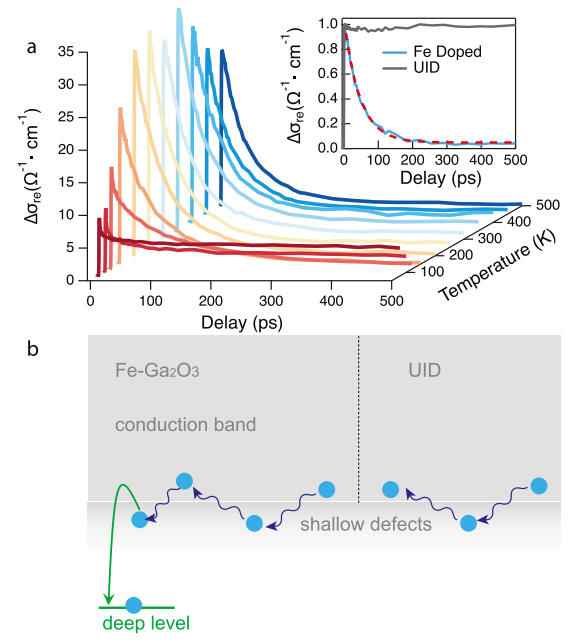
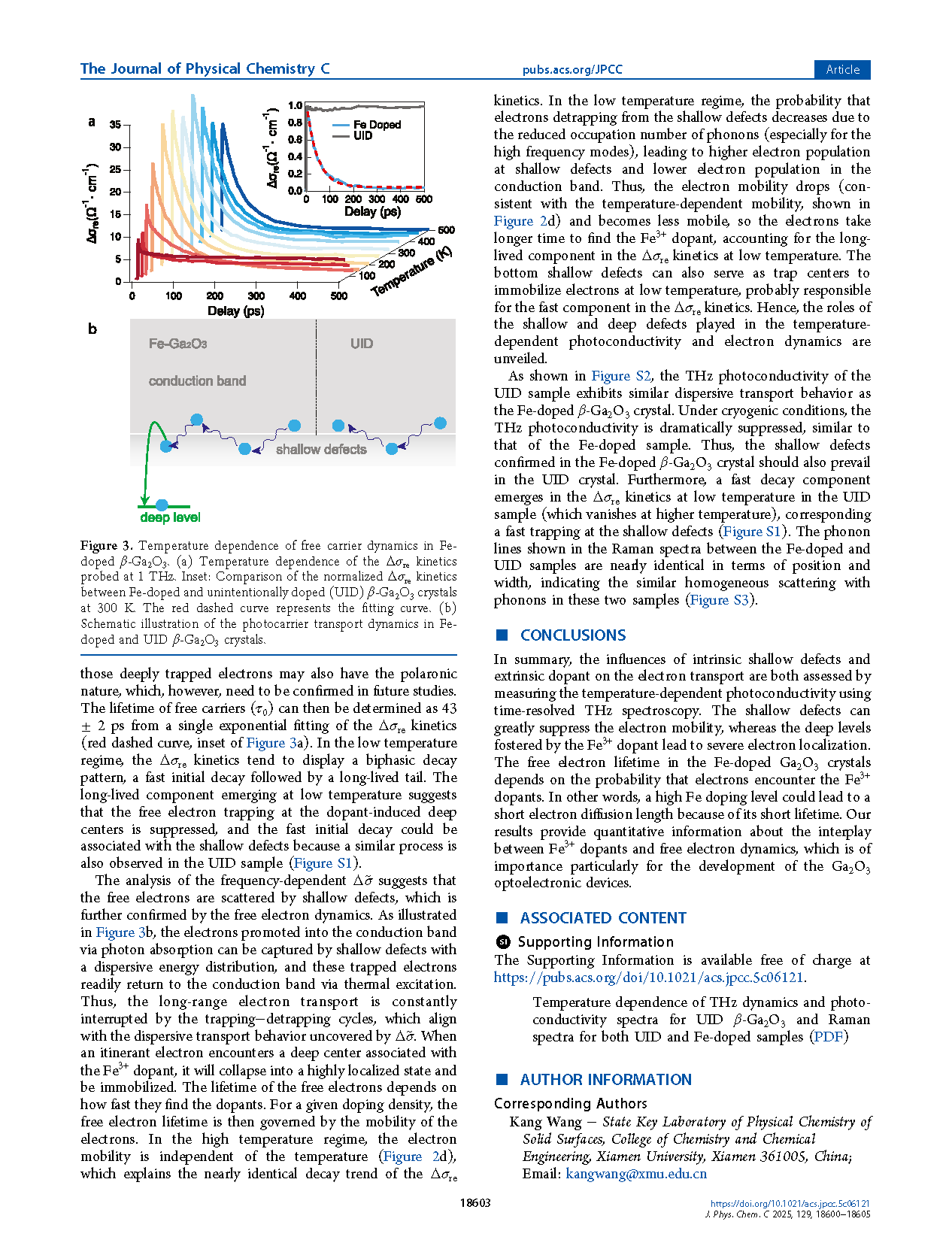
Figure 3. Temperature dependence of free carrier dynamics in Fe-doped β-Ga2O3. (a) Temperature dependence of the Δσre kinetics probed at 1 THz. Inset: Comparison of the normalized Δσre kinetics between Fe-doped and unintentionally doped (UID) β-Ga2O3 crystals at 300 K. The red dashed curve represents the fitting curve. (b) Schematic illustration of the photocarrier transport dynamics in Fe-doped and UID β-Ga2O3 crystals.
DOI:
doi.org/10.1021/acs.jpcc.5c06121

Instruction
Official Account

Cooperation
Top