


Researchers from the Peking University have published a dissertation titled "Ga2O3 Optoelectronic Array with Solar-Blind Ultraviolet Perception for Neuron Spatiotemporal Integration and Forgetting-Enabled Neuromorphic Computing" in ACS Applied Materials & Interfaces.
Project Support
This study was supported by the Shenzhen Scientific and Technological Foundation (RCYX20231211090332037, JCYJ20220531093210023, JCYJ20240813160211015), the National Natural Science Foundation of China (Nos. 62474008, 62204007), and the Guangdong Provincial Natural Science Foundation (No. 2024A1515030044), and was in part supported by Guangdong Provincial Key Laboratory of In-Memory Computing Chips (2024B1212020002), Shenzhen POC center of Flexible Electronics and Guangdong Technology Center for Oxide Semiconductor Devices and ICs.
Background
Bioinspired electronics aim to use electronic devices to mimic the functions of living systems, providing a new paradigm and hardware support for information perception, data storage, and processing. Among these, neuromorphic vision sensing systems inspired by biological vision can integrate the perception, storage, and computation of light signals, thus attracting wide attention. In the human visual system, the retina, as part of the central nervous system, exhibits a complex neural circuitry in which photosensitive neurons in the retina can sense light signals and convert them into nerve signals to transmit to other neurons via axons. In this process, synapses not only act as connections between neurons but also can change their weight under different stimulus conditions, controlling the perception, memory, and computation of light signals by retinal neurons. Therefore, optoelectronic neuromorphic devices that can achieve synaptic plasticity under light stimulation are the core components of neuromorphic vision sensing systems. Moreover, due to the use of light signals for modulation, optoelectronic neuromorphic devices have advantages such as expansive bandwidth, low crosstalk, high computational speed, and high energy efficiency.
Abstract
Optoelectronic neuromorphic devices capable of perceiving and memorizing light signals are essential for constructing artificial vision systems. While oxide-semiconductor-based optoelectronic devices are valued for their stable performance and mature fabrication processes, they primarily operate in the near-ultraviolet to near-infrared spectral range, lacking sensitivity to the solar-blind region (<280 nm), which offers extremely low background noise and enhanced signal-to-noise ratios. Herein, this study presents an optoelectronic neuromorphic device array based on wide-bandgap Ga2O3, designed to perceive optical signals in the solar-blind region. Stimulated by a 254 nm light pulse, the device emulates biological visual synaptic plasticity and exhibits tunable relaxation characteristics of postsynaptic current under varying stimuli. Notably, the device array replicates the spatiotemporal integration and processing of signals from multiple preneurons via dendritic structures, demonstrating its potential for implementing advanced neuromorphic computing, including the perception and memory of solar-blind ultraviolet images during learning processes. Moreover, leveraging the tunable relaxation properties of Ga2O3 devices, a forgetting-based artificial neural network is developed to address multisolution problems in complex equations with ultralow power consumption. These findings not only establish an optoelectronic neuromorphic system capable of perceiving solar-blind signals but also broaden its potential applications in low-power computing and intelligent sensing.
Conclusion
In conclusion, this work demonstrated a solar-blind ultraviolet a-Ga2O3 optoelectronic neuromorphic array capable of emulating dendritic integration among multiple neurons in the human retina. The individual neuromorphic device exhibits tunable synaptic plasticity, controlled via bias voltage and light pulse parameters, enabling the perception, memory, and processing of solar-blind ultraviolet image information. Moreover, a brain-inspired forgetting algorithm was developed, combined with the device’s adjustable relaxation characteristics, to address multisolution problems in complex equations, achieving seamless integration of perception, memory, and neuromorphic computation. This work establishes a robust hardware and algorithmic framework for advancing artificial vision systems that operate in the solar-blind ultraviolet spectrum. Future efforts will focus on developing large-scale small-line-width a-Ga2O3 neuromorphic hardware integrated with advanced neural network algorithms to further enhance the performance and capabilities of optoelectronic neuromorphic computation.
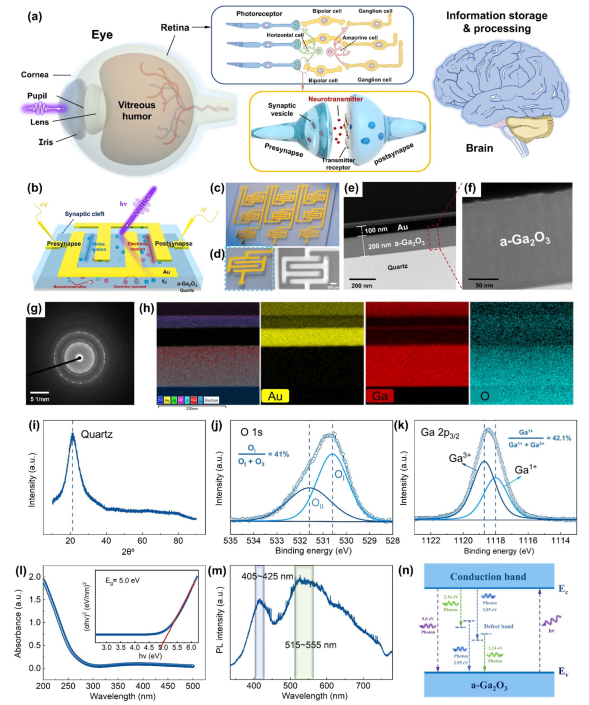
Figure 1. Design and structure of a-Ga2O3 optoelectronic neuromorphic device. (a) Schematic diagram of the human visual system and retinal neurons. (b) Schematic diagram of the a-Ga2O3 optoelectronic neuromorphic device. (c) Optical microscope image of the 3 × 3 a-Ga2O3 optoelectronic neuromorphic array. (d) Optical microscope (left) and SEM (right) images of one a-Ga2O3 device in array. (e) TEM image of the device. (f) Zoomed-in view of the a-Ga2O3 region. (g) Diffraction pattern extracted from (f). (h) EDS maps of the device. (i) XRD pattern of the a-Ga2O3 thin film. (j) O 1s and (k) Ga 2p3/2 spectra of the a-Ga2O3 thin film. (l) Absorbance spectrum of the a-Ga2O3 thin film and the plot of (αhν)2 versus hν for the sample in inset. (m) PL spectra of a-Ga2O3 thin film. (n) Mechanism model of PL of a-Ga2O3thin film in green and blue regions.
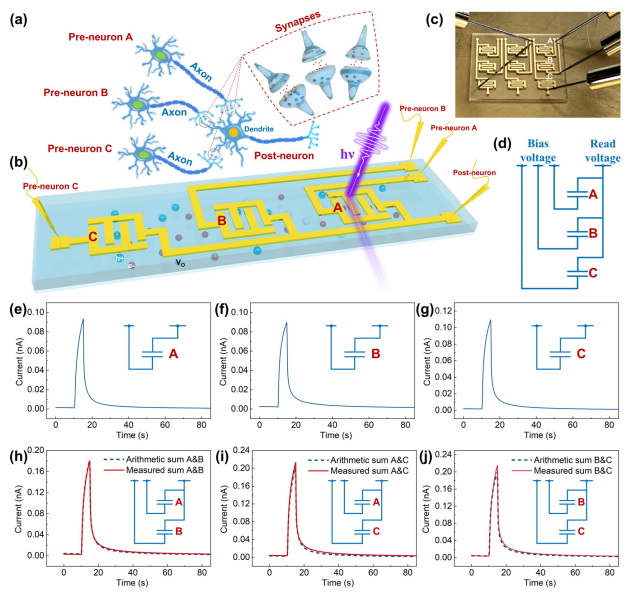
Figure 2. Emulation of the connections between multiple neurons. (a) Schematic diagram of a neuron connected to multiple neurons through a dendrite. (b) Connections between devices in the array. (c) Photograph of the neuromorphic array under testing. (d) Symbol diagram of three neurons interconnected in the array. PSC response output of (e) neuron A, (f) neuron B, and (g) neuron C to a single light pulse (254 nm, 5 s). Relationship between the arithmetic sum of the output and the measured sum of the output when (h) neuron A and neuron B, (i) neuron A and neuron C, and (j) neuron B and neuron C are simultaneously stimulated by a single light pulse (254 nm, 5 s).
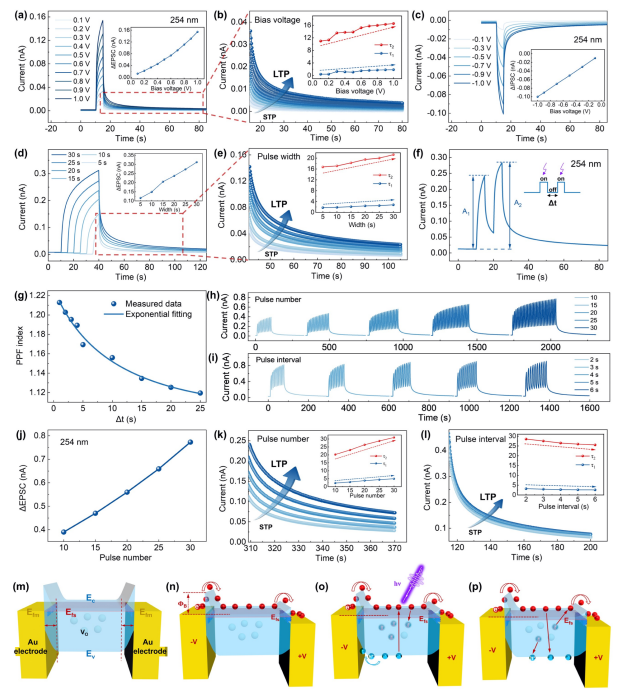
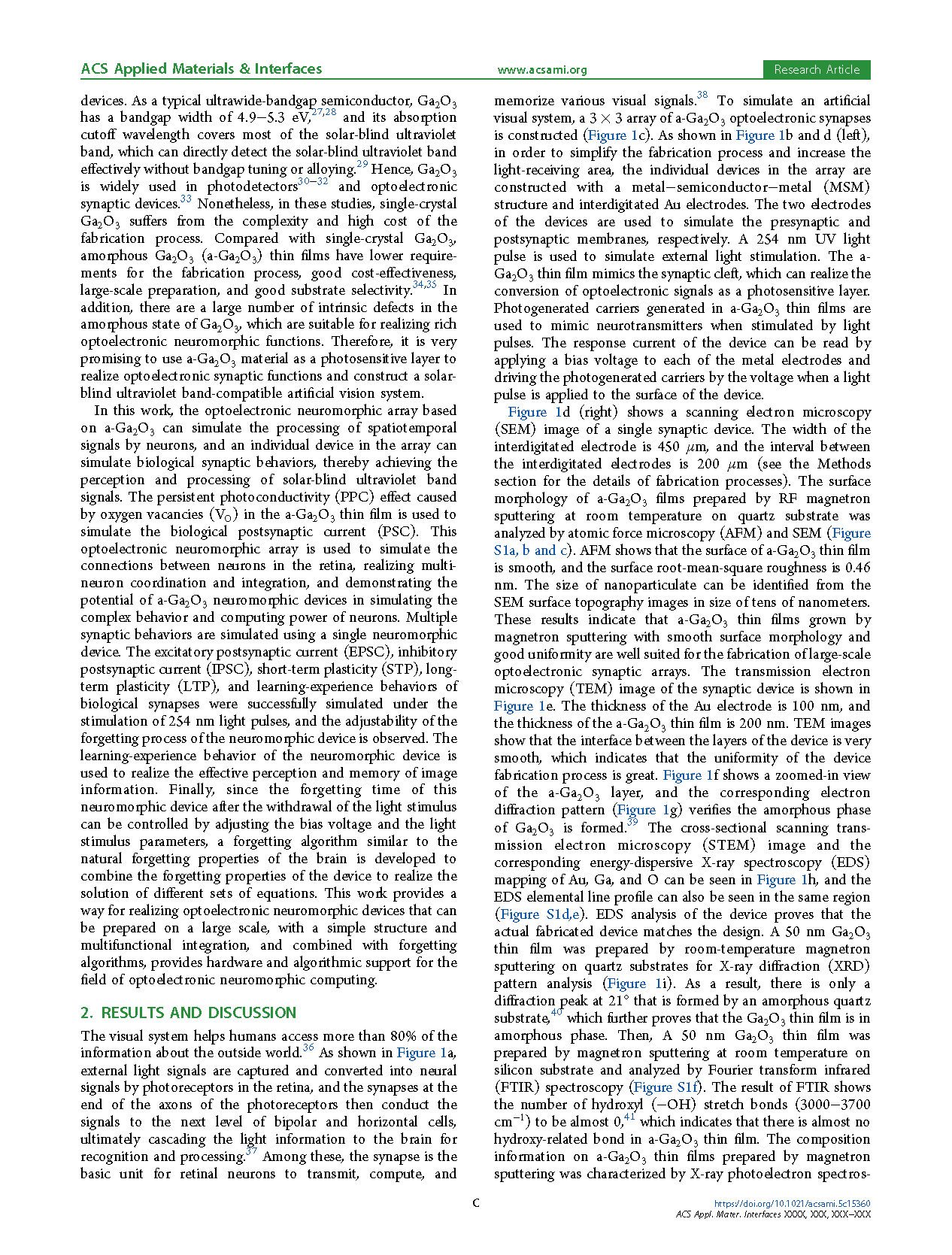
Figure 3. Synaptic behavior of the device under light pulse stimulation. (a) EPSC response of the device to a single light pulse (254 nm, 5 s) with different bias voltages. The inset shows the relationship between the peak of EPSC and bias voltage. (b) Transition from STP to LTP behavior by bias voltage. The inset shows the relationship between the time constants τ1 and τ2 with bias voltage. (c) IPSC response of the device to a single light pulse (254 nm, 5 s) with different bias voltages. The inset shows the relationship between the peak of IPSC and bias voltage. (d) EPSC response of the device to a single light pulse (254 nm) with different pulse widths. The inset shows the relationship between the peak of EPSC and light pulse width. (e) Transition from STP to LTP behavior by light pulse width. The inset shows the relationship between the time constants τ1 and τ2 with light pulse width. (f) EPSC triggered by a pair of light pulses with a time interval (Δt) of 5 s and a pulse width of 5 s. (g) PPF index variation as a function of Δt. (h) EPSC response of the device to a light pulse sequence (254 nm, 5 s) with different light pulse numbers. (i) EPSC response of the device to a light pulse sequence (254 nm) with different light pulse intervals. (j) Relationship between the peak of EPSC and light pulse number. (k) Transition from STP to LTP behavior by light pulse number. The inset shows the relationship between the time constants τ1 and τ2 with light pulse number. (l) Transition from STP to LTP behavior by the pulse interval of the light pulse sequence. The inset shows the relationship between the time constants τ1 and τ2 with the interval of the light pulse sequence. (m) Energy band diagram of the device after contact between Au and a-Ga2O3 in dark conditions. (n) Energy band diagram of the device after applying bias voltage to the electrodes in dark conditions. (o) Energy band diagram of the device under light illumination and bias voltage. (p) Energy band diagram of the device under bias voltage when returning to dark conditions after removing the light illumination.
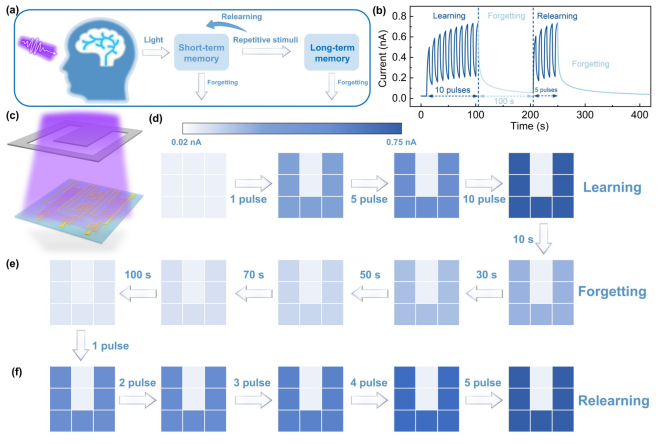
Figure 4. Emulation of learning-experience behavior to achieve image memory function. (a) Schematic diagram of the transition from short-term memory to long-term memory in the human brain. (b) “Learning-experience” behavior of the device, including learning, forgetting, and relearning processes. (c) Schematic diagram of light passing through a U-shaped metal mask and illuminating the array. (d) Photoresponse image mapping during the first learning process. (e) Photoresponse image mapping during the first forgetting process. (f) Photoresponse image mapping during the relearning process.
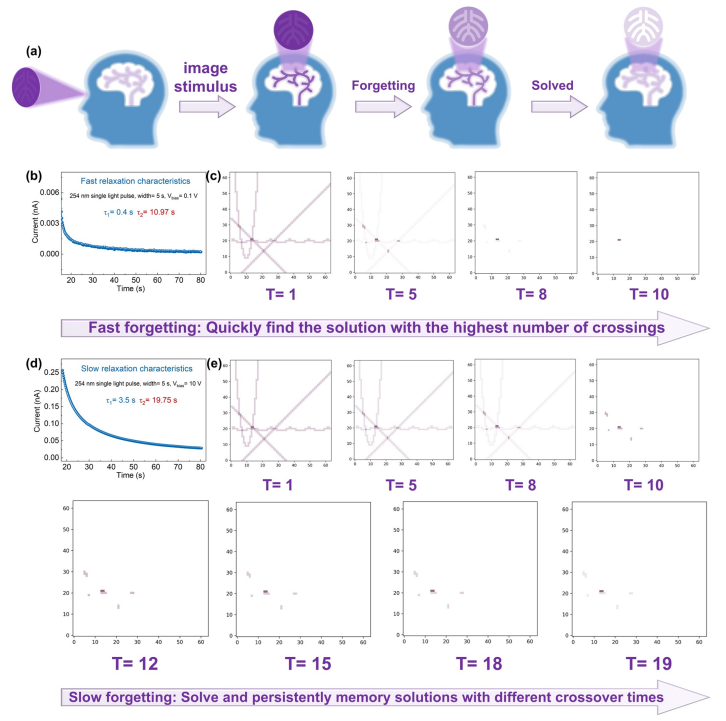
Figure 5. Brain-inspired forgetting-based algorithms for solving systems of equations based on different forgetting characteristics of device. (a) The perception and forgetting of images by the human visual system, including the stimulation of light signals, the perception and initialization of the image, the forgetting process (gradually forming contrasts), and the generation of the target image. (b) Forgetting curve of the device under single light pulse stimulation of 254 nm and a bias voltage of 0.1 V. (c) Based on the fast forgetting process of the device, combined with the forgetting-based algorithm to solve the dynamic process of the system of equations. (d) Forgetting curve of the device under single light pulse stimulation of 254 nm and a bias voltage of 10 V. (e) Based on the slow forgetting process of the device, combined with the forgetting-based algorithm to solve the dynamic process of the system of equations.
DOI:
doi.org/10.1021/acsami.5c15360




Instruction
Official Account

Cooperation
Top