


Researchers from the Xidian University have published a dissertation titled "High-Temperature Robust β-Ga₂O₃ Phototransistors on Sapphire with Record Detectivity for Solar-Blind UV Detection" in 2026 10th IEEE Electron Devices Technology & Manufacturing Conference (EDTM).
Background
Solar-blind ultraviolet (UV) photodetectors (SBPDs) operating in the UVC region (200-280 nm) are highly attractive for flame monitoring, missile tracking, biochemical sensing, and secure communications due to the natural atmospheric cut-off of solar radiation. Among various wide-bandgap semiconductors, β-phase gallium oxide (β-Ga₂O₃) is considered an ideal candidate owing to its ultra-wide bandgap (4.6-4.9 eV), high thermal and chemical stability, and strong radiation hardness.
Compared with conventional two-terminal photodetectors, β-Ga₂O₃ phototransistors offer active gate control, suppressed dark current, and high sensitivity, making them promising for weak-light detection. However, the use of expensive β-Ga₂O₃ native substrates and their low thermal conductivity limit large-scale integration and high-temperature operation. Heteroepitaxial growth on foreign substrates provides a cost-effective solution, among which sapphire is particularly attractive due to its wide availability, relatively high thermal conductivity, and electrical insulation.
Abstract
We report heteroepitaxial β-Ga₂O₃ phototransistors grown on sapphire substrates via MOCVD, exhibiting a high responsivity (R) of 9.0 × 10⁵ A/W and detectivity (D*) of 2.7 × 10¹⁹ Jones under 254 nm illumination. Although photocurrent decreases with increasing temperature due to enhanced carrier scattering and recombination, the devices maintain high performance with a R 3.0 × 10⁴ A/W and D* of 2.6 × 10¹⁷ Jones at 200 °C. The temperature robustness is attributed to the combination of an electrically insulating sapphire substrate that suppresses parasitic conduction and a high-quality β-Ga₂O₃ channel with strong gate control, collectively maintaining an ultralow dark current over 25-200 °C. These results highlight the strong potential of phototransistors for weak-light solar-blind UV detection in harsh environments.
Conclusion
Heteroepitaxial β-Ga₂O₃ phototransistors on sapphire demonstrate outstanding responsivity and detectivity enabled high epitaxial quality and suppressed dark current. Importantly, the devices sustain high photodetection performance up to 200 °C, maintaining responsivity of 3.0 × 10⁴ A/W and detectivity of 2.6 × 10¹⁷ Jones. These results establish β-Ga₂O₃ phototransistors on sapphire as promising candidates for solar-blind UV detection under extreme environmental conditions.
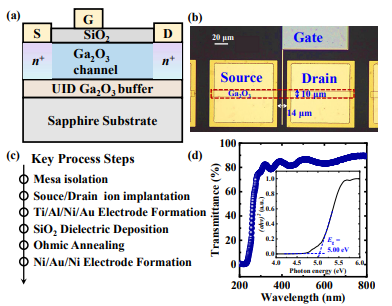
Fig. 1 (a) Schematic and (b) optical microscope images of the β-Ga2O3 solar-blind phototransistors. (c) Key process steps of the fabricated device. (d) Transmittance spectrum of the β-Ga2O3 epitaxial film.
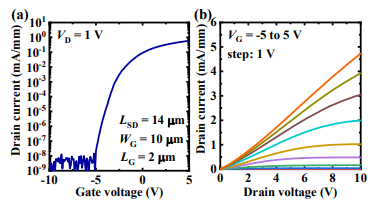
Fig. 2 (a) Transfer and (b) output curves of the β-Ga2O3 solar-blind phototransistors.
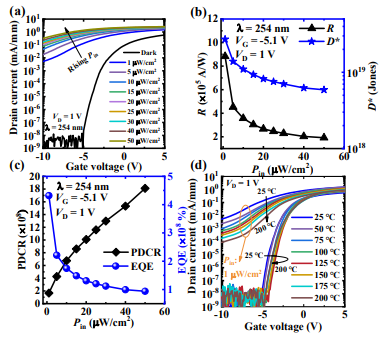
Fig. 3 (a) Transfer characteristics of the phototransistor under illumination of 254 nm with various light intensities. The dependences of (b) R and D*, (c) PDCR and EQE on the light power density. (d) The transfer curves of β-Ga2O3 phototransistors under dark and illumination of 1 μW/cm2 at a variety of temperature ranging from 25 °C to 200 °C.
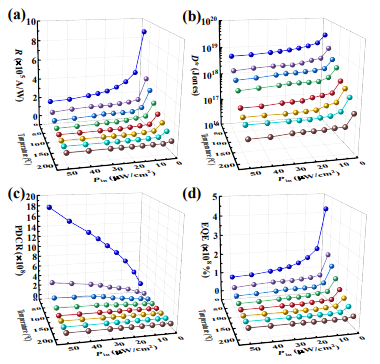
Fig. 4 The dependences of (a) R, (b) D*, (c) PDCR, (d) EQE of the β-Ga2O3 phototransistors on the light power density and temperature.
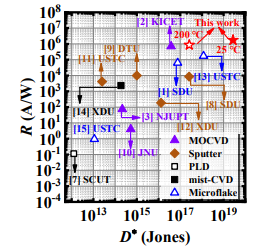
Fig. 5 Benchmarking R and D* of this work with the values of reported β-Ga2O3 phototransistors.
DOI:
doi.org/10.1038/s41524-026-02022-z
Instruction
Official Account

Cooperation
Top