


Background and Highlights
Solar radiation contains a significant amount of ultraviolet (UV) light. However, ozone in the Earth’s stratosphere strongly absorbs ultraviolet radiation within the 200–280 nm wavelength range, thereby creating a natural “solar-blind” window. Owing to the absence of solar background interference, solar-blind ultraviolet photodetectors possess unique advantages such as high signal-to-noise ratio, excellent concealment capability, and strong anti-interference performance. As a result, they play irreplaceable roles in critical applications including missile plume detection, corona discharge monitoring in high-voltage power grids, biochemical environmental sensing, and secure optical communication.
At present, solar-blind UV detection technologies mainly face three technological routes. Traditional photomultiplier tubes offer extremely high sensitivity, but they are bulky, fragile, and require high operating voltages. Silicon-based detectors combined with external optical filters are technologically mature, yet they suffer from high cost and incomplete spectral filtering. In contrast, ultra-wide-bandgap semiconductors such as AlGaN and Ga₂O₃ are considered the most promising candidates because their intrinsically wide bandgaps enable highly selective deep-ultraviolet detection without the need for external filters. These materials also exhibit advantages including radiation resistance, compact device size, and low dark current.
Nevertheless, the practical development of ultra-wide-bandgap semiconductor photodetectors still faces a critical challenge in device structure design. Photoconductive detectors can achieve high gain, but their response speed is severely limited by the persistent photoconductivity effect. On the other hand, Schottky-type and heterojunction detectors generally provide fast response and low dark current, yet their sensitivity is often restricted by poor band alignment and inefficient interfacial charge separation. Therefore, designing photodetectors that simultaneously achieve high sensitivity and rapid response remains a long-standing challenge in this field.
Recently, the research group led by Prof. Jiangang Ma and Associate Prof. Peng Li at Northeast Normal University reviewed the latest advances in overcoming the long-standing sensitivity–speed trade-off in solar-blind ultraviolet photodetectors through band-engineering strategies.
The study particularly highlights the innovative “unipolar barrier” structures, such as nBn and pBp architectures. The core concept is to employ precise band engineering to construct a “one-way gate” at the heterojunction interface: a high energy barrier is introduced for majority carriers (electrons or holes), thereby effectively suppressing the dark-current transport path, while minority carriers (holes or electrons) encounter nearly zero barrier height, enabling efficient transport of photocurrent.
This design not only significantly suppresses dark current and improves the signal-to-noise ratio and specific detectivity, but also allows the device to operate under higher reverse bias conditions. The resulting strong electric field can induce carrier impact ionization and avalanche multiplication, leading to ultrahigh internal gain. Meanwhile, photogenerated carriers can be rapidly extracted within the depletion region, fundamentally eliminating the slow carrier trapping and release processes that typically limit response speed. As a result, both high gain and fast response can be achieved simultaneously.
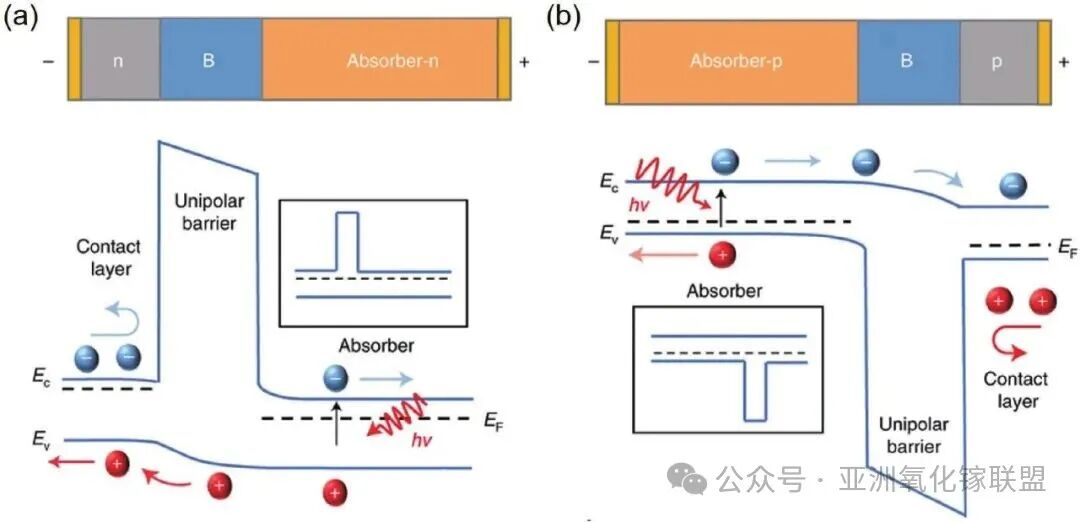
Figure 1. Energy-band diagrams of the (a) nBn and (b) pBp unipolar barrier structures. Through band engineering, majority carriers are blocked by the barrier layer to suppress dark current, while photogenerated minority carriers can transport freely along the energy bands.
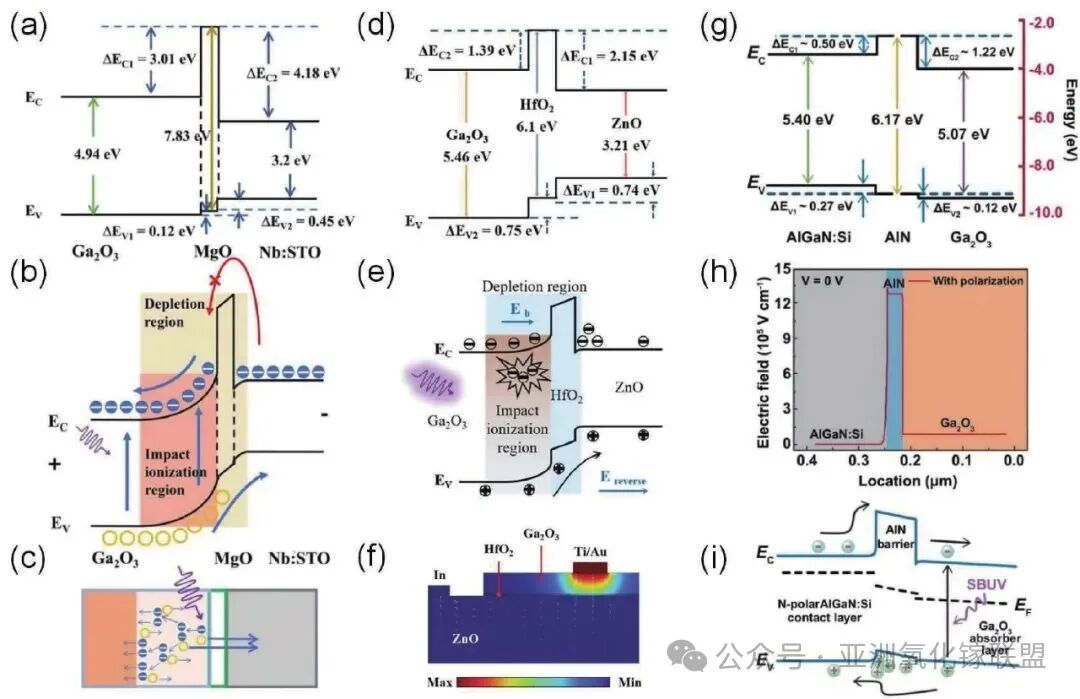
Figure 2. (a) Energy-band diagram of the Ga₂O₃/MgO/Nb:STO heterostructure under equilibrium conditions; (b) energy-band diagram under avalanche conditions; (c) schematic illustration of the avalanche process in an nBn unipolar barrier avalanche photodiode; (d) energy-band diagram of the ZnO/HfO₂/Ga₂O₃ heterojunction at equilibrium; (e) potential distribution of the ZnO/HfO₂/Ga₂O₃ avalanche photodiode under reverse bias; (f) energy-band diagram of the ZnO/HfO₂/Ga₂O₃ heterojunction during operation; (g) band alignment at the AlGaN:Si/AlN/Ga₂O₃ interface without polarization effects; (h) electric-field distribution inside the AlGaN:Si/AlN/Ga₂O₃ heterojunction under polarization effects; (i) working mechanism of photodetection in the AlGaN:Si/AlN/Ga₂O₃ heterojunction.
Article Information
Band engineering solar-blind ultraviolet photodetectors: Breaking the sensitivity-speed trade-off
Hongbin Wang, Peng Li, Jiangang Ma
Semicond. 2026, 47(5): 050201
DOI: 10.1088/1674-4926/26010031
Instruction
Official Account

Cooperation
Top