


Researchers from the Fuzhou University have published a dissertation titled "High-grade β-Ga2O3 VUV Photodiodes Achieving 131 dB Linear Dynamic Range for 50-200 nm Beamline Applications" in IEEE Electron Device Letters.
Background
Advanced vacuum ultraviolet (VUV) light sources—such as synchrotron radiation (SR, 40–200 nm) and free-electron lasers (FEL, 50–150 nm)—serve as indispensable tools for probing electronic structures and ultrafast dynamics in fundamental research. In situ deployment of photodetectors (PDs) across multiple stations is essential to monitor photon flux dynamically. These PDs require large active areas (exceeding beam profiles), broad linear dynamic range (LDR), and fast response speeds for precise dose quantification. As the prevailing standard detectors, Si-based PDs face rapid responsivity degradation and lattice damage, creating urgent demand for next-generation photodetector solutions. Belonging to the fourth-generation semiconductors, β-Ga2O3 (~4.9 eV) emerge as promising alternatives for VUV photodetection, offering high quantum efficiency, inherent radiation hardness and thermal stability.
Project Support
This work was financially supported by the National Natural Science Foundation of China (62501162), and Fujian Provincial Science and Technology Project (2024J01251, JZ240006). We acknowledge Fujia Co., Ltd. for technical support with the MOCVD process. We thank the staff members of the Metrology Beamline (BL08B) (https://cstr.cn/31131.02.HLS.Metrology) at the Hefei Light Source and the Dalian Coherent Light Source (https://cstr.cn/31127.02.DCLS) for their technical support and assistance in data collection and analysis.
Abstract
Advanced vacuum ultraviolet (VUV) light sources serve as indispensable tools for investigating electronic structures and ultrafast dynamics. Here, we report packaged β-Ga2O3 photodiodes specifically engineered for VUV beamline monitoring. Through precision-controlled MOCVD epitaxy, we demonstrate high-grade β-Ga2O3 film with near-perfect thickness uniformity (99%) and atomically smooth surface, enabling uniform carrier transport across the large active area. The optimized vertical architecture achieves an ultrahigh photo-to-dark current ratio of 7.98×10⁷, a wide linear dynamic range of 131 dB and a nanosecond-scale response time, enabling accurate flux measurements under dynamic beam conditions. Comprehensive spectral characterization from 58-350 nm reveals a peak responsivity of 1.98 A/W at 140 nm (-1 V bias), representing the first complete VUV response profile reported for β-Ga₂O₃ devices. These results establish a new standard for radiation-hard VUV photonics.
Conclusion
In summary, to address the demand for large-area, wide-dynamic-range, and fast-response detectors for advanced VUV beamline monitoring, this study successfully developed a vertical PD based on a β-Ga2O3 thin film. We established a high-grade β-Ga2O3 epitaxial growth process, yielding an atomically flat surface and excellent crystallinity. The packaged device demonstrates record-breaking performance in the VUV band, featuring a 131 dB LDR, a nanosecond-scale response and superior stability. These advances reveal β-Ga2O3's unique capabilities to address critical detection challenges in next-generation light sources, lithography, and space applications where conventional detectors fail. In the future, the VUV irradiation dose threshold and irradiation damage mechanism of β-Ga2O3 detectors still need to be further systematically studied to promote the real application of such devices in various high-radiation fields.
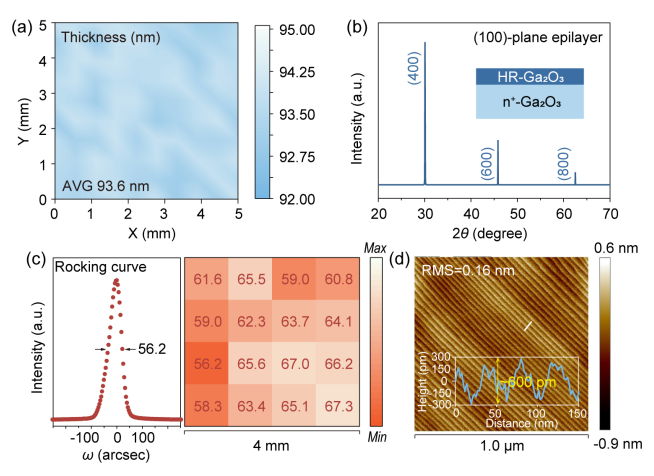
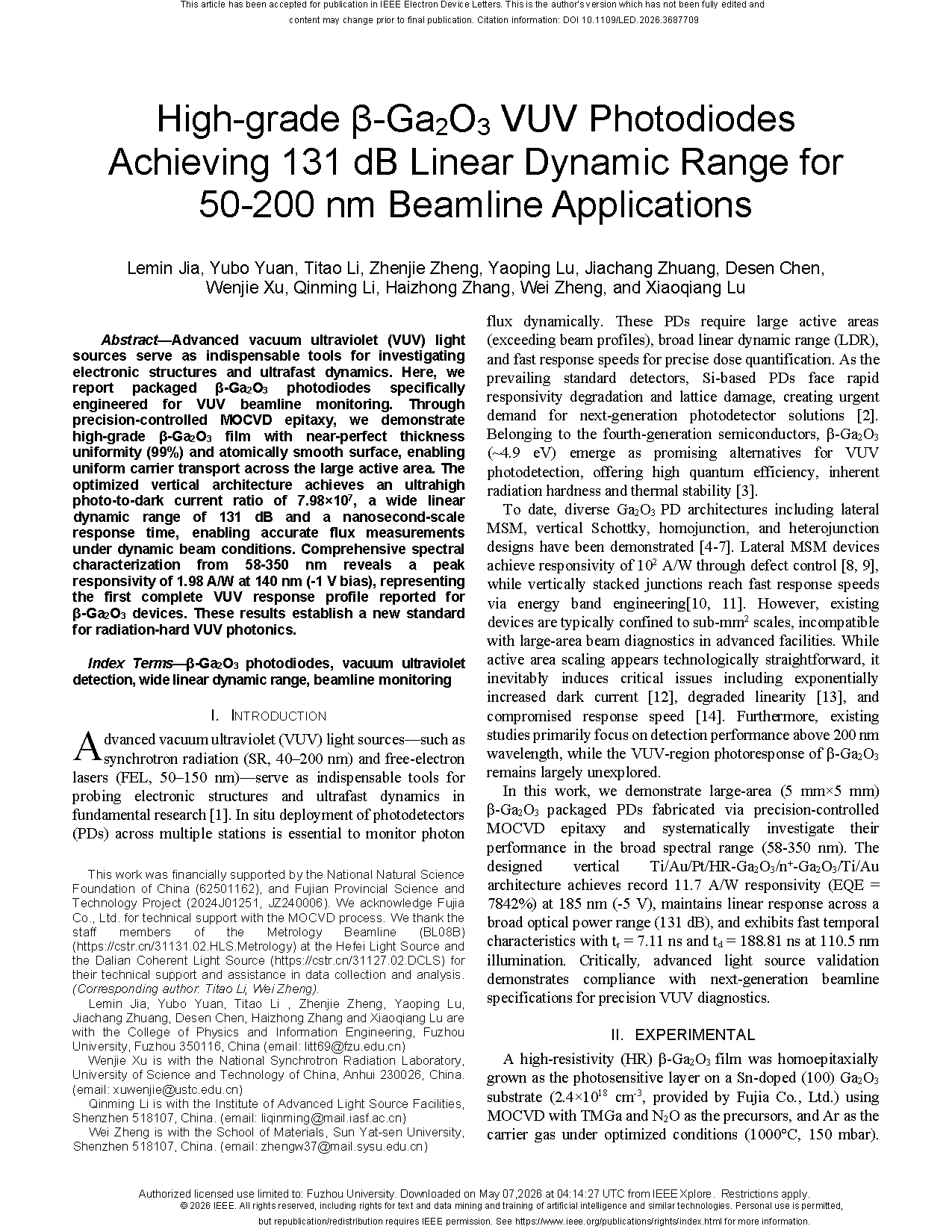
Fig. 1. (a) Film thickness gauge measurement, (b) XRD pattern, (c) HRXRD rocking curve, and (d) AFM image of the β-Ga2O3 film.
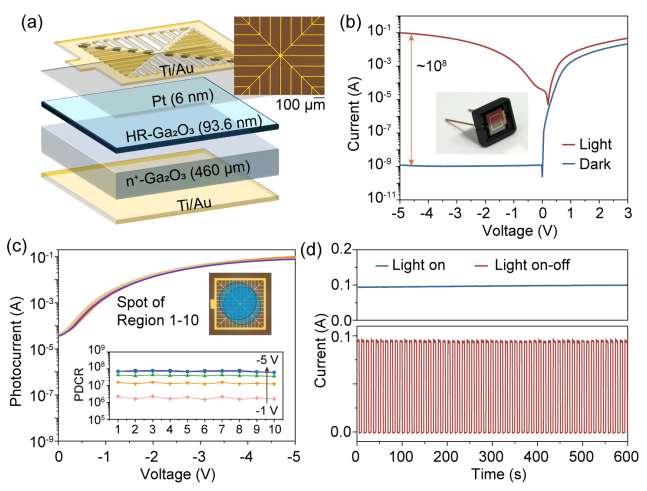
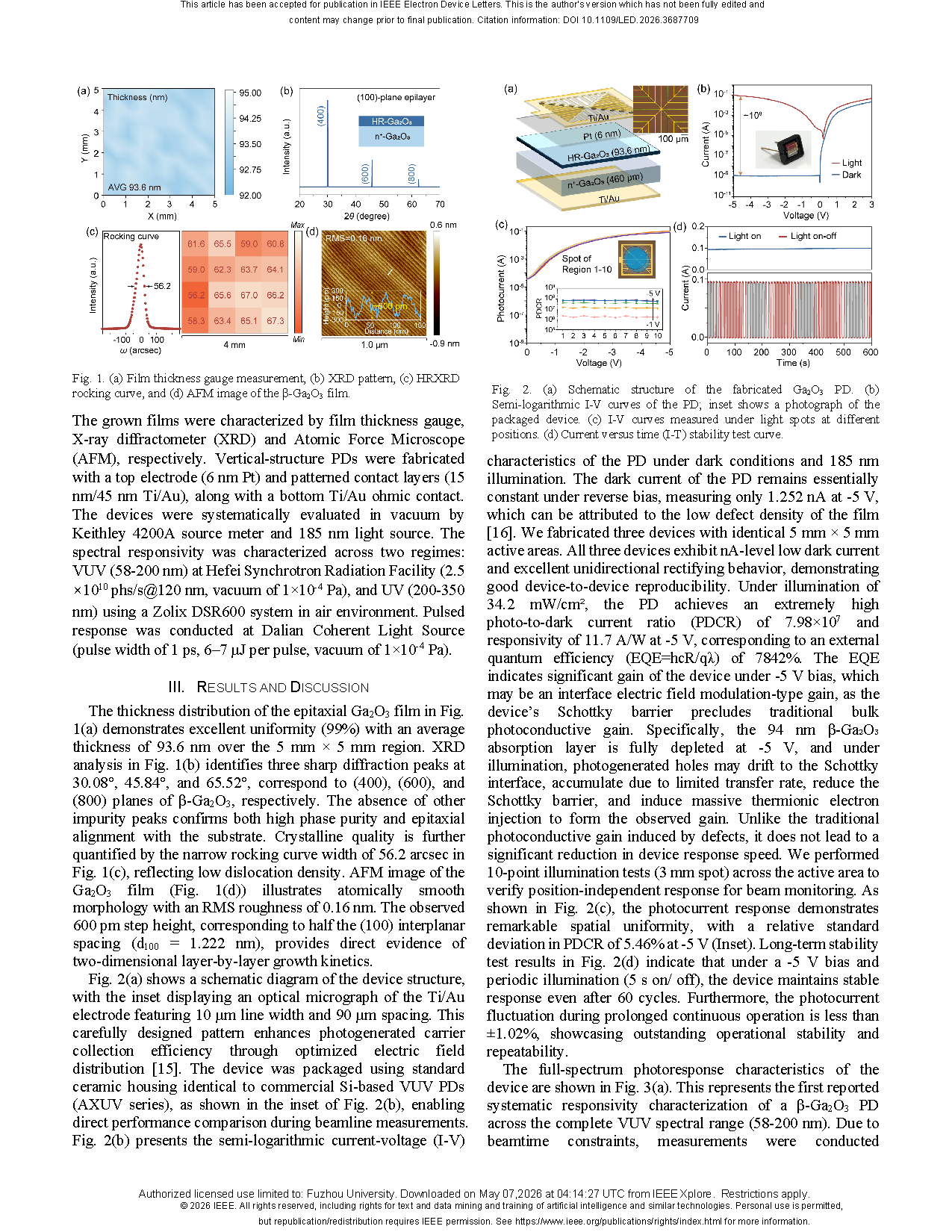
Fig. 2. (a) Schematic structure of the fabricated Ga2O3 PD. (b) Semi-logarithmic I-V curves of the PD; inset shows a photograph of the packaged device. (c) I-V curves measured under light spots at different positions. (d) Current versus time (I-T) stability test curve.
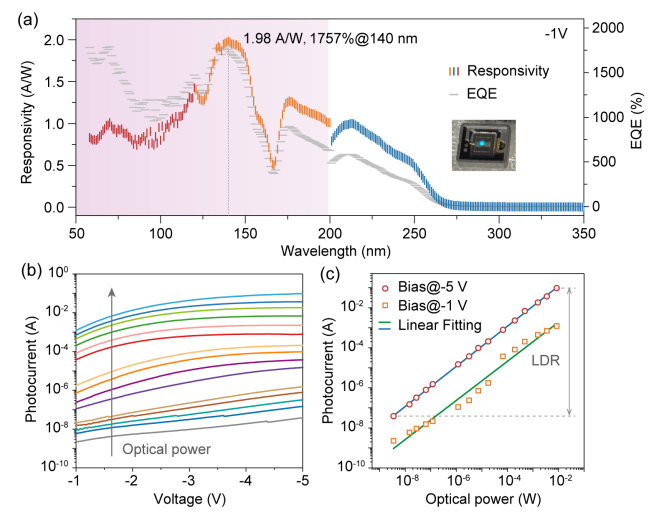
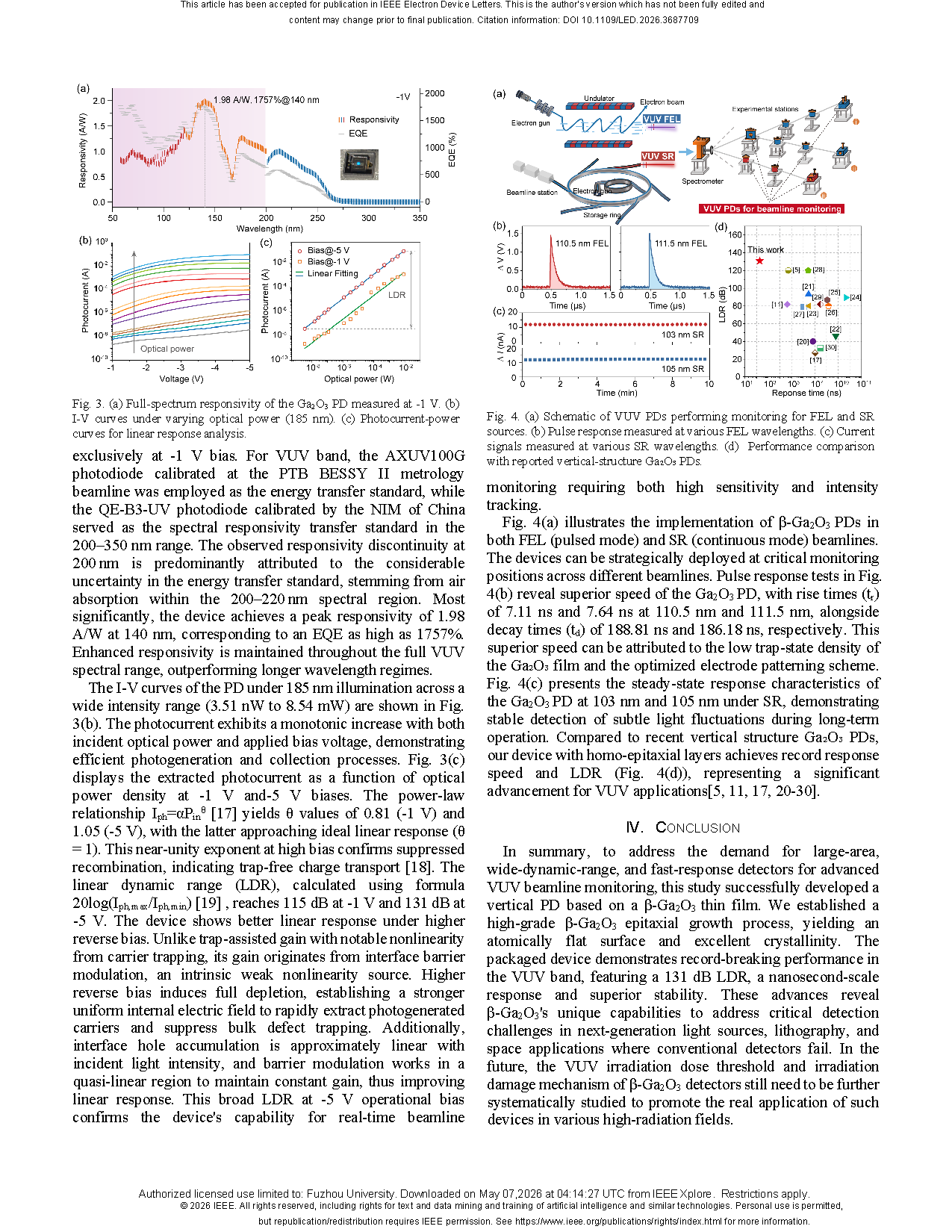
Fig. 3. (a) Full-spectrum responsivity of the Ga2O3 PD measured at -1 V. (b) I-V curves under varying optical power (185 nm). (c) Photocurrent-power curves for linear response analysis.
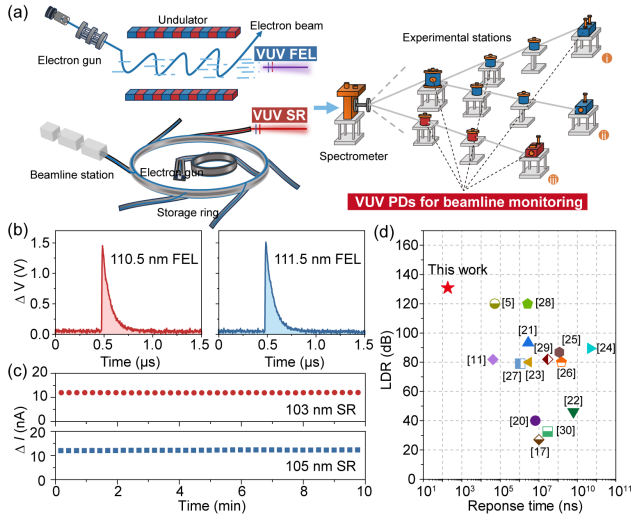
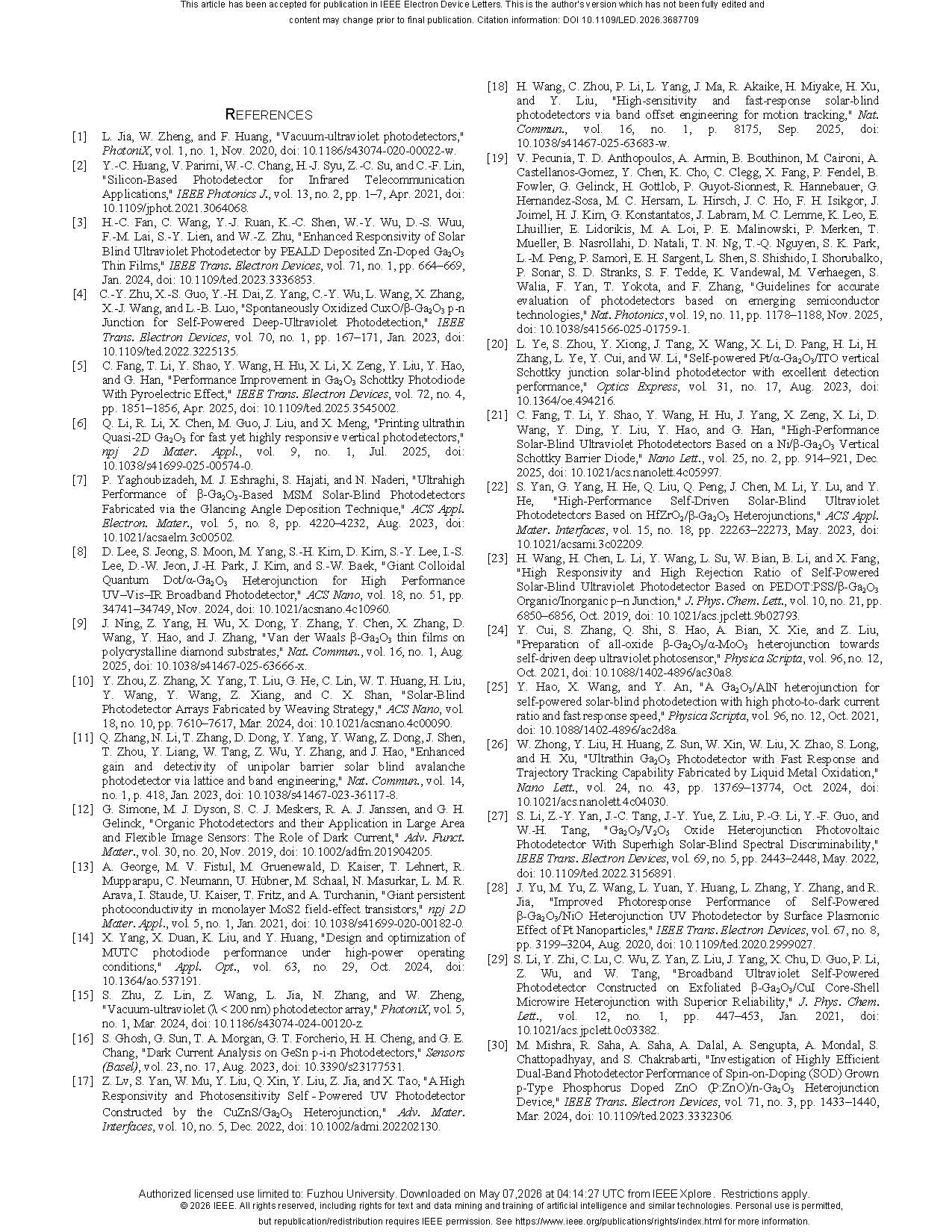
Fig. 4. (a) Schematic of VUV PDs performing monitoring for FEL and SR sources. (b) Pulse response measured at various FEL wavelengths. (c) Current signals measured at various SR wavelengths. (d) Performance comparison with reported vertical-structure Ga₂O₃ PDs.
DOI:
doi.org/10.1109/LED.2026.3687709
Instruction
Official Account

Cooperation
Top